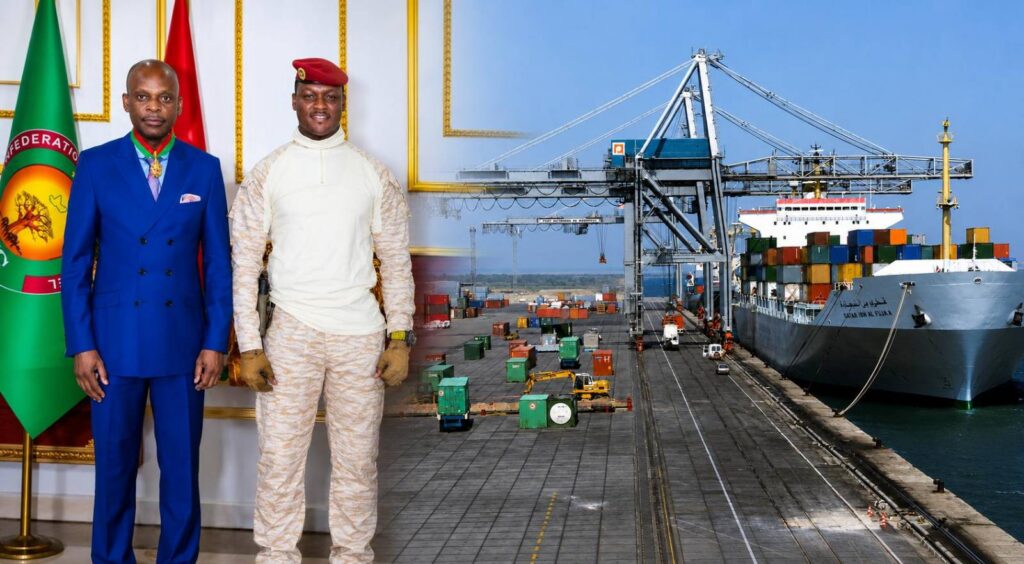
The Togolese Minister of Foreign Affairs was recently bestowed with the rank of Commander of the Order of the Stallions, Burkina Faso’s highest honorific distinction. While official channels hail this gesture as definitive proof of Lomé’s policy of openness, solidarity, and regional proximity, political realities on the ground paint a far less flattering picture of the bilateral relationship.
Diplomacy driven by convenience, not conviction
Beyond the symbolic weight of this distinction, one must ask: what does this decoration truly signify? An exemplary act of diplomacy or a convergence of interests between two governments grappling with shared political and economic challenges? In international relations, honors are often used to reinforce alliances, yet they can also serve as subtle political signals to neighboring states.
In private, many analysts view this accolade as the culmination of a geopolitical charade. The diplomatic thaw between the two capitals follows a contentious episode that left a lasting impression. The Togolese regime, under Faure Gnassingbé, had granted asylum to Burkina Faso’s former president, Roch Marc Christian Kaboré—only to abandon him when economic interests demanded it. The decision to sacrifice a political figure on the altar of commerce speaks volumes about the pragmatic, if not opportunistic, nature of Togolese foreign policy.
The economics of interdependence
For Lomé, regional solidarity appears to have clear limits when port-related interests are at stake. By handing over Kaboré to Ouagadougou’s new leadership, Faure Gnassingbé prioritized strategic trade agreements, particularly those ensuring the free transit of Burkinabé goods and merchandise through the Port Autonome de Lomé (PAL).
This approach hinges on a well-established economic interdependence. As a landlocked nation, Burkina Faso relies heavily on maritime corridors for its supply chains, with the Port of Lomé serving as a critical hub for imports and exports. For both countries, fostering strong ties with Lomé is mutually beneficial: Ouagadougou secures vital logistical routes, while Lomé garners substantial transit revenue. This mutual dependence explains the rapid diplomatic rapprochement between the two nations.
By trading a political exile for guaranteed logistical flows, Lomé has made one thing clear: its so-called policy of proximity is, in reality, a financial opportunism disguised as diplomacy.
A transactional foreign policy under scrutiny
The timing of this distinction is noteworthy, coinciding with ongoing regional discussions about governance, political rights, and public freedoms. For some observers, this honor reflects strategic alignment rather than a recognition of democratic values or principled cooperation.
This episode underscores a broader trend in West Africa: a shift toward transactional diplomacy, where economic and security considerations increasingly overshadow traditional political or moral commitments. Alliances are now forged based on commercial interests, logistical necessities, and security imperatives, casting doubt on the sincerity of official rhetoric about African solidarity.
The gap between rhetoric and reality
Government statements frame this distinction as evidence of an exemplary partnership between Togo and Burkina Faso. Yet, this institutional narrative clashes sharply with reality, failing to address the unspoken trade-offs behind the diplomatic embrace. When foreign policy decisions are so closely tied to economic interests, the discourse on African unity loses credibility in the eyes of a skeptical public.
Ultimately, this accolade underscores a foreign policy governed by political realism, where state interests take precedence over ideological principles. Nations prioritize strategic advantages, trade exchanges, and political stability—even if it means drawing criticism for the disconnect between their words and actions.
Behind the polished smiles and ceremonial medals lies a cold pragmatism. Far from symbolizing selfless brotherhood, this distinction appears to reward a secured commercial partnership—and in doing so, it highlights the ethical compromises inherent in modern African diplomacy. It is this very discrepancy that fuels today’s debates about the true nature of relations between Lomé and Ouagadougou.