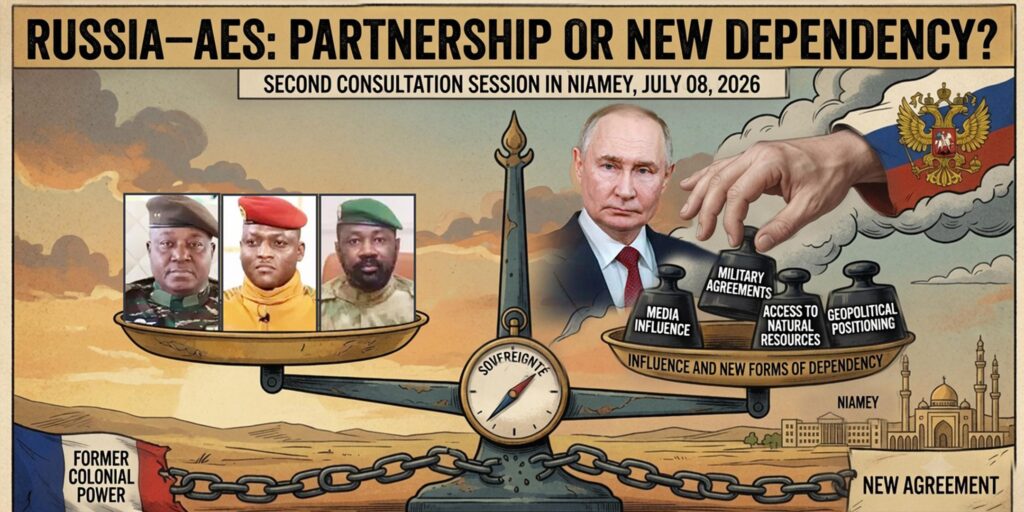
The second session of consultations between the foreign ministers of the Confederation of Sahel States (AES) and their Russian counterpart, Sergey Lavrov, held in Niamey on July 8, 2026, has been framed by regional authorities as a pivotal moment in fostering a partnership rooted in sovereignty and mutual respect. However, beneath the official rhetoric, a critical question arises: could this alignment inadvertently entrench a fresh wave of dependence—this time toward Moscow?
from colonial legacy to a new geopolitical equation
For years, the AES leadership has vocally criticized the historical influence of former colonial powers, particularly France, under the banner of national sovereignty. Yet substituting one foreign power for another does not inherently secure greater autonomy. Historical precedents demonstrate that interstate relations are frequently dictated by geopolitical, economic, and strategic interests, which may not always align with the aspirations of local governments.
the expanding footprint of Moscow in the Sahel
Russia has progressively deepened its presence across the Sahel through a multifaceted strategy encompassing military cooperation, bilateral agreements, economic exchanges, and cultural and media influence. Proponents of this engagement argue that diversifying partnerships empowers sovereign decision-making. Critics, however, caution that such ties may merely recalibrate dependency rather than eliminate it entirely.
The dynamics at play underscore a fundamental reality: major powers rarely engage in regions without anticipating tangible returns. Whether through access to natural resources, diplomatic leverage, or strategic positioning in Africa, each alliance serves a national agenda. Russia is no exception to this pattern, raising concerns about the long-term implications for the AES member states.
diplomatic autonomy in a multipolar world
The growing entrenchment with Moscow has also sparked apprehensions over the erosion of political independence. Over-reliance on a single power risks constraining diplomatic flexibility, narrowing the scope for alternative alliances, and exposing states to the volatility of global power struggles. In an era defined by great-power rivalry, the Sahel could become a battleground for competing interests rather than a zone of autonomous agency.
True sovereignty, as many analysts argue, is not merely about replacing one external partner with another. It hinges on the ability to preserve decision-making independence, cultivate balanced relationships, and advance national interests without defaulting to rigid alignment with any single actor.
partnership claims versus tangible outcomes
Advocates of the AES-Russia collaboration describe it as a mutually beneficial endeavor. Yet, the validity of this assertion will ultimately be measured by concrete achievements—sustained security enhancements, economic growth, job creation, skills transfer, and institutional strengthening. Without demonstrable progress in these areas, assertions of sovereignty risk sounding more like political rhetoric than lived reality for the populations affected.
The trajectory of this partnership remains uncertain. Will it genuinely empower the AES nations to assert greater autonomy, or will it merely represent a transition from one sphere of influence to another? For many observers, the hallmark of true independence lies not in swapping dominant partners but in cultivating a diplomacy that engages universally while remaining beholden to none.