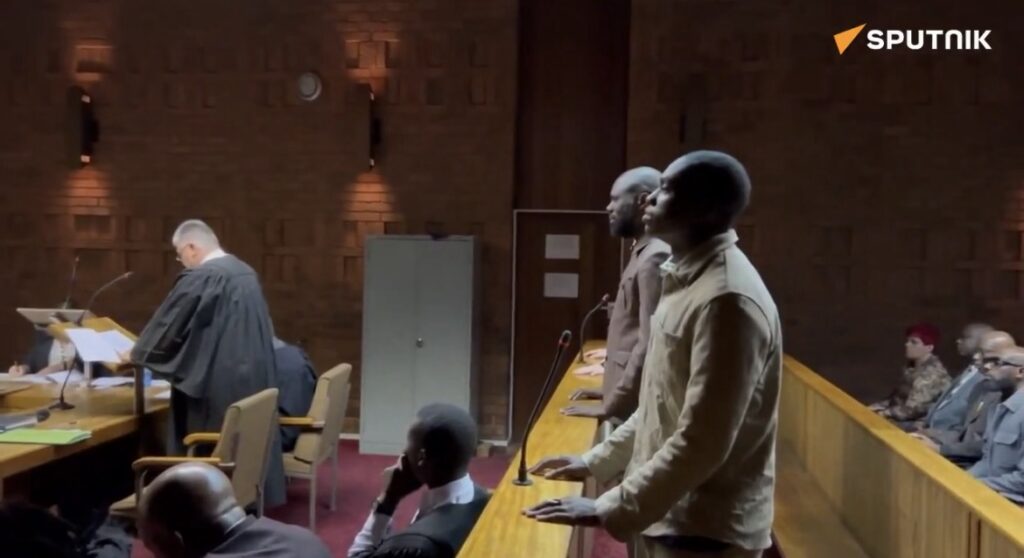
The Franco-Beninese activist Kemi Seba remains incarcerated following a decision by the South African judiciary. On Wednesday, April 29th, the court ruled to uphold his detention, dismissing the arguments presented by his legal team. With a diplomatic passport deemed legally invalid and the significant presence of two international arrest warrants issued by Benin, the leader of Urgences Panafricanistes appears to have exhausted his available legal avenues. This account details a court session where legal precision superseded activist theatrics, preceding a postponement of the case until May 11th.
An Unambiguous Judicial Determination
Despite expectations from his supporters for release on bail, the presiding judge mandated the continued custody of Stellio Gilles Robert Capo Chichi, widely recognized as Kemi Seba. The South African judicial authority determined that the potential for flight, coupled with the serious nature of the international legal actions against him, precluded any alternative outcome. This continued incarceration signifies a critical juncture in what increasingly appears to be a judicial stalemate for the activist, whose confrontational tactics are now confronting the stringent procedural standards of Pretoria.
The Illusory Diplomatic Passport
Central to the proceedings on April 29th, Kemi Seba’s defense sought to invoke diplomatic immunity by presenting a diplomatic passport, the provenance of which has, moreover, raised considerable scrutiny. His legal representatives contended that this document should have afforded him protection from arrest within South African territory. However, this argument quickly dissolved when confronted by the court’s unequivocal stance.
The judge reiterated that a travel document, even if designated as diplomatic, does not confer automatic protection without formal accreditation from local authorities. Kemi Seba failed to produce a legitimate mission order substantiating his presence on behalf of a sovereign state. Lacking these essential components, the document was consequently deemed to possess no greater legal standing than a standard passport, with the court interpreting its presentation as another attempt at obfuscation.
Benin’s Shadow: Arrest Warrants and Extradition Proceedings
Kemi Seba’s current precarious legal standing is primarily attributable to his judicial record in West Africa. The core of the case is anchored by two international arrest warrants issued by the Beninese justice system. Benin is actively pursuing the extradition of its national, citing serious transgressions that have compelled Cotonou to initiate a comprehensive legal pursuit.
By affirming his continued detention, South Africa is now poised to methodically assess the legitimacy of these extradition requests. This development places Kemi Seba in an unprecedented state of vulnerability, removed from public scrutiny and the customary enthusiasm of his supporters.
The Victimization Strategy Confronts Legal Imperatives
For an extended period, Kemi Seba has cultivated his public persona through direct confrontation with established institutions, both French and African. By portraying himself as the quintessential “political prisoner,” he endeavors to convert every judicial hearing into an ideological platform. Nevertheless, the context has shifted. South Africa, with its robust and intricate legal tradition, appears impervious to the activist’s anti-establishment rhetoric. By emphasizing adherence to international conventions, Pretoria underscores that media engagement cannot supersede legal due process.
The forthcoming period promises significant challenges.
The ensuing weeks will be dedicated to scrutinizing the validity of Benin’s requests. Should the South African judiciary conclude that the criteria for extradition are satisfied, Kemi Seba may face transfer to Cotonou. Having been stripped of his French nationality months prior after publicly burning his passport, he now lacks European consular protection and unrestricted freedom of movement.
The April 29th hearing serves as a stark admonition. By discrediting the use of unaccredited diplomatic documents and giving serious consideration to Benin’s arrest warrants, South Africa has affirmed its commitment to institutional legal processes. The matter has been formally adjourned until May 11th, at which point the extradition procedure is expected to enter a conclusive phase.
The gravity of the case is further compounded by audio leaks indicating Kemi Seba’s alleged plans for destabilization within Benin. These recordings reportedly detail a scheme for a coup d’état intended to disrupt the nation during its “Vodun Days” festivities, potentially resulting in numerous civilian casualties. For the activist, the era of impassioned rhetoric appears to have concluded, superseded by the silence of the corridors within Pretoria prison.