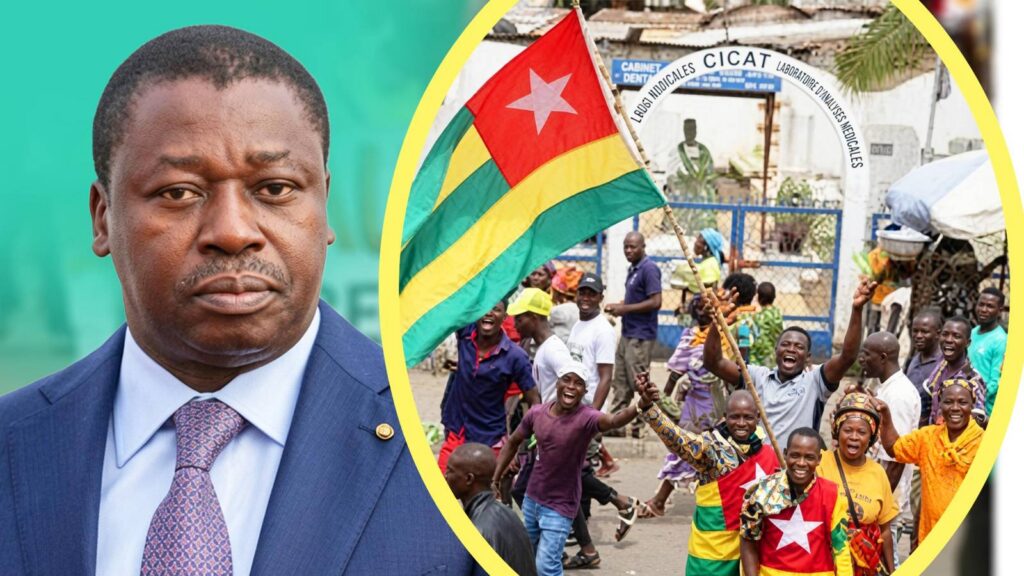
The youth of Togo face an increasingly stark choice: either emigrate in search of a dignified life abroad, or remain trapped in a country where their aspirations wither with each passing day. This stark reality has intensified criticism of President Faure Gnassingbé, whose leadership over more than two decades is now widely viewed as the primary obstacle to progress and hope for the nation’s younger generation.
What was once a distant possibility—leaving the country to build a future—has now become the only viable option for many young Togolese. Where previous generations once believed in the potential to achieve success at home, today’s youth see migration not as a choice, but as a necessary step toward survival. This shift reflects a profound disillusionment not only with the state’s institutions but also with the very notion that Togo can offer a promising future for its citizens.
The illusion of progress and the harsh reality of unemployment
Official narratives frequently emphasize economic modernization and reform, yet the labor market tells a far grimmer story. While government figures may claim low unemployment rates, the reality reveals a far more troubling picture: over 70% of young workers are trapped in informal employment or underemployment, with no access to stable, decent work.
Each year, universities in Lomé and Kara graduate tens of thousands of students, yet initiatives such as the National Employment Agency (ANPE) and the National Coalition for Youth Employment (CNEJ) have proven woefully inadequate in addressing the scale of the crisis. Without viable opportunities, many of these graduates resort to informal work—driving zémidjans (motorcycle taxis), selling goods on the streets, or piecing together temporary jobs just to survive. Their years of education and training are rendered meaningless in a system that fails to reward merit or effort.
This wastage of human capital extends beyond individual disappointment. When an engineer becomes a street vendor or a law graduate is forced into petty trading, the consequences are far-reaching. The nation loses not only potential innovators and skilled workers but also the economic dynamism needed to compete in a globalized world. A weak industrial base, coupled with a lack of high-value job creation, ensures that the economy continues to stagnate, offering little more than survival opportunities for the majority.
A system entrenched in favoritism and exclusion
The frustration felt by young Togolese is compounded by a deep sense of injustice. Families invest heavily in education, believing that hard work and qualifications will lead to a better life. Yet in Togo, merit alone no longer guarantees success. Access to entrepreneurship, funding, and economic opportunities remains tightly controlled by a small elite closely aligned with the ruling party (UNIR). Without political connections or financial guarantees, securing a loan or winning a government contract is nearly impossible for the average young citizen.
The Fonds d’appui aux initiatives économiques des jeunes (FAIEJ), designed to support youth-led businesses, has done little to alleviate these barriers. For most, navigating the bureaucratic hurdles and securing funding without patronage is an insurmountable challenge. This entrenched system of favoritism erodes trust not only in the economy but in the very idea of fairness and opportunity. When young people conclude that persistence and education are no longer enough to succeed, the social contract itself begins to unravel.
The private sector’s struggle to drive growth
The private sector, which should serve as a catalyst for job creation, operates in an environment plagued by obstacles. Entrepreneurs cite cumbersome regulations, limited access to capital, sluggish consumer demand, and economic uncertainty as persistent barriers to expansion and hiring. Without a thriving private sector, the country’s economic prospects remain dim, further discouraging those who might otherwise consider building their careers at home.
Emigration as the only path forward
With prospects at home virtually nonexistent, emigration has become more than a personal strategy—it is a survival imperative. The exodus manifests in two alarming trends:
- Diplomatic queues: Daily, long lines form outside embassies in Lomé—particularly those of France, Canada, and Gulf states—as young Togolese seek visas and a chance at a better life abroad.
- Brain drain in critical sectors: Hospitals are depleted of doctors, nurses, and engineers, while tech specialists, researchers, and entrepreneurs relocate to build their futures elsewhere. The loss of these skilled professionals undermines the country’s ability to innovate, attract investment, and modernize its economy.
The irony is stark: Togo invests in educating its youth, only for the benefits of that investment to accrue to foreign economies. While families sacrifice to fund education, the resulting talent is exported, leaving the nation to grapple with a shrinking pool of skilled workers and leaders.
Political stagnation: the death of hope for change
The economic despair is deepened by a crisis of political confidence. For many young Togolese, the current challenges stem directly from a political system that refuses to evolve.
The controversial adoption of the Fifth Republic Constitution in 2024, which transformed the country into a parliamentary system, has extinguished the last embers of hope for democratic renewal. The reform is widely perceived as a legal maneuver to indefinitely prolong President Gnassingbé’s grip on power, now under the title of Prime Minister. By eliminating any prospect of generational change or democratic alternation, the regime has pushed a generation to abandon faith in public life and seek opportunities exclusively abroad.
More than an economic issue, this disillusionment has become existential. Many young people believe that without institutional renewal, an independent judiciary, and genuine political competition, economic reforms will remain ineffective. The belief that the future lies outside Togo’s borders is growing stronger by the day.
This withdrawal from civic engagement is equally damaging. A declining willingness to participate in political parties, civil society, or public initiatives further weakens democratic vitality and deprives the nation of the energy, creativity, and innovation that a young population should provide.
Can a nation thrive without its youth?
Critics argue that President Gnassingbé, in power since 2005 following his father’s rule, bears direct responsibility for this trajectory. Two decades of governance have failed to create an inclusive economic model capable of meeting the needs of a growing youth population. Instead, wealth continues to concentrate in the hands of a privileged few, while the majority grapple with poverty or contemplate exile.
History demonstrates that no nation can achieve sustainable prosperity when its most talented and ambitious citizens view departure as their only hope. The countries that thrive are those that retain their skilled workers, foster innovation, ensure equal opportunity, and cultivate trust between citizens and institutions.
A critical question now looms over Togo’s future: how can a nation develop when its brightest, most educated, and most driven youth dream only of leaving? Until the government addresses the core issues—unemployment, governance failures, economic transparency, and democratic aspirations—this country will continue to lose the very people who should be its greatest asset, leaving behind a shrinking workforce and a diminished capacity for progress.