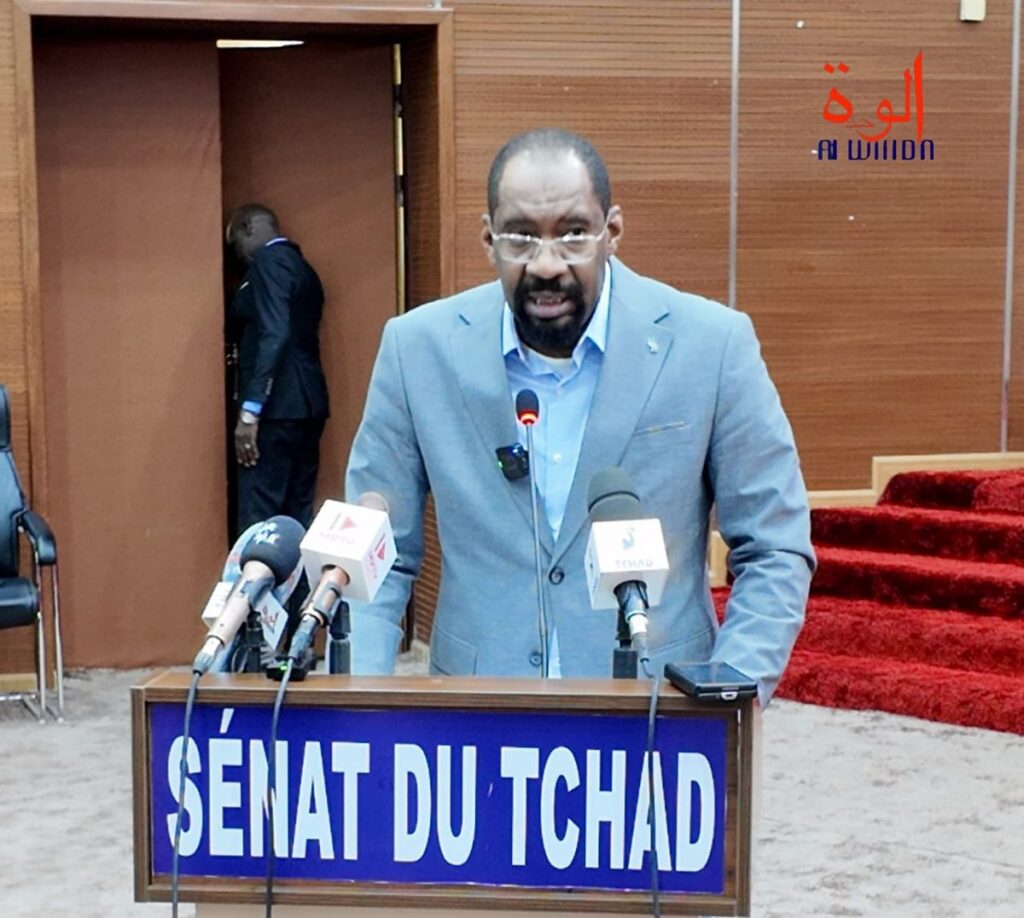
The Minister of Public Security and Immigration, General Ali Ahmat Aghabache, appeared before the Senate today to address rising intercommunal violence and persistent insecurity across Chad. The session, presided over by Senate President Dr. Haroun Kabadi, focused on recent violent incidents reported in provinces such as Mayo-Kebbi Ouest, Salamat, and Hadjar-Lamis, which have resulted in multiple fatalities.
During the hearing, Dr. Kabadi highlighted that despite the deployment of defense and security forces, sporadic outbreaks of violence continue to plague several regions. For instance, a deadly clash between farmers and herders occurred in Mandakao, Logone Occidental, in May 2025, followed by a reconciliation agreement in July 2025.
General Aghabache opened his remarks by expressing deep condolences to the families of those who lost their lives or suffered injuries in these conflicts. He acknowledged the severity of the situation in provinces like Logone Occidental, Mayo-Kebbi, Wadi, Sila, Bahr El-Ghazal, and Salamat, as well as the more recent tensions in Wadi Fira. “Our hearts go out to the victims and their loved ones,” he stated, emphasizing the government’s commitment to addressing the root causes of these clashes.
The minister conceded that while Chad’s overall security situation remains under control, pockets of instability persist. He noted that no country can claim absolute safety, but stressed that purely security-based responses are insufficient. “Military presence can temporarily contain violence, but sustainable solutions require addressing the underlying social and political factors,” he explained.
To provide context, General Aghabache outlined the key drivers behind the escalation of intercommunal violence:
- Resource-driven conflicts: Disputes over water and land, particularly during the rainy season, often escalate into violent confrontations between farmers and herders, with retaliatory attacks becoming common.
- Land and water scarcity: Climate change and prolonged droughts in northern regions have reduced pastoral zones, forcing herders to migrate southward. Meanwhile, population growth and expanding farmlands intensify competition for resources.
- Legal ambiguities: The lack of clear regulations governing grazing corridors, land rights, and agricultural zones creates a breeding ground for disputes.
- Demographic pressures: A rapidly growing population increases demand for land, water, and food, straining already fragile ecosystems and deepening community tensions.
- Political manipulation: Some actors exploit tribal affiliations to gain political leverage, further inflaming local conflicts.
- Ethnic diversity and tribal structures: Chad’s complex social fabric, comprising over 200 ethnic groups, often prioritizes tribal loyalty over national identity, weakening social cohesion.
- Regional spillover: The proliferation of small arms across borders has intensified conflicts, turning traditional disputes into deadly confrontations.
- Land ownership and historical grievances: Disputes over land borders and historical claims have contributed to a significant human toll, with 318 deaths and 315 injuries recorded in 2025 alone.
Senators raised concerns about the most affected provinces and questioned the effectiveness of current measures to curb violence. While acknowledging the government’s efforts, they emphasized the need for stronger action. General Aghabache responded by urging local leaders, traditional authorities, and elected officials to prioritize community sensitization and social cohesion initiatives to prevent future clashes.
The minister also presented a performance review of security operations from 2024 to 2025, highlighting the seizure of over 4,000 illegal weapons, the arrest of more than 1,300 bandits, and the confiscation of substantial quantities of narcotics. He addressed specific concerns, including kidnappings for ransom in Mayo-Kebbi Ouest and child abductions by Boko Haram in Lac Province. Regarding the presence of undocumented foreigners, Senator Mariam Ahmat Djamil emphasized the potential security risks they pose.
In response to calls for decentralized security infrastructure, General Aghabache confirmed ongoing efforts to establish new police stations and gendarmerie units. Recent deployments in Abéché, Ouaddaï Province, have reportedly contributed to reducing insecurity in the area.