The current Senegalese political landscape: a clash of legitimacy models
Senegal’s political scene is currently navigating a complex crossroads where two distinct forms of legitimacy intersect. On one side stands institutional legitimacy, derived from constitutional frameworks and electoral processes. On the other, a powerful charismatic legitimacy emanates from a figure who has reshaped the nation’s political discourse. This duality, though not uncommon in political science, introduces significant challenges to democratic stability when left unresolved.
Ousmane Sonko’s meteoric rise and its implications
Ousmane Sonko’s political journey exemplifies this tension. His rapid ascent has been fueled by a break from traditional governance, captivating a youth demographic long sidelined by the political elite. His rhetoric, centered on national sovereignty, dignity, and grassroots empowerment, has resonated deeply across social strata. Notably, Sonko has previously advocated for a harmonious cohabitation with the presidency, a stance that gained unexpected momentum following his recent election to the National Assembly.
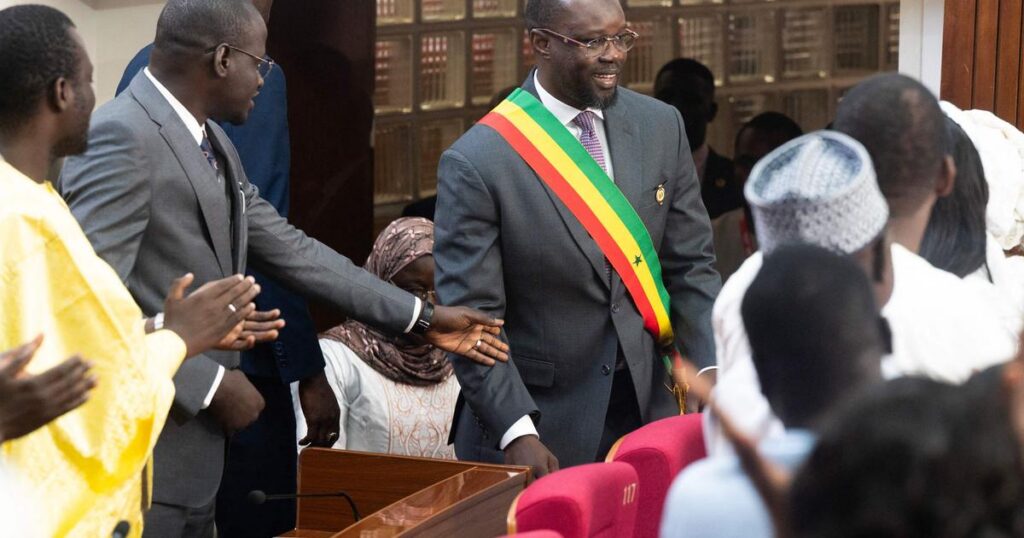
The sequence of events leading to his election unfolded with striking speed. On May 22, President Bassirou Diomaye Faye removed Ousmane Sonko from his position. The very next day, Malick Ndiaye, then Speaker of the National Assembly, resigned, strategically clearing the path. By May 25, Ahmadou Alhaminou Mohamed Lô was appointed Prime Minister, and on May 26, Sonko secured the Assembly presidency with an overwhelming 132 votes out of 165, solidifying his influence within the Pastef party he founded. While some heralded the move as historic, others labeled it an institutional coup, placing Sonko in direct opposition to his former ally, President Faye. This shift raises critical questions: Will the Pastef, which unanimously supported Sonko, align with the new technocratic government? The ruling party has insisted on adherence to the 2024 victory program, heavily shaped by Sonko himself. He has oscillated between conciliatory gestures and firm warnings, emphasizing the Assembly’s constitutional prerogatives and expressing discontent over the lack of consultation in the Prime Minister’s appointment. Amidst this turbulence, Senegal’s sovereign credit rating was downgraded from stable to negative.
The paradox of charismatic leadership
The power of charisma lies in its ability to mobilize and inspire, yet it also poses a latent threat to institutional balance. When a leader becomes the sole symbol of a nation’s aspirations, the risk of hubris—an overestimation of personal influence—grows. The current scenario in Senegal underscores this dilemma: Can a movement rooted in populist fervor transition smoothly into structured governance? The challenge is not merely political but structural, revealing how democracy’s resilience depends on institutions asserting their primacy over individual personalities.
Institutional legitimacy vs. popular mandate
The heart of the debate revolves around legitimacy. Is power derived from electoral processes and constitutional mandates, or does it stem from the emotional connection between a leader and their followers? Senegal’s political landscape has been marked by this ambiguity: Who truly holds authority—the elected president or the movement leader? Is governance a matter of institutional hierarchy or the will of the people as embodied by a single figure? While such duality may fuel energy in the short term, it ultimately undermines stability if unresolved. A state cannot sustain two competing centers of symbolic power; institutions must eventually reclaim their central role.
Ousmane Sonko’s influence transcends his formal roles. He is not just a former Prime Minister or current Assembly President; he represents a movement, a militant cause, and the aspirations of a generation. This multifaceted role, while empowering, also carries risks. The danger is not outright authoritarianism but the gradual erosion of institutional authority in favor of a cult of personality. When institutions cede ground to the charisma of a single leader, democracy’s foundations weaken, even if imperceptibly.
A test of democratic endurance
Senegal now faces a pivotal moment: Can charisma coexist with institutional governance, or will one inevitably overshadow the other? The true measure of a leader lies not in their ability to mobilize but in their willingness to embrace the constraints of democratic systems. Transitioning from opposition to governance demands more than rhetoric; it requires compromise, respect for institutional hierarchies, and, at times, personal sacrifices for the greater good of the nation.
The Pastef’s future—and by extension, Senegal’s democratic stability—hinges on this delicate balance. History offers few examples of movements that successfully navigate this transition without stumbling. The coming months will reveal whether Ousmane Sonko and his party can evolve from agents of change into stewards of a resilient, enduring system. The stakes could not be higher: the fate of Senegal’s democracy may well be decided in this crucible of institutional and charismatic legitimacy.