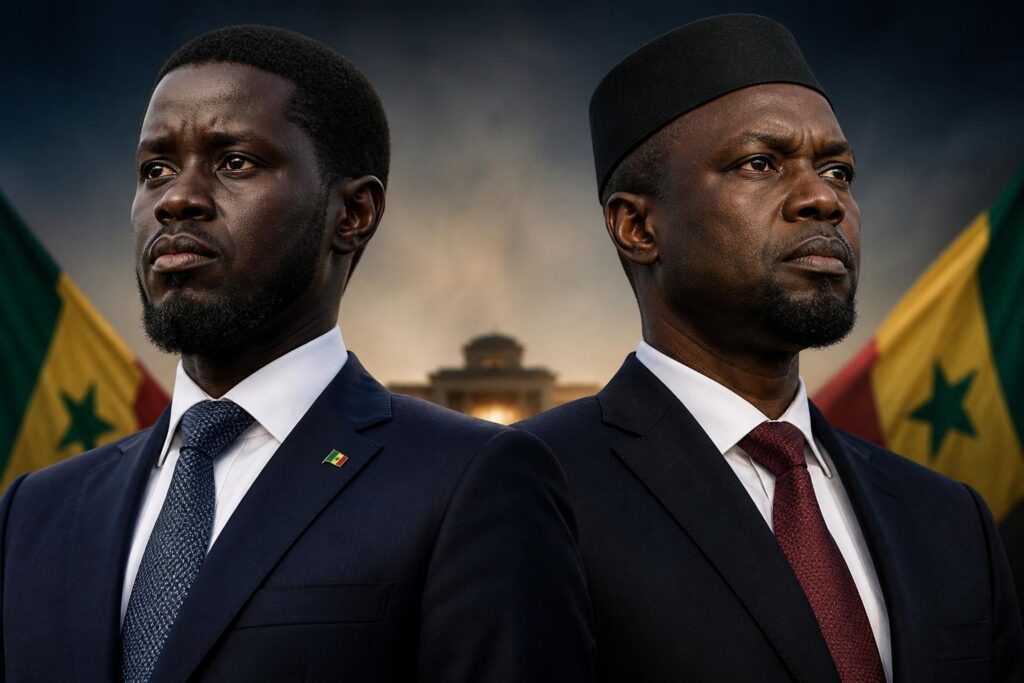
In the heart of West Africa, Senegal is witnessing a political evolution where the lines between party loyalty and presidential authority are being redrawn. The early days of Bassirou Diomaye Faye‘s presidency were defined by a close partnership with Ousmane Sonko, his former mentor and now Prime Minister. However, a recent public statement has signaled a shift that could reshape the country’s future.
The moment of truth for the political duo
During a national press engagement, President Faye addressed mounting tensions between the government’s actions and the Pastef party’s vocal supporters. His words carried unprecedented weight: he declared his loyalty to the nation’s vision but made it clear that his first duty is to the Senegalese people. The president’s firm stance—explicitly stating he would not hesitate to take decisive action if partisan interests clashed with national priorities—echoed through Dakar’s political landscape like a thunderclap.
The statement shattered the narrative of an unbreakable alliance. For months, the public had seen a Pastef leader who continued to act as de facto party chief, dominating headlines with rallies and direct appeals that often overshadowed official government communications. This dynamic has now collided with President Faye’s vision of a unified executive branch, where institutional authority must take precedence over party discipline.
Ousmane Sonko’s shadow: a prime minister’s growing influence
The roots of today’s tension trace back to the 2024 election campaign, when Faye’s victory was framed as a mandate for Sonko’s policies. Yet as president, Faye has sought to define his own path—one marked by pragmatism in economic affairs and cautious diplomacy with international partners. This approach has clashed with Sonko’s more confrontational stance, particularly on issues like foreign debt and relations with global institutions.
Additional friction stems from cabinet appointments. While the president favors technocrats to strengthen governance, Sonko’s party insists on placing loyalists in key roles. The contrast between the two men’s leadership styles—one measured and institutional, the other dynamic and grassroots-driven—has become impossible to ignore.
Is a political split unavoidable?
While an immediate breakup remains unlikely, the possibility is now openly discussed. President Faye’s recent remarks suggest he is determined to govern independently, even if it means distancing himself from the very movement that brought him to power. Within the Prime Minister’s office, officials downplay the tension as mere role clarification, but the president’s message carries deeper implications: Senegal’s presidency will not be held hostage by any political faction.
This shift introduces uncertainty into the country’s political landscape. Past experiences with divided executive power in Senegal have led to institutional paralysis, raising concerns about potential gridlock if the current tensions escalate. Should a separation occur, Faye would face the challenge of governing without the full machinery of the Pastef party behind him, forcing him to seek new alliances or rely more heavily on constitutional prerogatives.
The stakes of presidential autonomy
For Faye, the priority is twofold: reassuring international partners of Senegal’s stability while proving to citizens that he is firmly in control. Public opinion is divided. Younger voters, drawn to Sonko’s charisma, may view this shift as a betrayal of the movement’s ideals. Meanwhile, legalistic segments of the population welcome a president who is finally exercising the full authority of his office.
The president is navigating a high-stakes balancing act. He must assert his leadership without triggering social unrest that opponents could exploit. The question is no longer about personal rapport but whether Senegal’s governance structure can sustain two competing centers of power.
What we are witnessing is the end of a political fairy tale. Governance is not about friendship; it’s about power management. By asserting his constitutional authority, Faye has signaled that the state must come before the party. The ‘duo’ that once led the charge is now becoming the very obstacle to effective leadership. Senegal stands at a crossroads where the state’s institutions must assert their primacy—and the president has just drawn the line.