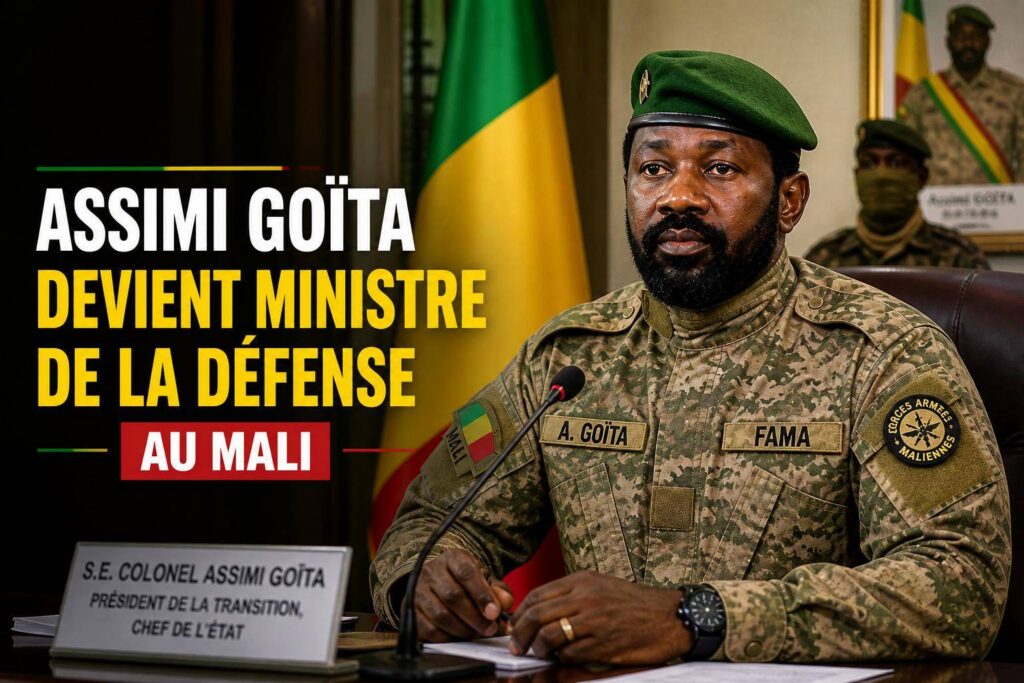
Colonel Assimi Goïta has solidified his grip on authority in Bamako by officially assuming the responsibilities of Minister of Defense in addition to his duties as Head of State. This move, far from being a mere administrative adjustment, appears to be an acknowledgment of underlying vulnerabilities: a faltering chain of command and an increasingly ineffective military strategy. Between the recent strategic loss of Kidal to the JNIM and FLA, and the questionable efficacy of its Russian allies, Mali is navigating an unprecedented period of instability.
At this moment in Bamako, all decisions seem to converge on Koulouba. By combining the presidency with the defense portfolio, Colonel Assimi Goïta is no longer simply defining political direction; he has become the primary operational leader of the nation’s armed forces. For many regional observers, this development indicates a growing distrust within the highest echelons of power.
Within the context of a prolonged transition, this extreme centralization raises a critical question: how can a single individual effectively manage state affairs, regional diplomacy, and the intricate tactical details of an asymmetric conflict? This accumulation of roles suggests a desperate move forward. By removing ministerial buffers, Goïta now places himself directly in the line of fire. Any military setback on the ground will no longer be attributed to a subordinate but will be perceived as a direct failure of the Head of State.
the illusion of Kidal: from recapture to loss of control
Just months ago, official communications grandly celebrated the “liberation” of Kidal. It was hailed as a symbol of restored sovereignty and a trophy for the transitional government. However, the harsh reality on the ground has now dashed these aspirations. The city, a crucial strategic stronghold in the North, has once again fallen into the hands of armed groups, specifically the Group for the Support of Islam and Muslims (JNIM) and the forces of the Coordination of Azawad Movements (CMA/FLA).
This reversal is more than just symbolic; it carries significant tactical weight. The insurgent takeover of Kidal demonstrates that despite rhetoric about strengthening its capabilities, the Malian army struggles to maintain control over recaptured territories for extended periods. The absence of public administration and the security vacuum allowed for a swift reoccupation by jihadist groups and separatist rebels. The JNIM, in particular, appears to have refined its strategy, isolating garrisons and severing supply lines, effectively turning Bamako’s victories into fleeting successes.
Wagner’s shadow: a russian partner running on empty?
Another cornerstone of Goïta’s security strategy involves the partnership with Russia, primarily through the Wagner Group paramilitaries (now operating under the Africa Corps banner). While this choice was presented as a sovereign alternative to the former colonial power, France, its tangible security outcomes have yet to impress.
The Russian partners, despite their presence on the most active fronts, seem to favor a scorched-earth policy which, far from bringing peace, tends to radicalize local populations. Reports of human rights violations are escalating, creating fertile ground for terrorist group recruitment. More concerning is the questioning of these instructors’ technical effectiveness, given the ease with which Malian army convoys fall into deadly ambushes. Russia, itself embroiled in its own European conflict, is unlikely to provide Mali with the necessary air and technological support to counter the JNIM’s mobility. Doubts about this remain significant.
regional diplomacy in tatters
This security crisis unfolds within a backdrop of increasing diplomatic isolation. By withdrawing from ECOWAS to form the Alliance of Sahel States (AES), Mali gambled on security self-reliance. Yet, reality is stubborn: borders are porous, and terrorism knows no national boundaries.
By disengaging from regional cooperation mechanisms, Bamako deprives itself of vital intelligence and logistical support from neighboring countries. Goïta’s accumulation of posts is seen by neighboring capitals as an authoritarian hardening, making dialogue even more complex. Mali currently finds itself in a paradoxical position: it seeks to assert its sovereignty through force, yet it appears more dependent than ever on opaque external forces and a command structure concentrated in the hands of a single individual.
the specter of quagmire: what future for Mali?
The situation is grim for the populations in the Central and Northern regions. Despite changes in leadership and overturned geopolitical alliances, insecurity continues to mount. Attacks against civilian and military convoys have become almost a daily occurrence.
The new “President-Minister of Defense” is making a high-stakes gamble. If the security situation does not improve rapidly, social discontent, currently suppressed by a heavy security blanket, could eventually erupt. African history is replete with examples where excessive power concentration served as a prelude to significant instability.
To escape this deadlock, Mali must undertake a comprehensive reassessment of its overall strategy. Brute force and mercenary alliances have demonstrated their limitations. Without a return to inclusive governance and a genuine strategy for social reintegration across its territory, Colonel Goïta’s military approach risks quickly faltering against the resilience of armed groups.
This is no longer a time for wartime rhetoric, but for urgent political realism. For beyond the titles and uniforms, the very existence of the Malian state hangs in the balance on the shifting sands of the North.