Senegal is set to revitalize its marine and fisheries research capabilities with the upcoming rehabilitation of the ITAF Dème, a key research vessel. The announcement follows a recent high-level inspection at the Port of Dakar, underscoring the nation’s commitment to strengthening its maritime sovereignty and sustainable ocean governance.
Since its immobilization in late 2022, the ITAF Dème had been sidelined from critical scientific missions, including fish stock assessments and marine ecosystem monitoring—operations vital to the work of the Dakar-Thiaroye Oceanographic Research Center (CRODT) under the Senegalese Institute of Agricultural Research (ISRA).
Why the ITAF Dème is vital to Senegal’s blue economy
This 80-meter research vessel has long served as the backbone of Senegal’s maritime science infrastructure. Equipped for deep-sea expeditions, it collects essential oceanographic and environmental data, supports fisheries stock evaluations, and trains the next generation of marine scientists and technicians. Beyond its scientific mission, the ITAF Dème enhances national autonomy by reducing reliance on foreign expertise and reinforces Senegal’s leadership in West African fisheries and oceanographic research.
However, the prolonged inactivity has disrupted routine monitoring and delayed key policy decisions, including sustainable fisheries management and international fishing agreements—both central to Senegal’s blue economy strategy.
Ministerial inspection signals progress toward restoration
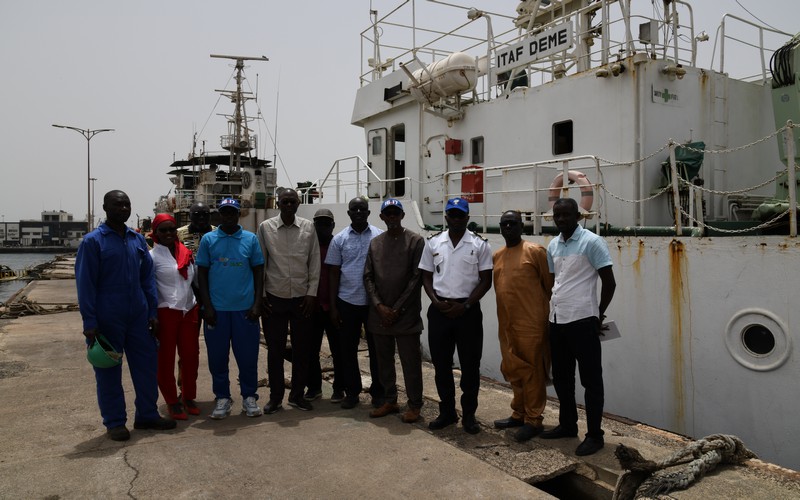
On May 14, 2026, Dr. Mamadou Abibou Diagne, Secretary-General of the Ministry of Fisheries and Maritime Economy, conducted an on-site assessment of the vessel’s condition. Accompanied by senior officials from ISRA and CRODT, including Dr. Moustapha Guèye (ISRA Director General), Youssoupha Bâ (ISRA Secretary-General), and Dr. Ismaïla Ndour (CRODT Director), the visit aimed to accelerate plans for the vessel’s return to service.
The ship’s commander, Seydina Hamza Amar, presented a comprehensive technical status report. He confirmed that despite its prolonged docked status, the ITAF Dème remains structurally and operationally viable. With targeted rehabilitation, the vessel can resume its scientific missions without delay, he assured the delegation.
Government doubles down on maritime research investment
Following the inspection, Dr. Diagne reaffirmed the government’s unwavering commitment to advancing national marine science capacity. He highlighted two complementary initiatives: the rehabilitation of the ITAF Dème and the ongoing acquisition of a new research vessel. Together, these efforts aim to bolster sustainable fisheries management and expand the blue economy—sectors central to national development and food security.
He emphasized the strategic importance of the fishing sector, which employs thousands and contributes significantly to Senegal’s GDP, reinforcing why this vessel—and its missions—are priorities for state policy.
CRODT warns of growing research gaps
Dr. Ismaïla Ndour, Director of CRODT, welcomed the ministerial visit as a strong endorsement of marine and fisheries research. Yet he also stressed the severe consequences of the ITAF Dème’s absence: delayed stock assessments, lost regional influence in fisheries science, and weakened national negotiating power in international fishing agreements.
“The ITAF Dème is the only national vessel dedicated to fisheries research,” he noted. “Its immobilization has left a critical gap in our ability to monitor marine resources and make data-driven decisions.” He praised the renewed political will but cautioned that sustained funding and rapid action are essential to restore full operational capacity.
With the rehabilitation now underway and high-level engagement intensifying, Senegal is poised to reclaim its position as a leader in West African marine science—and secure a more sustainable future for its ocean resources.