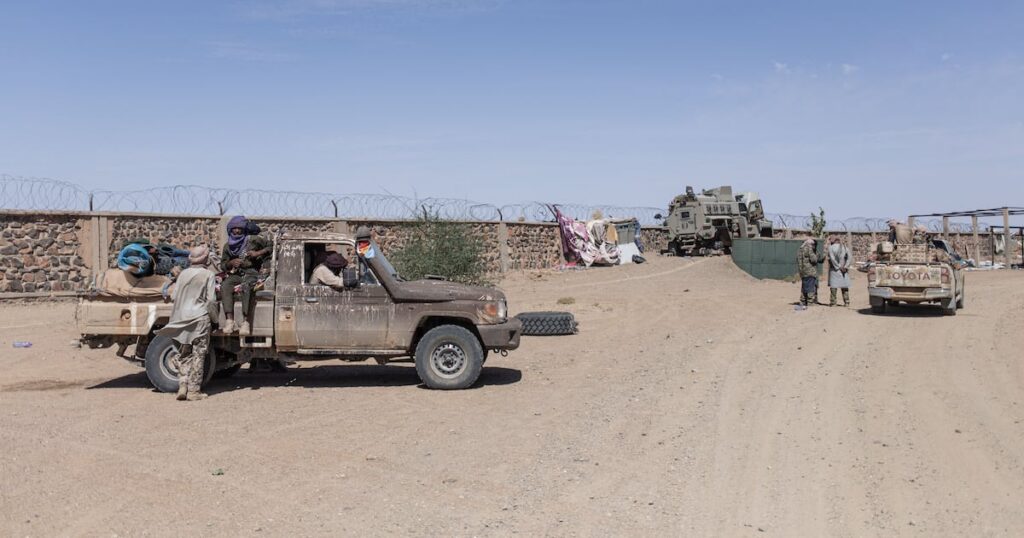
Following the coordinated assaults on Bamako, Kati, Gao, Sévaré, and Kidal on April 25 and 26, a once-taboo debate has resurfaced in Mali’s security circles: should the government consider engaging in dialogue with jihadist factions? With the Jamaat Nusrat al-Islam wal-Muslimin (JNIM), an Al-Qaeda-affiliated group, joining forces with the Tuareg separatists of the Front de Libération de l’Azawad (FLA), security experts are questioning whether a purely military response remains viable amid the escalating violence.
From northern Mali to its southern regions, the offensive has spread at an unprecedented pace. Armed groups have intensified coordinated attacks on military installations and state symbols across at least six cities, culminating in strikes close to Bamako. The unprecedented scale of this operation stems from the rare collaboration between the JNIM and the FLA, formed in late 2024 after the dissolution of the Permanent Strategic Framework (CSP). The FLA, which advocates for the self-determination of the vast Azawad region in northern Mali, has broadened the conflict’s dynamics.
These attacks have laid bare the vulnerabilities of Mali’s leadership. Neither the junta led by Assimi Goïta nor its Russian allies, Africa Corps, have managed to halt the armed groups’ advances. Across regional media and diplomatic circles, the possibility of negotiations with the JNIM is gaining traction, especially as Bamako faces growing isolation and the security situation deteriorates. Yet, the government continues to dismiss any form of engagement, insisting it will not entertain talks with terrorist armed groups and maintaining a strictly military stance despite the mounting crisis.
Since late April, pressure on the regime has intensified, with violence escalating in central Mali. Last week, attacks on villages in the Bankass region—including Kouroude and Dougara—left between 70 and 80 civilians dead, according to local and security sources.
A historic alliance and a wake-up call
The JNIM remains the driving force behind the jihadist insurgency across the Sahel, spanning Mali, Burkina Faso, and Niger. For the military juntas of the Alliance of Sahel States (AES), which seized power promising to restore security, the deadlock is tightening. In Mali, jihadist attacks have crept steadily closer to the capital over the past year, signaling a critical shift in the conflict.
« From July 2025 onward, the jihadists expanded their operations westward, targeting gold mining sites and industrial facilities before focusing on the Bamako-Dakar corridor, effectively choking the capital », explains Alain Antil, Director of the Sub-Saharan Africa Center at the French Institute of International Relations (IFRI). « What’s striking isn’t just the magnitude of this offensive but the deliberate choice of targets—Kati and Bamako lie at the heart of the regime », notes Héni Nsaibia, a researcher at ACLED.
The killing of Mali’s Defense Minister, Sadio Camara, in Kati sent shockwaves through the government. Equally damaging was the loss of Kidal, retaken in late 2023 and hailed as a major victory, which now stands as a strategic setback.
The strategy of strangulation
Even before this latest offensive, analysts observed a shift in the JNIM’s strategy. « The group is seeking to impose a stronger power dynamic—not just through military pressure but by pushing the Malian authorities toward negotiations », Antil observes. The jihadists are now replicating locally tested tactics on a national scale: economic blockades, gradual encirclement of urban centers, and disruption of critical supply routes.
« The JNIM is attempting to impose an economic siege on Bamako », Antil emphasizes. This long-term approach is designed to weaken the government from within, exploiting fractures within the military and institutional systems, according to Abdel Nasser Ould Ethmane Elyessa, a Sahel security expert.
« The group no longer prioritizes the immediate imposition of Sharia law as a prerequisite for peace and now presents itself as open to dialogue », he adds. The rivalry between the JNIM and the Islamic State in the Greater Sahara (ISGS) further complicates the landscape, as both factions vie for territorial dominance and influence.
From taboo to necessity: the case for dialogue
Officially, the AES regimes reject any form of negotiation. « For the leaders of the Alliance of Sahel States, political dialogue is not an option. Their rhetoric remains uncompromising, with military force as the sole response », Antil notes. Yet, the reality on the ground tells a different story.
The actions of state forces and their Russian allies have eroded public trust. Between January 2024 and March 2025, nearly 1,500 civilians were killed by government troops and their allies in Mali—nearly five times the number attributed to the JNIM, according to the Global Initiative Against Transnational Organized Crime (GI-TOC). This brutality fuels resentment and inadvertently fuels jihadist recruitment.
States must accept the compromise of the brave.
Abdel Nasser Ould Ethmane Elyessa, Sahel expert
In light of this impasse, an increasing number of experts advocate for a paradigm shift. « A purely military approach is a dead end in addressing the Sahel’s jihadist crisis. It must be paired with political negotiations », argues Antil. While some of the JNIM’s demands—such as combating corruption, improving justice, and ensuring equitable access to resources—could serve as a basis for discussion, their violent methods cannot be overlooked.
« States must accept the compromise of the brave. The idea is to integrate jihadists into the political process to expose their limitations », Elyessa proposes. However, he sets clear red lines: « Gender equality and the secular nature of the state are non-negotiable ».
As jihadist offensives advance, the once-unthinkable idea of dialogue is transitioning from heresy to a plausible political strategy. For many experts in Mali, the question is no longer whether to negotiate but how long Bamako can afford to refuse.