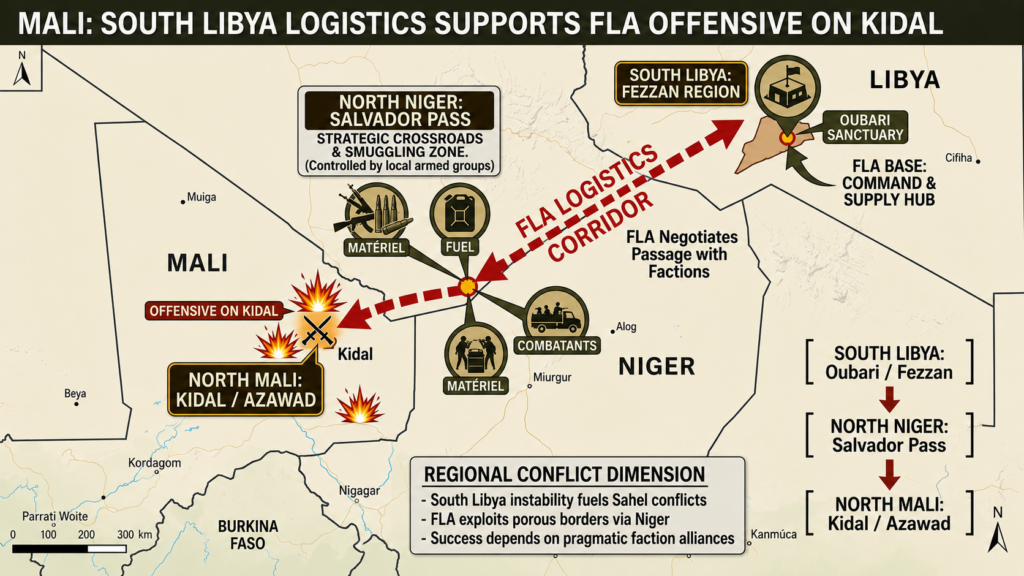
The strategic landscape of the Sahel’s security challenges has once again placed southern Libya at the epicenter of regional dynamics, particularly in the context of the recent military campaign waged by Tuareg rebels. Recent developments indicate that the Front de Libération de l’Azawad (FLA) has established a critical logistical corridor linking southern Libya to northern Mali, transiting through Niger, to execute their ambitious offensive launched on April 25 aimed at regaining control of Kidal.
The Fezzan and Oubari: pivotal logistical strongholds
At the heart of this operational framework lies the Fezzan region, a historically porous area in southern Libya. Rebel infrastructure appears to have been consolidated in the vicinity of Oubari, transforming the area into more than just a passive refuge. Instead, it has functioned as a launching point, a central command hub, and a supply distribution center for FLA fighters.
The Fezzan’s role underscores its enduring significance as a logistical nexus, enabling the rebels to organize and sustain their operations targeting northern Mali.
The ‘Salvador Pass’: a cross-border artery for illicit flows
To project their forces and supplies into Mali, the rebels rely on a highly strategic transnational route that spans from southern Libya to northern Mali, cutting through Niger. The linchpin of this corridor is the so-called ‘Salvador Pass,’ a remote desert crossing in northern Niger notorious for its use by armed groups and criminal networks involved in arms and drug trafficking.
During this offensive, the pass has facilitated the movement of three critical components:
- Military equipment, including weapons, ammunition, and logistical support;
- Fuel, an essential resource for the mobility of pickup columns navigating the desert terrain;
- Manpower, enabling fighters to deploy to the front lines before retreating into Libyan territory post-combat.
The operational flow can be visualized as follows:
Southern Libya (Oubari / Fezzan) → Northern Niger (Salvador Pass, controlled by local armed groups) → Northern Mali (Kidal / Azawad)
Niger: a constrained but essential transit point
The utilization of this corridor highlights the intricate web of transnational alliances underpinning regional security challenges. The northern section of this route, located within Niger, remains under the influence of various local armed factions. Consequently, the FLA could not operate unilaterally; securing passage required negotiating with these actors who control access to the area.
This logistical compromise underscores a broader reality: the success of military offensives in the Sahel is increasingly contingent upon pragmatic agreements between interconnected armed groups operating across borders. As the struggle for control over northern Mali intensifies, these developments reaffirm the deeply interconnected nature of the conflict, where the ripple effects of Libyan instability continue to shape and exacerbate tensions across the Sahel.