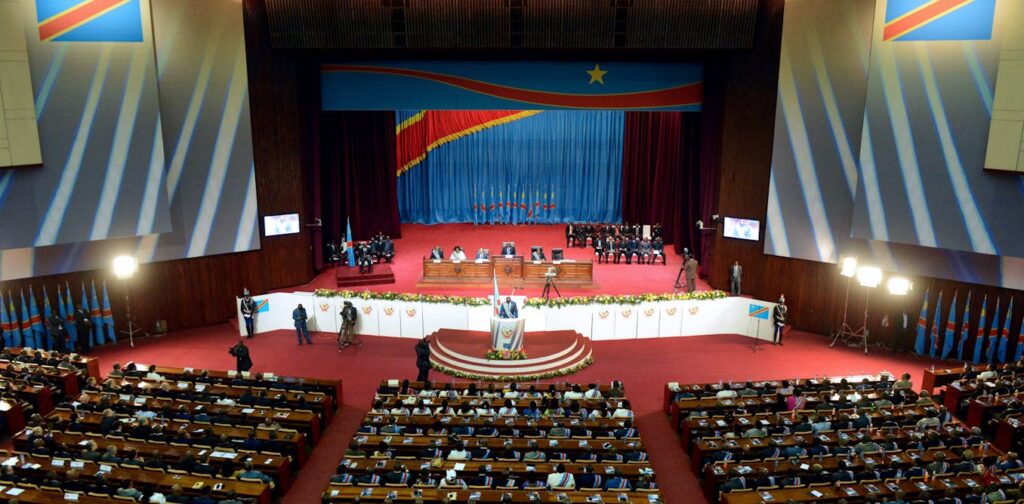
On May 15, 2026, the Congolese political landscape was shaken by a display of blatant misogyny originating from the highest levels of the National Assembly. During a televised session, Micheline Mpundu, a national deputy, was finishing a presentation at the rostrum. As she prepared to return to her seat, Christophe Mboso, the second vice-president who was presiding over the session, chose to publicly comment on her physical appearance. “Thank you, colleague. She is very beautiful… isn’t she?” he remarked from his elevated position.
The situation escalated as he continued in Lingala, urging the assembly to “look at her for yourselves,” while laughing and using his hands to mime the contours of the deputy’s body. He added comments about her being “God’s creation” and the “property of another man,” remarks that were met with visible laughter and sustained applause from the chamber. The session then proceeded without interruption, treating the objectification of a lawmaker as a routine occurrence.
It was only after a wave of outrage from political figures, civil society, and human rights defenders—coupled with internal pressure—that Mboso offered an apology several days later. Despite the public outcry, he faced no formal sanctions for his behavior.
This recent display of verbal violence raises a fundamental question: when will African legislative bodies, particularly those in the République Démocratique du Congo, stop being hostile environments for the women they are meant to represent? My political science research into masculinity within Congolese legislative organs suggests that this video is not merely an isolated lapse in judgment. Instead, it reveals a deep-seated structural problem. There is a staggering disconnect between the gender equality the DRC government promises on paper and the daily reality experienced by female elected officials.
A phenomenon crossing borders
Parliamentary violence is a broad category of abuse that women in politics face globally, and the DRC is no exception. Before the footage of Mboso surfaced in Kinshasa, numerous other instances of sexism had already been documented, highlighting a trend that actively discourages women from participating in decision-making processes.
While the democratization waves of the 1990s led to a surge of women entering African parliaments—with their numbers tripling between 1990 and 2010—the hope that increased presence would automatically reform institutional culture has proven to be a mirage. In many cases, the arrival of women has been viewed as a threat to the established order, triggering structural resistance from male colleagues across the political spectrum. Some openly argue that the political arena is a male sanctuary where women do not belong.
Data from the Inter-Parliamentary Union supports this. A 2016 global survey involving female lawmakers from 39 countries revealed that over 65.5% had experienced repeated verbal aggression and insults during their mandates. Most of this abuse comes from male peers. Furthermore, society often subjects female leaders to a specific type of scrutiny; rather than evaluating their legislative records, public discourse frequently focuses on their appearance, marital status, or how well they fit traditional roles as mothers and caregivers.
Sexism does not stop at the doors of the National Assembly; it enters with the representatives and is sometimes weaponized from the speaker’s chair. A regional study by the IPU and the African Parliamentary Union in late 2021 confirmed that progress in achieving effective political participation for women remains sluggish across the continent.
The applause heard in the recent video is telling. It suggests the issue is not just one individual, but a system that tolerates such conduct. This serves as a control mechanism to keep women in a subordinate position. This “semiotic violence”—expressed through gestures, laughter, and words—reminds female deputies that some colleagues view them as bodies first and legislators second. Even though these women are elected through the same democratic processes as men, they are often reduced to objects of patriarchal control.
Patterns across the continent
The incident involving Mboso echoes similar events in other African nations. In 2022, the Sénégal witnessed a shocking scene where deputy Amy Ndiaye, who was pregnant at the time, was slapped and kicked in the stomach during a session. In 2025, Nigerian Senator Natasha Akpoti-Uduagha faced suspension not for professional misconduct, but for speaking out against sexual harassment from the Senate President. These cases in the DRC, Sénégal, and Nigeria demonstrate that while parliaments may tolerate the presence of women, they do not yet fully respect their dignity.
A history of hostility in the DRC
The DRC has a documented history of such incidents. In April 2020, Thambwe Mwamba, then President of the Senate, used a plenary session to disparage Senator Bijoux Ngoya. He publicly detailed private meetings and accused her of making advances toward him to secure a position. The session collapsed into chaos following the verbal assault.
In July 2021, during a constitutional debate, Deputy Christelle Vuanga was interrupted by Nsingi Pululu, who dismissed her arguments by simply stating in Lingala, “You are a woman.” This was a direct attempt to invalidate her expertise based solely on her gender.
The lack of surprise surrounding the Mboso affair stems from the fact that while the DRC ratifies international conventions and passes gender-equality laws, the culture within the chamber remains stagnant. The gap between legal texts and practical reality is well-known, yet it continues to be ignored by those in power.
The cost of silence
Decades ago, feminist thinkers noted that women are often defined as “the other.” In 2026, this status persists in the Congolese Parliament, where female deputies are still defined by their physicality rather than their political contributions. Such incidents signal that internal patriarchy is undermining democracy.
As long as sexist behavior goes unpunished, the National Assembly remains a misogynistic space. Currently, women hold only 65 out of 477 seats—roughly 13%—in a country where they make up 51% of the population. Their underrepresentation does not excuse the abuse they face.
Other legislative bodies have addressed these issues through campaigns like #NotTheCost and #NotInMyParliament, which use concrete sanctions to protect victims and shift institutional culture. While the DRC has introduced promising legislation, such as the 2025 project on violence against women, a law without enforcement is merely a suggestion. Failing to sanction leaders for sexism sends a discouraging message to every Congolese woman considering a career in public service.