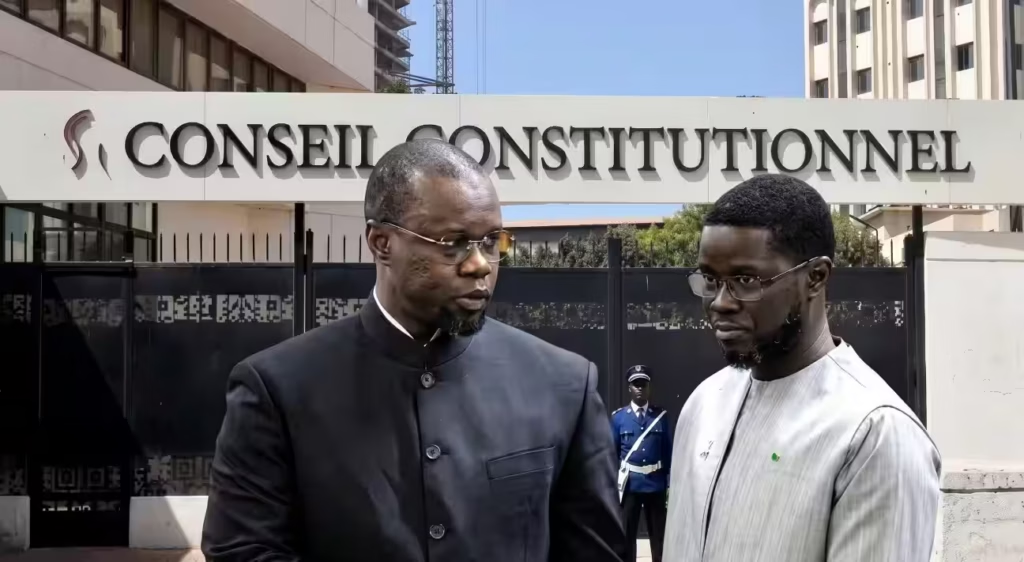
When the Constitutional Council of Senegal delivered its verdict on Ousmane Sonko’s reinstatement to the National Assembly, it ignited a storm of debate across the nation’s legal landscape. The decision, cloaked in procedural language, has left jurists and political observers dissecting its deeper implications, particularly regarding the court’s evolving jurisprudence.
Legal intricacies behind a contentious ruling
The June 17, 2026 ruling hinged on a technicality—declaring the court incompetent to rule on the matter. Yet beneath this seemingly straightforward justification lies a more complex narrative. Critics argue that the decision marks a departure from the council’s earlier assertive stance, where it had positioned itself as a guardian of institutional stability and a regulator of political processes.
Contrasting this with the council’s approach in early 2024, when it adopted a more expansive interpretation of its powers, the shift is striking. Legal analysts highlight how the recent verdict appears to prioritize narrow juridical formalism over substantive constitutional principles, raising questions about the court’s consistency in navigating high-stakes political disputes.
A debate over jurisprudential evolution
The ruling has reignited discussions about the council’s role in Senegal’s democracy. While some view the decision as a necessary adherence to procedural limits, others see it as a subtle retreat from the judiciary’s responsibility to uphold constitutional values in politically charged cases. The council’s reasoning, though framed in legal terms, has exposed tensions between judicial restraint and the demands of a dynamic political environment.
The controversy extends beyond Sonko’s case, touching on broader concerns about the judiciary’s capacity to mediate between state institutions and citizens. As Senegal’s legal community grapples with these questions, the ruling stands as a pivotal moment in the evolution of its constitutional jurisprudence.