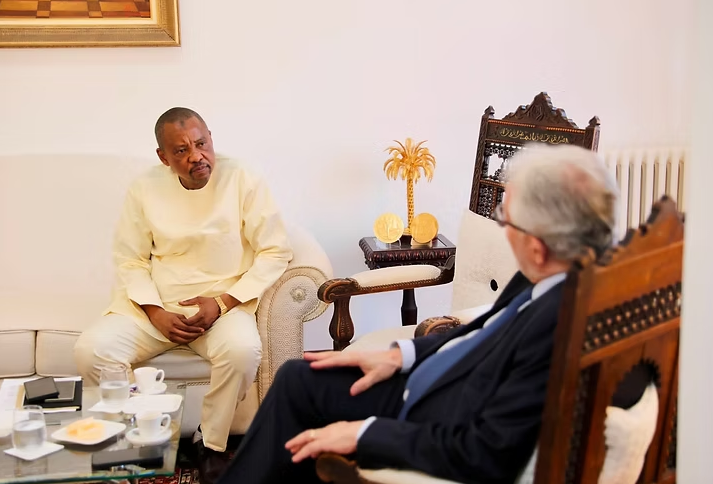
The unexpected meeting between Hamadou Saley, Niger’s chargé d’affaires in France, and Chems-eddine Hafiz, rector of the Great Mosque of Paris, has sparked intense debate. While framed as a cultural or religious exchange, this encounter reveals a deeper political maneuver: Niamey’s desperate attempt to bypass France’s official diplomatic channels by leveraging the influence of one of the country’s most prominent Islamic institutions.
When diplomacy bypasses the Quai d’Orsay
Since the political upheaval in Niamey and the sharp deterioration of bilateral relations with Paris, formal communication between the two capitals has effectively ground to a halt. Diplomatic expulsions, nationalist rhetoric, and the suspension of cooperation agreements have frozen the Paris-Niamey axis. Yet, economic, migratory, and geopolitical realities inevitably resurface, forcing even the most hardened positions to reconsider. The Nigerien government understands it cannot afford to sever all ties with France—but with the traditional diplomatic route blocked, alternative pathways must be explored.
The mosque as a political backdoor
By sending a senior diplomat to engage with an institution as historically significant as the Great Mosque of Paris, Niamey is not merely seeking spiritual dialogue. It is attempting to bypass the void left by France’s Ministry of Foreign Affairs. The mosque, with its deep-rooted institutional ties to the French state, represents a potential gateway for Niger to re-enter the public and political discourse of France—after being shut out of the front door.
A strategy built on contradiction
This approach highlights a stark inconsistency. While Niger’s official narrative condemns foreign interference and advocates for a complete break from its former partner, its behind-the-scenes diplomacy is quietly exploiting religious structures in France to soften its image and re-establish indirect dialogue. Cultural and religious projects should not serve as a smokescreen for political normalization. If Niger truly seeks to rebuild constructive relations with France, such efforts must unfold transparently, through state channels and international protocols—not by manipulating religious sensibilities.
As debates unfold in Paris, the Nigerien government’s tactics raise critical questions about the blurred lines between faith and diplomacy in modern international relations.