Actualité
New training programme empowers Mali’s manuscript guardians
Under the project “Promoting the preservation and accessibility of endangered African documentary heritage,” a major capacity-building programme has officially begun with a series of training workshops dedicated to Mali’s ancient manuscripts.
Led by the UNESCO Office in Mali in partnership with the NGO SAVAMA-DCI, this initiative targets over 70 participants — including staff from families who hold ancient manuscripts, students, and researchers — to improve the preservation and promotion of this invaluable heritage.
The ancient manuscripts of the Sahel, especially those in Mali, offer a unique source of knowledge and reflect the continent’s rich historical and intellectual legacy. With threats from security crises and climate change, safeguarding them has become a top priority for national authorities and their partners.
Within this context, the current project aims to build on achievements from earlier programmes and enhance conservation, accessibility, and valorisation practices for at-risk documentary heritage.
The training programme is structured around several successive workshops:
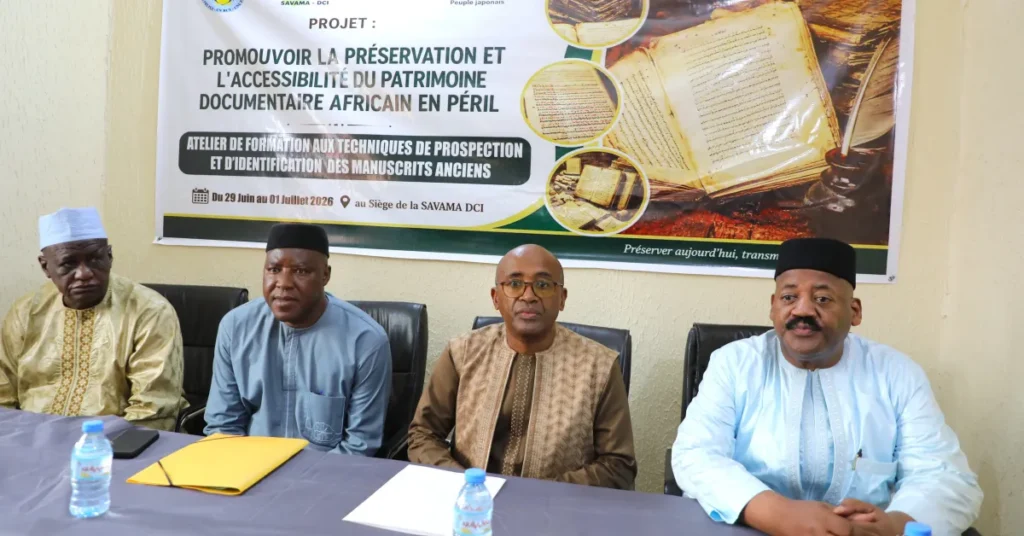
The first workshop, held from 29 June to 1 July 2026, focuses on survey and identification techniques for ancient manuscripts. Participants will gain skills to locate and identify manuscripts within families, libraries, and other storage sites.
The second workshop, from 2 to 4 July 2026, covers inventory and cataloguing methods. Trainees will learn to collect, organise, and describe manuscript information, and to create standardised descriptive records.
These two complementary sessions, opened on 29 June 2026 by the representative of the Minister of Handicrafts, Culture, Hotel Industry and Tourism, alongside the acting head of the UNESCO Office in Mali and the Executive President of SAVAMA-DCI, will cover the entire management chain of ancient manuscripts — from identification to systematic documentation — benefiting 15 staff members from manuscript-holding families.
“The Department of Handicrafts, Culture, Hotel Industry and Tourism assures its ongoing support for the success of this project and will pay close attention to the expected results and impacts,” said Mr. Mamadou Cissé, technical advisor and representative of the Minister of Culture.
The acting head of the UNESCO Office, Mr. Ali-Mohamed Sinane, stated: “Preserving ancient manuscripts means preserving our memory, identity, and shared history. It also means passing on an intellectual heritage of immense value to future generations. I hope these workshops are rich in exchange, learning, and commitment, and that they significantly contribute to safeguarding Mali’s documentary heritage.”
After these two workshops, beneficiaries will be able to conduct field missions, correctly identify manuscripts, describe them, and contribute to their integration into structured inventory systems.
This training programme, which will continue in the coming months for students and researchers on topics such as critical edition and translation of ancient manuscripts, marks an important step in strengthening national capacities for protecting and promoting Mali’s ancient manuscripts.
Through these workshops, UNESCO and its partners — notably the Government of Japan — reaffirm their commitment to safeguarding African documentary heritage. The goal is not only to preserve these treasures for future generations but also to enhance public recognition of them as culturally and historically significant heritage.