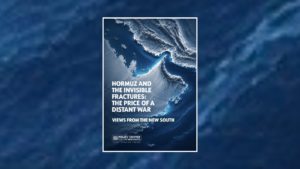
The escalating tensions between Iran, the United States, and Israel have once again brought the strategic Strait of Hormuz into the spotlight, raising concerns about global energy security. A newly published collective work, ‘Hormuz and the Invisible Fractures: the Price of a Distant War’, delves into the geopolitical, economic, and security repercussions of this ongoing conflict.
The Policy Center for the New South (PCNS) has compiled contributions from prominent international experts, including Abdelhak Bassou, Ferid Belhaj, Ian Lesser, Hafez Ghanem, Hinh T. Dinh, and Rida Lyammouri. Their analysis spans multiple regions, with a sharp focus on how the crisis could reshape North African economies—particularly Morocco, which emerges as the most exposed to an oil price shock stemming from Hormuz disruptions.
How a Hormuz crisis could ripple through Morocco’s economy
A key chapter in the study, authored by economist Hinh T. Dinh, examines the potential impact of a 20% surge in global oil prices on the economies of Morocco, Tunisia, and Egypt. Using an input-output economic model, the research highlights Morocco’s heightened vulnerability compared to its North African neighbors.
The findings reveal structural weaknesses across multiple Moroccan sectors, including agriculture, construction, transportation, and energy-intensive industries. These vulnerabilities stem from the country’s reliance on imported oil and gas, as well as its integration into global supply chains that pass through the Strait of Hormuz—a critical chokepoint for nearly a third of the world’s seaborne oil.
In contrast, Egypt is projected to partially benefit from higher oil prices due to state revenues from energy exports, while Tunisia’s economy is expected to remain relatively balanced despite sectoral disparities.
Beyond economics: a fractured global order
The PCNS study goes further than economic projections, exploring how the 2026 conflict signals a fundamental shift in the international order. Ferid Belhaj argues that the crisis reflects the growing fragmentation of the global system, where traditional cooperation and deterrence mechanisms are losing their effectiveness. Marcus Vinicius de Freitas suggests this could herald a more multipolar world where conflicts are managed rather than resolved.
Meanwhile, Ian Lesser’s contribution examines the strain on transatlantic relations, noting deepening divisions between the United States and European allies over military intervention and crisis management. The work also warns of heightened risks to African energy security, Sahel stability, and South American economies, while underscoring the rising geopolitical importance of strategic minerals in shaping new global power dynamics.
The PCNS emphasizes that this collective effort serves as a critical contribution to discussions on adapting to crises that could disrupt energy markets, supply chains, and geopolitical balances for years to come. For Morocco, the findings underscore an urgent need to reassess its economic resilience in the face of potential energy shocks.