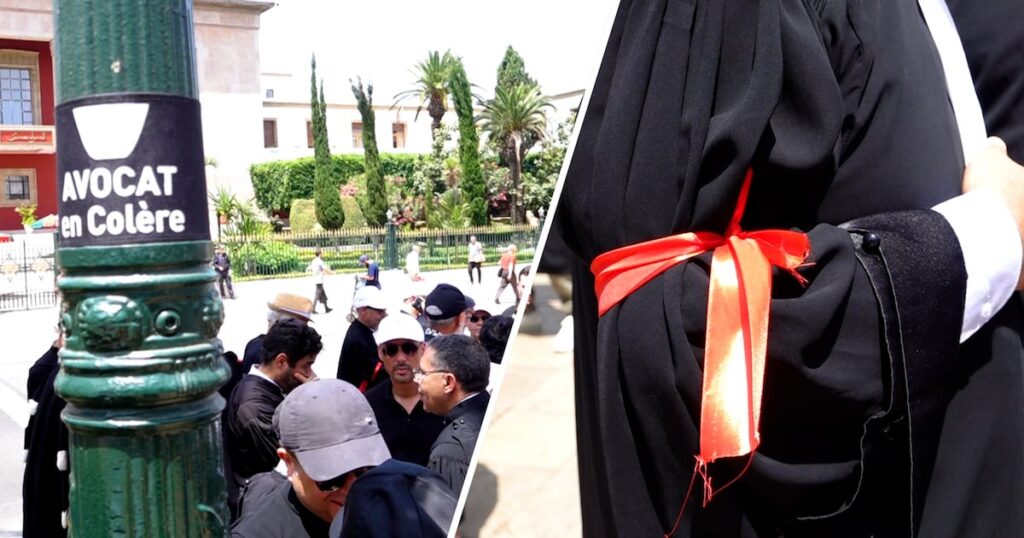
With red armbands wrapped firmly around their sleeves, Moroccan lawyers entered another day of indefinite strike on Monday, July 6, gathering outside the Parliament building in Rabat. Their resolve remains unshaken as they escalate their protest against what they describe as a dangerous erosion of democratic freedoms, demanding the complete withdrawal of the controversial draft law regulating their profession.
The sea of black robes at the demonstration underscored the scale of opposition. Lawyers argue that the proposed legislation infringes on their independence, particularly concerning disciplinary oversight by the public prosecutor’s office and the Ministry of Justice. They also criticize the transfer of training authority to the Ministry of Justice and the lowering of the minimum age for candidates in the qualifying examination.
Just days earlier, during a prior gathering outside Parliament, legal representatives had warned that the struggle has only just begun, vowing to intensify their actions unless the bill is scrapped entirely.
Aziz Rouibah, the elected head of the Rabat Bar Association, emphasized the profession’s unwavering stance in an exclusive statement. “Our very existence is under threat,” he declared, accusing unnamed actors of attempting to “symbolically dismantle the legal profession.” He stressed the moral obligation to resist what he characterized as an aggressive legislative onslaught against lawyers. “This is not just a professional crisis—it is an attack on the foundations of justice and democracy,” he added.
Me Mounir Belghiti, a member of the Rabat Bar Council, framed the protest as a final appeal to lawmakers. The duration of the sit-in, he noted, would hinge on parliamentary developments, with the goal of ensuring the new law reflects “the nation’s interests and future,” rather than being shaped by “personal grievances or short-term political gains.”
Belghiti framed the deadlock as a crisis of confidence in the legislative process. “When legislation is tailored to serve narrow agendas rather than the public good, we erode the very pillars of democratic governance,” he cautioned. The current draft, he argued, risks normalizing exceptions as rules, thereby weakening the legal system.
Parliamentary debates on the contested bill are set to resume this week in the Chamber of Advisors. If amendments are introduced, the revised text will then be forwarded to the Justice Commission of the Chamber of Representatives for further review.
In the meantime, Morocco’s court system continues to grapple with severe disruptions caused by the lawyers’ strike. Delays in judicial proceedings have left many litigants in limbo, particularly pre-trial detainees whose cases have been postponed for nearly a month.
The Moroccan Association of Bar Associations (ABAM) serves as the umbrella organization uniting all local bar councils across the Kingdom, reinforcing the unified front presented by the nation’s legal community.