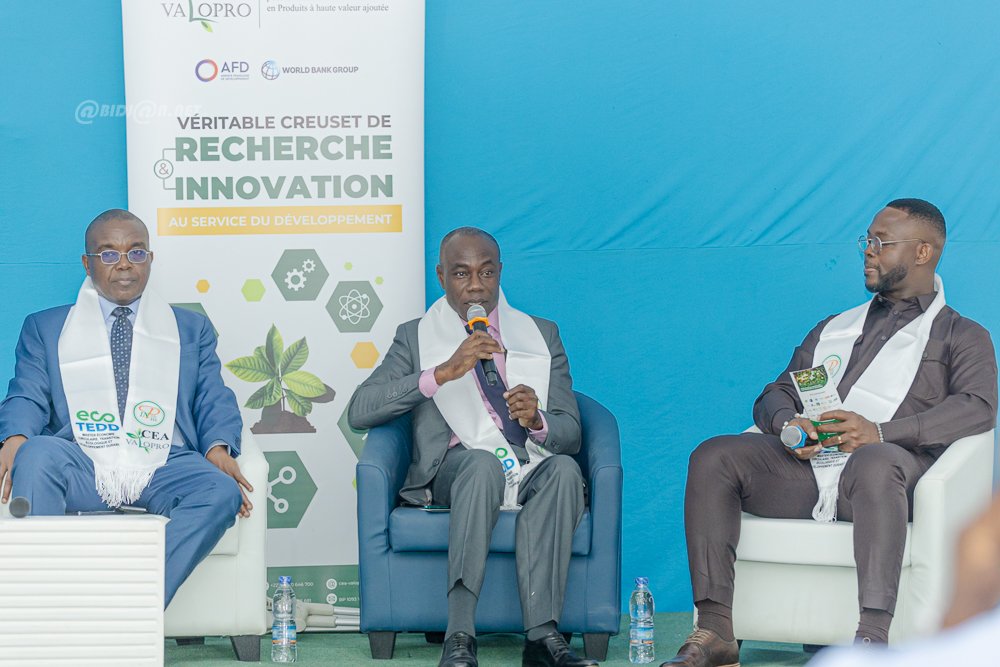
The Institut National Polytechnique Félix Houphouët-Boigny (INP-HB), through its Centre d’Excellence Africain en Valorisation des Produits Locaux (CEA VALOPRO), kicked off the Master’s program in Circular Economy, Ecological Transition, and Sustainable Development (ECOTEDD) this past weekend. The inaugural seminar, held in the heart of Bamako, brought together policymakers, private-sector leaders, technical partners, and environmental experts to explore innovative pathways for Africa’s green transformation.
Under the banner of ‘Sustainable Africa, Resilient Côte d’Ivoire: Leveraging CSR and Circular Economy for a New Development Model’, the event served as a platform to dissect the continent’s most pressing environmental hurdles. Discussions centered on waste management, deforestation, energy transitions, and the persistent barriers to accessing climate financing, a critical yet often overlooked challenge across West Africa.
Building Resilient Economies Through Local Solutions
Professor Benjamin Yao, Coordinator of CEA VALOPRO, set the tone by emphasizing the need for data-driven, context-specific strategies. “Circular economy isn’t just about recycling—it’s about preserving value,” he noted, highlighting how agricultural byproducts like cashew and cocoa waste could be transformed into high-value resources. “Africa cannot afford to replicate Western models. We must craft solutions that are practical, scalable, and rooted in our realities.”
The seminar also scrutinized the role of Corporate Social Responsibility (CSR) in driving sustainable growth. While CSR is increasingly becoming a prerequisite for public sector contracts, many businesses still treat it as a mere PR exercise. “Integrating CSR into core operations is non-negotiable,” argued panelists. “It’s not enough to publish glossy reports—companies must embed these principles into their decision-making processes.”
Financing a Greener Future: The Funding Paradox
One of the event’s most debated topics was climate finance. Despite the availability of substantial international funds, bureaucratic hurdles often stifle local projects. “The money exists, but the paperwork is a minefield,” explained a financial expert. “We need to train homegrown professionals who can navigate these systems and assemble compliant proposals.”
Student representative Abraham Bosson, speaking on behalf of the program’s first cohort, underscored the urgency of youth-led innovation. “Our generation holds a historic responsibility,” he stated. “We’re not just here to learn—we’re here to act. From designing sustainable business models to spearheading community projects, we’re committed to reshaping Africa’s development trajectory.”
The two-year, highly selective ECOTEDD program blends academic rigor with hands-on training in waste valorization, CSR strategy, climate finance, and project development. Designed to produce a new wave of green leaders, the initiative aims to equip professionals with the tools to drive impact in both private enterprises and public institutions across Côte d’Ivoire and beyond.
The organizers anticipate opening the next round of applications soon, signaling a broader push toward a circular, inclusive, and resilient economic future for the region.