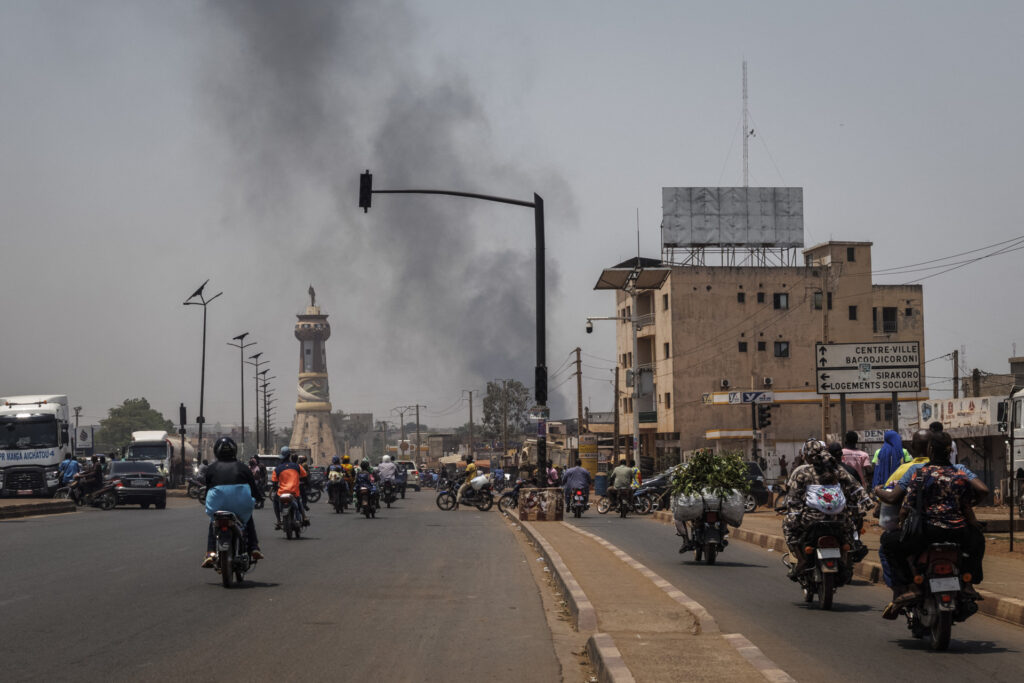
TOPSHOT - A column of black smoke rises above buildings as traffic passes the Africa Tower monument in Bamako on April 26, 2026. April 25, 2026's shock attacks, synchronised by Tuareg rebels of the Azawad Liberation Front (FLA) coalition and the jihadist Group for the Support of Islam and Muslims (JNIM), targeted several areas in the vast arid country. Fighting resumed on April 26 in several areas, including Kita near Bamako, Kidal, Gao and Severe. Tuareg rebels meanwhile announced an agreement allowing Russian forces backing Mali's army to withdraw from the northern city of Kidal, which they claimed was "totally" under their control. (Photo by AFP via Getty Images)
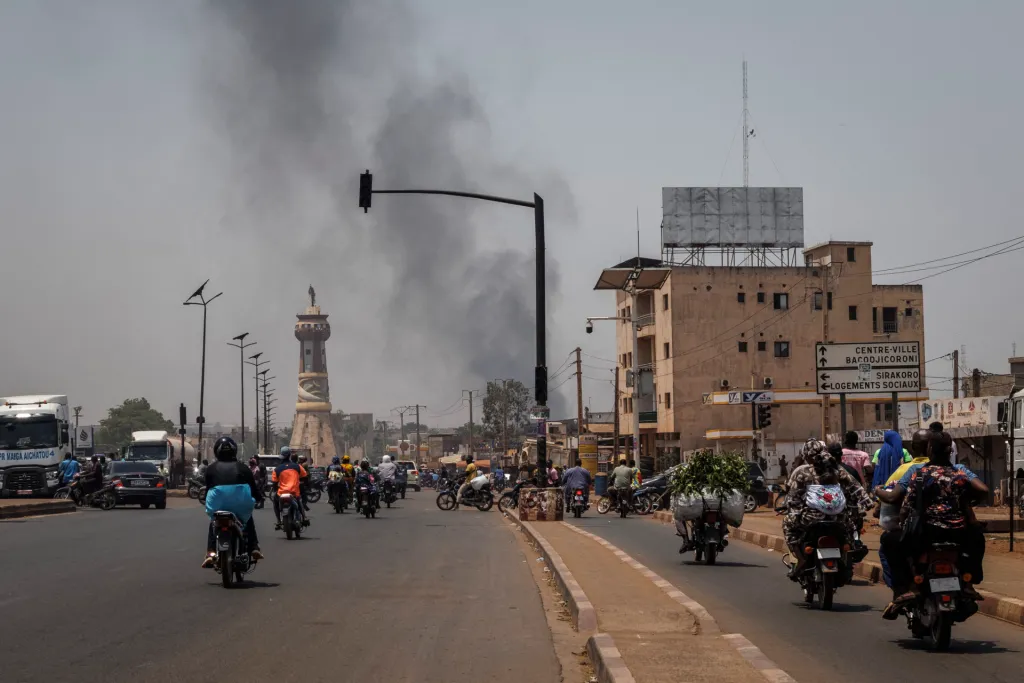
In the early hours of April 25, the silence of Kati, a strategic military town located just 15 kilometers from Mali’s capital, Bamako, was shattered by heavy gunfire and explosions. This marked the beginning of a massive, coordinated offensive launched by the jihadist coalition JNIM (Jama’at Nusrat al-Islam wal-Muslimin) and the Tuareg separatist group FLA (Front de Libération de l’Azawad). By the following day, the ruling military government confirmed that Defense Minister Sadio Camara had died from wounds received during an assault on his home. Reports also suggest that the junta’s intelligence chief, Modibo Koné, may have been killed or severely injured in the same wave of violence. While the regime attempted to project an image of stability by claiming the situation was under control, the scale of the violence told a different story.
These strikes represent the most significant threat to Assimi Goïta’s leadership since his 2020 coup. The Mali security crisis has worsened as JNIM continues a month-long blockade that has crippled the landlocked nation. By targeting over 130 fuel tankers, the group has choked off vital imports from Sénégal and Côte d’Ivoire, leading to widespread school closures and economic paralysis. Despite public denials, rumors persist that the junta released over 100 prisoners to secure a brief truce for fuel convoys, highlighting how the insurgency is strangling the state beyond the traditional battlefield.
This resurgence of violence is a critical test for the junta’s reliance on Russia-backed security and the suppression of civil rights as a replacement for Western-supported democratic governance. The outcome of this struggle will likely influence similar military regimes in Burkina Faso and Niger, which have also turned away from traditional Western allies.
A recurring jihadist-separatist partnership
The current situation mirrors events from 2012, when a similar alliance of jihadists and separatists overwhelmed the Mali military in the north. At that time, Tuareg fighters returning from Libya with heavy weaponry joined forces with al-Qaeda in the Islamic Maghreb (AQIM) and Ansar Dine. Although that alliance eventually collapsed into internal conflict, it allowed the groups to seize a massive territory. The recent April attacks represent the first major joint operation between these factions in over a decade.
While JNIM and the FLA have different long-term goals—one seeking an Islamic state and the other Tuareg self-determination—their current tactical cooperation is designed to show that the Mali government cannot protect its own symbols of power. For JNIM, this is part of a broader strategy of attrition, aimed at exhausting the junta’s resources until the administration collapses from within.
The late Defense Minister Camara was a pivotal figure in Bamako’s alliance with Moscow, facilitating the arrival of the Wagner Group in 2021. This partnership led to the departure of France’s military and the end of the United Nations peacekeeping mission. Following the death of Yevgeny Prigozhin, Wagner was reorganized into Africa Corps under the direct oversight of the Russia Ministry of Defense. However, this transition has seen a shift from direct combat to a more limited advisory role, which has coincided with a decrease in operational effectiveness. Furthermore, the ongoing war in Ukraine has limited the personnel available for deployment in the Sahel.
The loss of Kidal and regional instability
The change in the Russia mandate became evident in Kidal. After Malian and Wagner forces captured the city in late 2023, it was hailed as a major victory for the junta’s new security model. However, following the recent April offensive, Africa Corps forces conducted an escorted retreat from the city, effectively surrendering the hard-won territory without a fight.
This retreat reflects the broader failure of the Alliance of Sahel States (AES) model. The juntas in Mali, Burkina Faso, and Niger justified their coups by promising better security than the Western-backed governments they replaced. Instead, they now oversee a region that is significantly more dangerous. Their decision to leave the Economic Community of West African States (ECOWAS) has only deepened their isolation.
History shows that insecurity often leads to further coups in the Sahel. Assimi Goïta now faces the same risks that led to the downfall of previous leaders. With the death of Camara, a leadership vacuum has emerged just as internal dissent grows. The junta’s decision to ban political parties and extend Goïta’s term until 2030 has further eroded its legitimacy. A failed coup attempt in August already highlighted divisions within the military, and the recent intelligence failures may provoke further unrest among the officer corps.
U.S. interests and the counterterrorism landscape
For years, Mali was the focal point of United States counterterrorism efforts in the region. While legal restrictions halted most aid after the coups, there are signs that Washington may be looking to re-engage. Recently, the Treasury Department lifted sanctions on several Malian officials, and discussions have reportedly touched on intelligence-sharing and access to critical minerals like lithium and gold.
The failure of the Russia-backed security strategy may actually give the United States more leverage. Washington could potentially offer a “minerals-for-security” arrangement, similar to a recent deal with the Democratic Republic of the Congo. Such a move would aim to bring Sahel juntas back into the Western sphere of influence while addressing the growing threat posed by JNIM.
The recent offensive proves that JNIM can strike the heart of the capital and disrupt the national economy at will. With the Malian state losing both resources and legitimacy, and no effective regional security framework in place, the Mali security crisis has reached a dangerous turning point. Neighbors and other African nations that have looked to Russia for protection are likely reconsidering their options as they watch the junta’s strategy unravel.