Northern Mali is currently experiencing a significant security upheaval. Within a brief period, the nation’s security landscape has undergone a dramatic transformation. Following the symbolic fall of Kidal, armed factions have maintained a rapid territorial expansion, concurrently, the Group for the Support of Islam and Muslims (JNIM) has initiated an unprecedented political maneuver, advocating for the overthrow of the interim government.
A military setback with echoes of the past
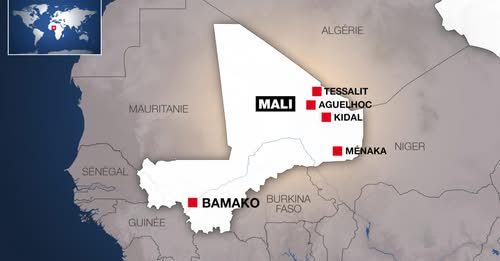
The grim sequence of events from 2012 appears to be recurring. On Friday, May 1, 2026, combatants from the JNIM, alongside separatists from the Azawad Liberation Front (FLA), seized command of the critical military installations at Tessalit and Aguelhoc. The withdrawal of the Malian Armed Forces (FAMa) and their Russian associates from Africa Corps facilitated the unopposed entry of the insurgent forces.
A widely verified image serves as a potent symbol of the humiliation, depicting Seidane Ag Hitta, a prominent figure within the JNIM, conspicuously displaying the keys to the Tessalit camp. This action carries profound implications, occurring five years subsequent to the departure of the French Barkhane mission. Since April 25, the towns of Ber, Tessit, Hombori, and Gourma Rharous have been retaken, leaving residents in Gao and Timbuktu gripped by profound apprehension.
Bamako’s determined response and Moscow’s unwavering backing
Despite this severe setback, the Koulouba Palace remains resolute. General Assimi Goïta has issued a call for «national resurgence», emphasizing that no form of «intimidation» will divert Mali from its chosen path.
The strategic military efforts are presently concentrated on two distinct operational fronts:
- Air and Ground Operations: The Malian military is conducting intensified precision strikes in Kidal, targeting governmental facilities and logistical storage points. While FLA rebels dispute the official casualty figures, Bamako asserts that numerous «terrorists have been neutralized».
- Logistical Resilience: As a jihadist blockade severely restricts arterial routes leading to the capital, a substantial convoy comprising 800 tanker trucks successfully navigated the passage this Friday, under the protective escort of air support and ground forces.
From Moscow, the Kremlin, through its spokesperson Dmitri Peskov, reiterated its full endorsement of the transitional authorities, dispelling any speculation regarding a potential Russian withdrawal following losses incurred in Kidal.
JNIM’s political gambit: navigating between «sovereignty» and Sharia
The most significant shift in this period is undeniably semantic. In a communiqué disseminated during the night of April 30, the JNIM abandoned its customary militant discourse in favor of a political rhetoric closely mirroring that of its adversaries.
The organization is now appealing to the «vital forces of the nation», political parties, and even religious leaders to forge a «common front» aimed at establishing a «peaceful transition» and terminating the «dictatorship of the junta». By deploying terms such as «sovereignty» and «dignity», the JNIM seeks to garner support from segments of the populace weary of the protracted conflict, while simultaneously reaffirming its ultimate objective: the implementation of Sharia law.
«From the worst, one seeks the lesser evil,» remarked a former opposition minister, encapsulating the profound quandary now confronting Mali’s political establishment: should dialogue be pursued with erstwhile adversaries to stem the current crisis?
A regime under mounting domestic pressure
Tension is acutely perceptible, extending even within the state apparatus. The Public Prosecutor at the Bamako Tribunal has confirmed the apprehension of several Malian military personnel, who are suspected of complicity in the assaults that occurred over the preceding weekend.
Amidst the territorial advances of insurgent groups, the JNIM’s ambivalent political overtures, and the economic strain imposed by the blockade, the transitional government is navigating its most severe crisis to date. The struggle for Mali’s future is no longer confined solely to the northern deserts but also encompasses the crucial arena of political legitimacy within Bamako itself.