In May 2026, West African households face a fresh economic challenge as purchasing power remains under strain from persistent inflation. A stark disparity has emerged between fuel prices at the pump in Côte d’Ivoire and those in neighboring Bénin, exposing deeper structural differences in regional energy policies.
Côte d’Ivoire: the burden of domestic production
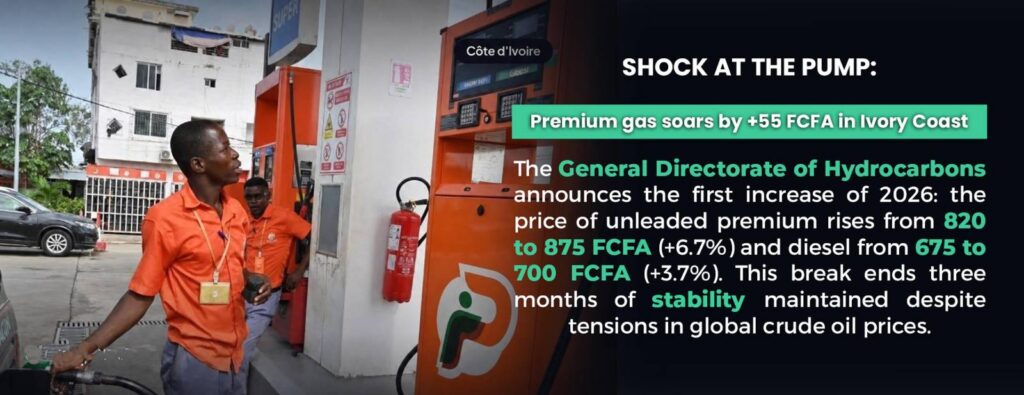
The Direction Générale des Hydrocarbures in Côte d’Ivoire recently announced the first price adjustment of the year, dealing a heavy blow to consumers. The cost of Premium unleaded petrol has surged from 820 to 875 FCFA per liter—a 6.7% increase—while diesel has now surpassed the 700 FCFA mark. This upward revision has sparked widespread frustration, particularly among citizens who question how a nation with domestic oil reserves can impose higher fuel costs than its neighbors.
Beyond immediate financial strain, the price hike triggers a domino effect across the economy. Increased transport expenses inevitably raise the cost of essential goods, amplifying the inflationary pressure on vulnerable households. The paradox is striking: a country endowed with natural resources appears to offer less protection to its people than a neighbor lacking such advantages.
Bénin’s pragmatic approach: stability through policy
While Bénin does not yet operate large-scale oil production, its government has adopted a countercyclical strategy to shield consumers from global volatility. Despite upward pressure on international crude prices driven by geopolitical tensions, domestic fuel tariffs have remained notably restrained since May 1, 2026:
- Premium unleaded petrol: 725 FCFA/L
- Diesel: 750 FCFA/L
The price gap is unmistakable: motorists in Bénin pay 150 FCFA less per liter of petrol than their counterparts in Côte d’Ivoire.
A senior government official emphasized the administration’s commitment to fiscal responsibility: “Our limited production capacity demands disciplined management, but the welfare of the average household remains our top priority.” By leveraging targeted subsidies and tax adjustments, Bénin has managed to maintain macroeconomic stability where others struggle.
Redefining energy sovereignty in West Africa
The widening price differential raises critical questions about the real-world impact of energy sovereignty. In Côte d’Ivoire, where oil extraction should theoretically confer economic resilience, the latest price adjustment feels like an invisible tax—a direct deduction from household budgets and future aspirations.
Bénin, despite its lack of natural resources, demonstrates that political resolve and fiscal ingenuity can deliver tangible benefits to citizens. This contrast underscores a pivotal question: Does energy independence truly serve its people if it fails to translate into affordable access at the pump?
As regional economies grapple with inflation and global uncertainties, the divergent paths of Côte d’Ivoire and Bénin highlight a fundamental truth: prosperity is not merely a product of natural endowments, but of deliberate governance.