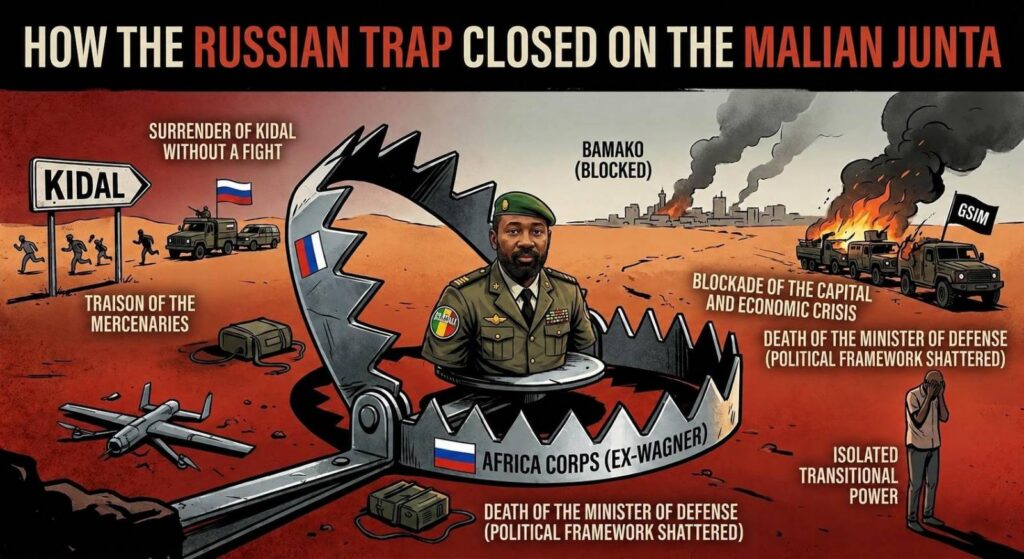
How Moscow’s mercenary gamble backfired in Bamako
The rapid unraveling of Mali’s political strategy is measured not just in lost towns, but in the speed at which its foreign patrons abandon the cause. The junta in Bamako, once confident in its alliance with Moscow’s paramilitary forces, now confronts a cascade of military setbacks at the hands of both Tuareg rebels from the Front de Libération de l’Azawad (FLA) and jihadist factions under the Groupe de soutien à l’islam et aux musulmans (GSIM). These coordinated offensives have exposed the fragility of a government that outsourced its security to foreign fighters.
As diplomatic channels push for the withdrawal of Africa Corps—formerly known as Wagner—Assimi Goïta’s transitional regime finds itself increasingly isolated, its survival hanging by a thread amid economic strangulation and relentless insurgent pressure.
Kidal: the symbol of a negotiated surrender
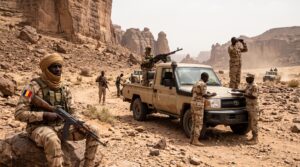
The turning point came in late April 2026, when the northern city of Kidal, once recaptured by Malian forces and Russian mercenaries in a high-profile operation, fell back into rebel hands—not through force, but through negotiation. The Africa Corps units did not make a stand; they negotiated their safe passage, discarding heavy weaponry in exchange for an exit strategy. Some even left behind caches of arms simply to secure their retreat.
« The Russians sold us out in Kidal, » admitted a Malian official to international media, capturing the sense of betrayal pervading Bamako’s corridors of power. The episode underscored a harsh geopolitical truth: mercenary forces operate on contracts, not loyalty. They do not die for foreign governments. By prioritizing their own survival over Mali’s territorial integrity, Russia demonstrated the shallow depth of its West African commitment.
Blowback hits the capital: the fall of Sadio Camara
The repercussions of this failed security model are no longer confined to the desert north. In April, a sweeping offensive reached Kati and Bamako itself, culminating in the death of General Sadio Camara, Mali’s Defense Minister and the principal architect of the junta’s pact with the Kremlin. With its chief strategist gone, the regime now faces a leadership vacuum at the worst possible moment.
Adding to the crisis is a suffocating blockade enforced by the GSIM, choking off fuel, food, and goods to the capital. The economy has ground to a halt: schools shuttered, hospitals overwhelmed, and electricity reduced to sporadic supply. The Russian shield, once touted as a game-changer, failed to prevent either the siege of Bamako or the infiltration of hostile forces deep into government territory.
The drone deception and rising civilian toll
To justify the expulsion of traditional peacekeepers such as MINUSMA and French counterterrorism units, the junta had promised a technological leap forward—drones, surveillance platforms, and precision strikes. While these assets were deployed aggressively, their use has inflamed local resentment, with repeated civilian casualties undermining any claim to legitimacy. Despite the show of force, the strategy has not stabilized the country; it has only deepened alienation and regional distrust.Observers now believe Africa Corps is shifting its remaining strength to a purely defensive posture around Bamako, abandoning any hope of regaining control or pacifying the wider territory. Moscow’s narrative of « thwarting a coup » rings hollow when the ground reality speaks of retreat and containment.
A regime on the brink of collapse
The Alliance des États du Sahel (AES), once hailed as a new bulwark of regional solidarity, has proven largely absent in the face of Mali’s crisis. Abandoned by its Russian partner seeking a face-saving exit, ostracized by regional blocs like ECOWAS, and loathed by a population crushed under blockades, the Bamako junta appears to have entered its terminal phase.
The gamble on imported Russian security has become the greatest strategic misstep in modern Malian history. By sidelining diplomacy, national dialogue, and regional alliances in favor of a private security contract, the military leadership has boxed itself into an inescapable dead end. In Bamako, the question is no longer whether the regime will fall, but how long it can stagger on before the security vacuum it created swallows it entirely.