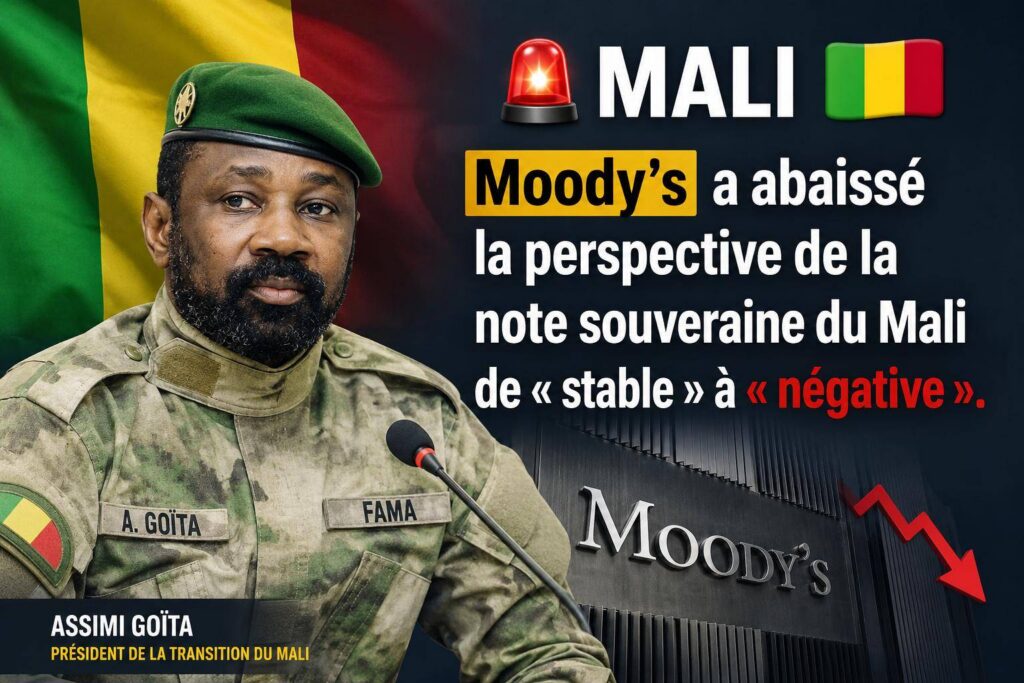
The international credit rating agency Moody’s has downgraded Mali’s sovereign credit outlook from stable to negative, while retaining its Caa2 rating. This move underscores growing investor unease over deepening security threats, tightening regional financing conditions, and persistent political instability—factors that now cast a long shadow over the country’s economic trajectory.
Ratings agencies sound the alarm on Mali’s economic health
For markets, a shift in sovereign credit outlook serves as a barometer of risk. By lowering Mali’s outlook to negative, Moody’s signals an elevated risk of a further downgrade in the near to medium term. Despite the Caa2 rating—already categorizing Mali as a high-risk, speculative borrower—the warning carries real consequences for investor confidence and access to capital.
The decision reflects a confluence of challenges that continue to strain Mali’s economic fundamentals. From the battlefield to the balance sheet, systemic pressures are converging to erode fiscal flexibility and investor trust.
A worsening security climate throttles growth
At the forefront of Moody’s concerns is the deteriorating security landscape. Despite ongoing military restructuring and counterinsurgency operations, armed violence persists across key regions. These disruptions cripple supply chains, depress agricultural output, and hinder tax collection—especially in remote areas—directly undermining the state’s revenue base and ability to fund public services.
Regional financing tightens as borrowing costs rise
Mali’s financial constraints have intensified as traditional external funding sources have dwindled. With access to global capital markets constrained, Bamako has increasingly relied on the regional bond market under the West African Economic and Monetary Union (WAEMU). However, this lifeline is rapidly weakening.
The Central Bank of West African States (BCEAO) has raised interest rates to curb inflation, pushing borrowing costs higher for all WAEMU member states—including Mali. Recent sovereign bond issuances have seen lukewarm investor demand, with commercial banks in the region growing more cautious about exposure to Malian debt. The result: steeper debt servicing costs that squeeze public budgets, leaving less room for critical infrastructure and social programs.
Political transition fuels investor skepticism
Moody’s warning also reflects deep unease over Mali’s political trajectory. The prolonged transition period, marked by repeated election delays and uncertainty over a return to constitutional order, has sapped confidence among multilateral partners and bilateral donors. While transitional authorities advocate for greater sovereignty through new alliances, global investors view these shifts with caution, fearing potential disruptions to trade flows, capital mobility, and regulatory predictability within the regional bloc.
What this means for everyday Malians
The ripple effects of Moody’s outlook revision extend far beyond Wall Street. Higher sovereign borrowing costs translate into reduced public spending on essential services—education, healthcare, and food subsidies—crucial to vulnerable households. For local businesses, especially small and medium enterprises that form the backbone of the economy, the credit crunch is palpable. Banks, increasingly exposed to government debt, are tightening lending to the private sector, stifling job creation and economic dynamism.
Can Mali recover investor trust?
Despite these headwinds, Mali’s economy retains pockets of resilience—particularly in gold mining and cotton production. Yet, in today’s interconnected financial ecosystem, resilience alone cannot shield the country from the realities of global capital markets. To reverse Moody’s negative outlook, authorities must chart a delicate course: restoring security, clarifying political timelines, and demonstrating disciplined fiscal management to rebuild regional and international investor confidence.
Without decisive action, the cost of capital will continue to rise, throttling growth and deepening socio-economic hardship for millions of Malians.