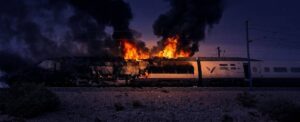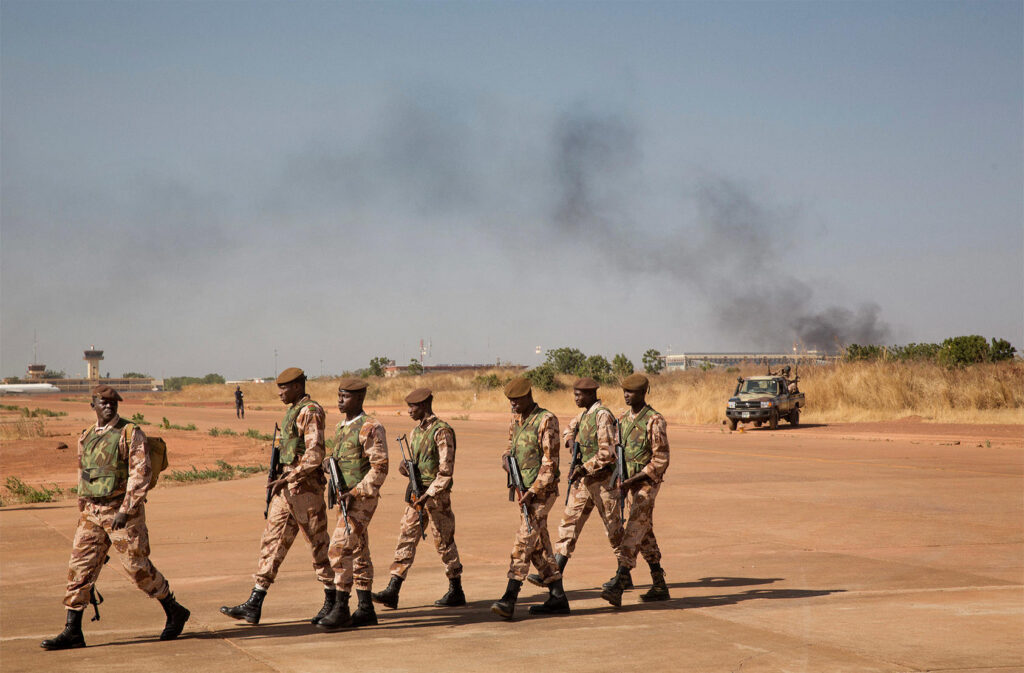
Mali has plunged back into a state of intense armed conflict following years of volatility, characterized by a jihadist insurgency and successive coups in 2020 and 2021. On Saturday, April 25, a massive military operation was launched by a coalition of Tuareg rebels from the Front de libération de l’Azawad (FLA) and jihadists from the Groupe de soutien à l’islam et aux musulmans (JNIM), an affiliate of Al-Qaïda. This coordinated strike targeted seven key locations across the country: the capital Bamako and its neighbor Kati; Konna, Mopti, and Sévaré in the central region; and the northern hubs of Gao and Kidal.
The city of Kidal, a strategic military stronghold in the north, has reportedly fallen entirely under the control of the insurgents. The attackers utilized a sophisticated array of tactics, including suicide vehicle-borne IEDs, kamikaze drones, indirect fire, and direct ground assaults. Reports indicate the offensive began early Saturday morning, with the JNIM and FLA (the successor to the Coordination des mouvements de l’Azawad) claiming responsibility for hitting the presidential residence, the Ministry of Defense, and Bamako‘s Modibo Keita International Airport.

The military response and government claims
The transitional government described the strikes as “complex and synchronized,” reporting at least 16 injuries among security forces and civilians while maintaining that the situation was under control. In response to the escalating violence, a 72-hour curfew was imposed on Bamako, and the international airport remained shut through Sunday. Oumar Diarra, the Chief of Staff of the Armed Forces, characterized the attacks as a broader “destabilization plan” orchestrated by both domestic and foreign entities to create a state of perpetual insecurity.
While the high command asserts that the Forces armées maliennes (FAMA) successfully repelled many attacks and neutralized over 200 militants, the situation in Kidal remains critical. General Diarra explained that the military is currently “redeploying” forces to Anefis but insisted that the army maintains a presence in the Kidal region, framing the move as a tactical adjustment to protect local populations more effectively.
Russian withdrawal and allegations of foreign interference
The Africa Corps, a Russian paramilitary unit under the Ministry of Defense that has replaced Wagner operations in the region, announced it has vacated Kidal alongside Malian troops. This withdrawal was presented as a joint decision with Bamako. In communications via X and Telegram, the Africa Corps claimed to have thwarted a coup attempt led by the FLA and Al-Qaïda‘s regional branch, allegedly supported by European and Ukrainian intelligence services.
According to the Russian forces, the offensive involved up to 12,000 combatants. They claim to have secured the presidential palace and other strategic infrastructure, neutralizing 1,000 insurgents in the process. However, reports of significant casualties within the Africa Corps have surfaced, with wounded personnel being evacuated. The Russian command also detailed intense fighting in Kidal, where they allegedly faced a force of 1,000 militants equipped with armored vehicles and FPV drones, purportedly guided by Ukrainian instructors.
The death of Defense Minister Sadio Camara
The conflict has claimed the life of a central figure in the Malian junta: Sadio Camara, the Minister of Defense. He was killed during a suicide attack on his home in Kati. The assault also resulted in the deaths of one of his wives, two children, and several civilians. Camara, widely seen as the second-in-command of the military government and a key architect of the strategic pivot toward Moscou, died from injuries sustained during a firefight with the attackers. His death is the most significant political and military loss for the transition since the 2020 coup. Additionally, Modibo Koné, head of national security, was wounded, while junta leader Assimi Goita was reportedly moved to a secure location.
A shifting alliance in the Azawad region
This weekend’s escalation highlights a formalizing alliance between Tuareg separatists and jihadist groups. The Front de libération de l’Azawad (FLA), formed in late 2024, has officially abandoned the 2015 Alger peace accords. While the Tuaregs seek autonomy for the Azawad region and the JNIM aims to establish an Islamic state, they have found common ground against the Bamako junta and its Russian partners.
This tactical cooperation intensified following the withdrawal of MINUSMA in late 2023. The alliance previously demonstrated its lethality in July 2024 during the Battle of Tinzaouaten, where Russian mercenaries suffered a major defeat. Ukrainian military intelligence (GUR) has been linked to these rebel successes, with spokesperson Andriy Yusov previously acknowledging the provision of information to the insurgents. Mali has since severed diplomatic ties with Ukraine, accusing Kiev of opening a “second front” to drain Russian resources in Afrique, though Ukraine denies direct support for groups classified as terrorists.