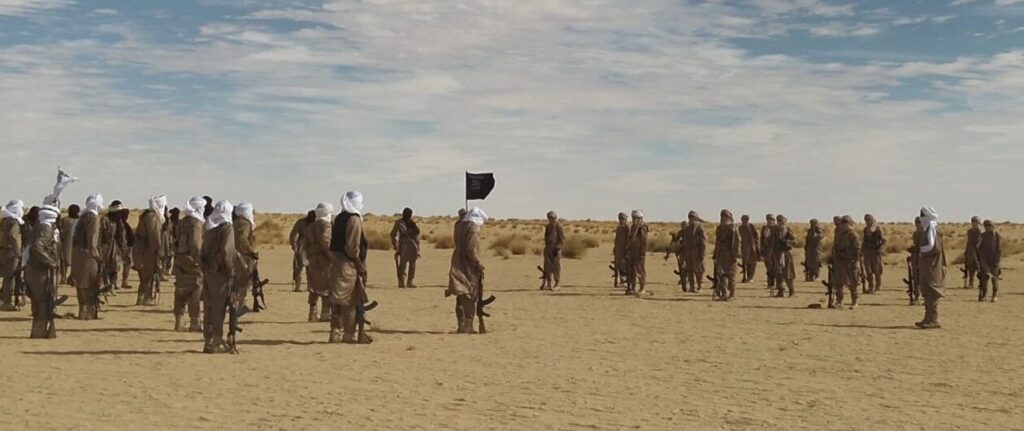
The northern and central regions of Mali are no longer mere battlegrounds for sporadic armed clashes. For years, they have endured a relentless state of war and systemic exhaustion. Recent offensives by the Group for Support of Islam and Muslims (JNIM) and the Azawad Liberation Front (FLA) against military outposts, supply convoys, and critical road infrastructure signal a pivotal strategic shift in their operations.
These armed factions are no longer fixated on seizing towns or staging high-profile attacks. Their new objective is far more ambitious: to progressively render vast territories ungovernable by Mali‘s military junta, pushing it into the confines of Bamako.
This transformation is significant because it redefines the very nature of the conflict. The battle is no longer merely about territorial control—it has become a struggle over movement. Who can still traverse the land? Who can transport goods, fuel, civil servants, or essential public services? These questions now dictate the course of the war.
Sabotaging circulation: the new weapon
Over the past months, attacks on highways and military supply lines have intensified. In several regions, administrative travel has become nearly impossible without armed escorts. This erosion of mobility not only weakens Mali‘s military but also undermines the state’s ability to assert its presence beyond major urban centers.
The JNIM has grasped a crucial truth: in a country already strained by institutional collapse, economic stagnation, and persistent insecurity, attrition can yield more political dividends than direct confrontation. Their strategy is economical—targeting supply chains, stretching security forces thin, and fostering a pervasive climate of fear. The result? A collective exhaustion that cuts across military, economic, and social spheres.
In rural areas, the crisis has evolved. The problem is no longer just the presence of armed groups—it is the gradual disappearance of any semblance of stable governance.
When military might falls short
The Malian military leadership has staked its legitimacy on restoring security, particularly since the series of coups. The withdrawal of French forces and the growing role of Russian military advisers were framed as a reclaiming of sovereignty. Yet sovereignty cannot be measured solely by the capacity to wage war. It must also encompass the ability to maintain territorial integrity, economic continuity, and administrative stability.
The paradox is striking: intensified military operations do not necessarily translate into lasting stability. In some regions, they coexist with a deepening fragmentation of rural spaces.
Current security policies rely heavily on offensive strikes, aerial bombardments, and large-scale deployments. However, they have yet to rebuild durable administrative structures—schools, healthcare, local justice, infrastructure, or economic circulation. This void fuels its own dynamics. As public services dwindle, communities increasingly depend on parallel systems for protection, dispute resolution, and survival.
The Sahel: a theatre of shifting armed alliances
The Malian crisis is no longer confined to its borders. The entire Sahel region is experiencing rapid realignment among armed actors, local alliances, and shadow economies.
The porous borders between Mali, Burkina Faso, and Niger enable militant groups to move freely. Yet state responses remain stubbornly national, despite insurgent movements operating across the region. The recent JNIM and FLA offensive exposed the fragility of regional alliances. Mali‘s military junta, isolated and reliant solely on the Africa Corps’ mercenaries, found itself without meaningful regional support.
This asymmetry favors groups that can adapt quickly. The JNIM thrives on its territorial flexibility, local anchoring in certain zones, and integration into informal economic networks. It does not seek to permanently control every territory it traverses—but it succeeds in imposing crippling security costs on the state.
The conflict in the Sahel has become a war of endurance. Armed groups are less interested in full territorial control than in making governance impossible for the state.
What Mali’s crisis reveals
The Malian case underscores the limitations of a purely counterterrorism lens on the Sahel. Reducing the crisis to a military confrontation obscures its social, economic, and territorial dimensions.
Across rural Mali, grievances tied to state neglect, land disputes, communal rivalries, and structural poverty have created enduring vulnerabilities. Armed jihadist groups do not always create these fractures—but they exploit them with precision.
The central challenge is political: how can the state rebuild legitimacy in areas where it appears only intermittently—primarily in the form of military patrols? The future of Mali will hinge on this question—not on a single decisive battle, but on the capacity to restore stable public presence beyond security operations.
A war of attrition does more than destroy military positions. It erodes roads, economies, administrations, social bonds, and ultimately, the very idea of a governed territory.