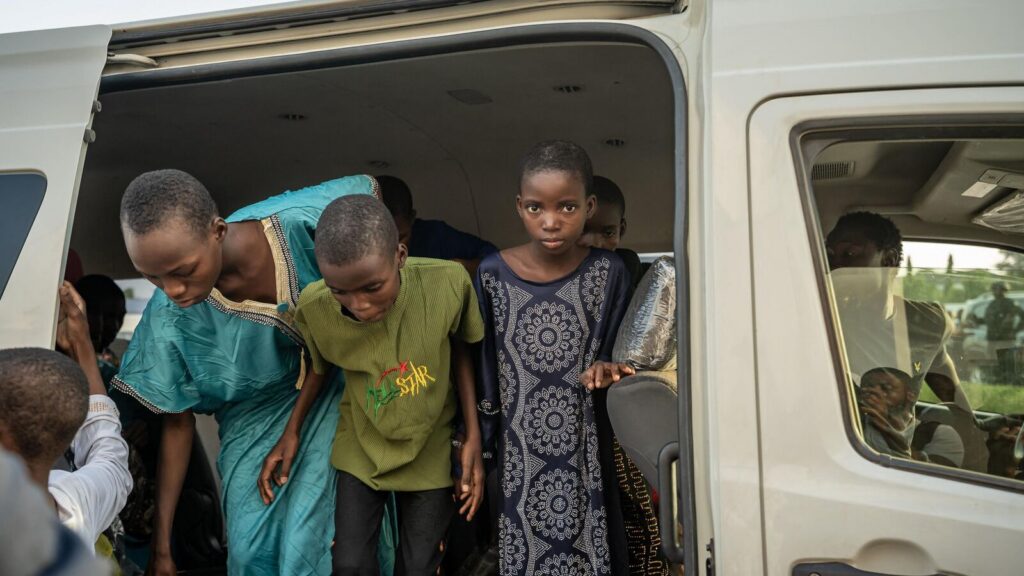
(FILES) Schoolchildren leave a minibus as they arrive at the local Governor's office in Minna on December 8, 2025. Around a hundred schoolchildren who were abducted last month by armed men from a Catholic school have arrived at the government headquarters in Minna, the capital of Niger State in central-northern Nigeria, as observed by AFP journalists on Monday. However, the fate of the 165 others abducted with them remains unknown. The students, mostly aged between 10 and 17, arrived in five white buses escorted by about ten military and armored vehicles and were received by Niger State Governor Mohammed Umaru Bago. (Photo by Light Oriye Tamunotonye / AFP)
Hundreds of Boko Haram captives freed in northeast Nigeria
The Nigerian army has announced the liberation of 360 individuals held by Boko Haram in northeastern Nigeria. Tragically, two infants perished from exhaustion during their captivity.
Hundreds of individuals, previously abducted by the jihadist group Boko Haram earlier this year in Borno State, northeastern Nigeria, have been successfully liberated. This significant development was confirmed by both military officials and local sources.
Since 2009, a relentless jihadist insurgency, spearheaded by Boko Haram and subsequently by its rival, the Islamic State West Africa Province (ISWAP), has claimed tens of thousands of lives and displaced millions across the densely populated nation’s northeast region.
Mass abductions, often culminating in ransom payments for release, remain a prevalent tactic employed by these Islamist groups. Samaila Kaigama, who chairs the Borno South Youth Alliance (BOSYA), a local youth organization, reported securing the release of 416 women and children originally seized from Ngoshe.
Tragic loss: two infants deceased
Kaigama informed journalists that “They were liberated on Saturday.” Senator Mohammed Ali Ndume, representing Borno State, also corroborated the release.
However, in a separate statement issued later that day, the military indicated that 360 individuals were freed, clarifying that their release was not orchestrated by Boko Haram but rather achieved through a specialized armed forces “operation,” meticulously planned and executed based on actionable intelligence.
The army detailed its strategy, which involved gathering critical intelligence and conducting “psychological operations” designed to sow “distrust among the insurgents” before initiating the “assault phase.”
According to the military’s communiqué, the captives endured “arduous conditions after being abducted from various communities, particularly along the Ngoshe axis.”
Daniel Bwala, spokesperson for President Bola Tinubu, also confirmed the release of 360 individuals and tragically noted on social media that “Unfortunately, two infants succumbed to exhaustion due to prolonged captivity and the harsh conditions.”
Ransom payments: a persistent issue
The village of Ngoshe, situated less than 10 kilometers from the Cameroonian border within the Gwoza hills, serves as a known stronghold for Boko Haram and has been subjected to relentless assaults by Islamist militants.
The head of the youth organization stated that he was unaware of the precise circumstances surrounding the liberation. BOSYA, which had previously established communication channels between the abductors and affected families, did not disclose further specifics.
While authorities consistently deny paying ransoms, analysts assert that such payments are a common practice, made by both governmental bodies and the families of victims.
A substantial sum of approximately $1.66 million was reportedly paid in ransoms between July 2024 and June 2025 to various armed factions across Nigeria, encompassing jihadists, “bandits,” and separatist groups. This figure comes from a report by SBM Intelligence, a Lagos-based consulting firm.