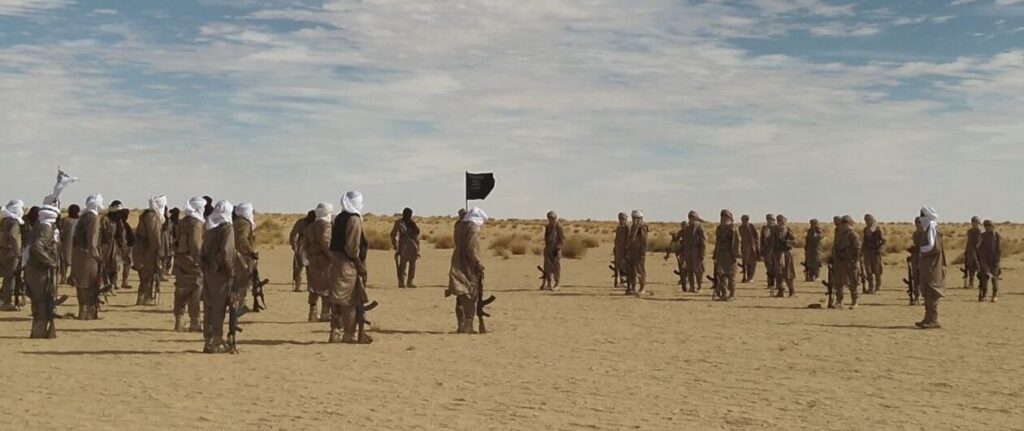
The northern and central regions of Mali are no longer merely exposed to sporadic armed assaults. For years, they have been trapped in a relentless cycle of violence and civilian exhaustion. Recent offensives by the Group for the Support of Islam and Muslims (JNIM) and the Azawad Liberation Front (FLA)—targeting military outposts, supply convoys, and critical roadways—signal a fundamental shift in insurgent strategy. No longer focused solely on territorial conquest or high-profile strikes, these armed factions are waging a war of attrition designed to erode state control from within.
From conquest to containment: a new phase in Mali’s insurgency
What began as a struggle for dominance over cities and military bases has evolved into a deeper contest over mobility and governance. The battlefield is no longer defined by who holds a hilltop or a checkpoint. Instead, it is measured by who can still move people, goods, fuel, or administrative personnel across the country’s fractured landscape. As convoys require armed escorts and officials hesitate to travel without military protection, the state’s presence in rural areas is increasingly reduced to sporadic, fleeting appearances.
The JNIM’s evolving tactics reflect a sober understanding of Mali’s institutional fragility. Rather than risk costly frontal assaults, the group has embraced a strategy of sustained disruption—one that drains military resources, inflates security budgets, and fosters a climate of perpetual uncertainty. The goal is not to seize territory outright, but to render large parts of the country ungovernable through exhaustion. Civilians in remote areas are not just caught in the crossfire; they are experiencing the slow disappearance of public services, a collapse in economic circulation, and the erosion of any sense of stable administration.
The limits of a purely military response
The Malian junta has staked its legitimacy on restoring security, particularly since the successive coups that reshaped the country’s political landscape. The withdrawal of French forces and the growing partnership with Russian military contractors were framed as steps toward reclaiming sovereignty. Yet sovereignty extends beyond the capacity to launch offensives—it demands the ability to maintain territorial integrity, economic continuity, and administrative presence.
Despite intensified military operations—offensive strikes, aerial bombardments, and rapid deployments—the state’s footprint remains uneven. While some areas experience temporary calm, others slip into deeper fragmentation. Schools close, health clinics vanish, local justice systems collapse, and roads fall into disrepair. The result is a paradox: the more the military asserts control, the more it fails to rebuild the very structures that define a functioning state.
As public services recede, communities turn to parallel systems for protection, dispute resolution, and survival. This vacuum is fertile ground for armed groups. They do not always create the conditions of instability, but they exploit them with growing efficiency, embedding themselves into local power structures and informal economic networks.
A regional insurgency outpacing national responses
The Malian crisis is no longer confined to Mali. Across the Sahel, armed factions are rapidly reorganizing, forging new alliances, and exploiting porous borders. The porous frontiers between Mali, Burkina Faso, and Niger enable militant groups to move freely, while state responses remain stubbornly national. Despite forming a shared political-military alliance, these countries have shown limited capacity—or willingness—to support one another in times of crisis. The recent JNIM-FLA offensive underscored the vulnerability of Bamako’s junta, which now relies almost exclusively on the Africa Corps’ mercenary forces for external backing.
This asymmetry favors groups that prioritize agility over territorial control. The JNIM’s strength lies not in holding ground, but in its ability to inflict sustained damage—disrupting supply lines, ambushing convoys, and forcing costly countermeasures. It does not seek to govern entire regions, but to make governance impossible. In doing so, it turns the Sahel into a theater of political endurance, where the objective is not victory in battle, but the prolonged paralysis of the state.
Beyond counterterrorism: the roots of Mali’s instability
A strictly military reading of the crisis obscures deeper realities. The conflict is not merely a struggle against terrorism; it is a crisis of governance, rooted in decades of state abandonment, land disputes, communal rivalries, and structural poverty. In many rural areas, frustration with absent authorities, weak institutions, and economic marginalization has created fertile conditions for armed mobilizations.
Armed groups—including the JNIM—do not always generate these grievances, but they instrumentalize them with alarming skill. The longer the state fails to deliver basic services or enforce the rule of law, the more these groups embed themselves as alternative authorities. The challenge facing Bamako is not simply to defeat an enemy on the battlefield, but to restore a credible, continuous presence in regions that have known only intermittent governance, often in the form of military patrols.
The future of Mali may not be decided by a single decisive battle, but by the ability—or inability—to rebuild public trust and stability beyond the confines of military operations. A war of attrition does not only destroy military positions. It erodes roads, stifles economies, paralyzes administrations, severs social bonds, and, ultimately, undermines the very idea of a governed territory.
Mourad Ighil