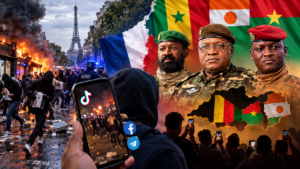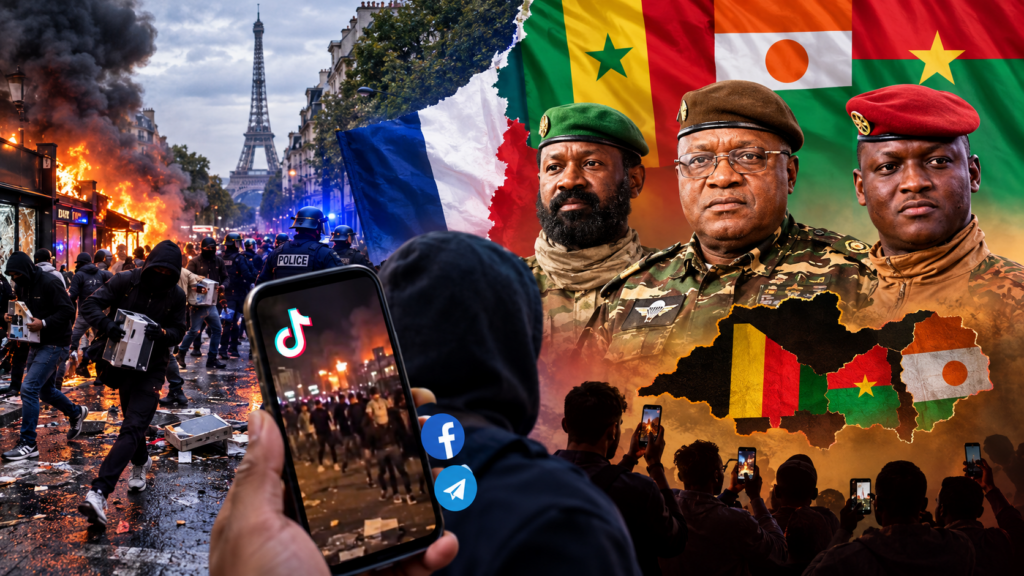
The recent wave of urban violence in France is not merely a domestic crisis it has far-reaching implications for international relations, particularly in the Sahel region. As clashes, looting, and civil unrest dominate headlines, the situation has become a focal point for political narratives in Mali, Burkina Faso, and Niger, where anti-French sentiment has surged following military takeovers. Social media platforms, including TikTok, Facebook, and Telegram, have amplified these scenes, portraying them as evidence of France’s systemic failures rather than isolated incidents of civil disorder.
Social media as a weapon: how Sahel juntas weaponize french unrest
The rapid circulation of images depicting violence in France has provided fertile ground for propaganda campaigns orchestrated by Sahel military regimes. For supporters of the Alliance of Sahel States (AES), these visuals serve as ammunition to undermine France’s credibility on issues of democracy, security, and the rule of law. The argument is a familiar one: if France cannot maintain stability within its own borders, how can it legitimately critique Sahel governments that have overthrown elected leaders? This narrative seeks to portray the former colonial power as hypocritical, thereby strengthening anti-French sentiment among local populations.
However, the debate extends beyond mere propaganda. It raises critical questions about the individual accountability of those involved in the unrest including foreign nationals from AES member states. Reports suggest that some individuals, including those in France irregularly, have participated in looting and destruction. If investigations confirm their involvement, they must face the same legal consequences as any other individual accused of committing crimes on French soil.
Legal accountability: separating propaganda from justice
The spread of misinformation on social media has complicated efforts to address the root causes of the violence. While some accounts selectively amplify footage to fit a predetermined narrative, judicial authorities are tasked with establishing the facts. Prosecutors must determine the precise roles of individuals implicated in the unrest, gather evidence, and ensure that justice is served impartially.
For non-citizens, including those in an irregular administrative situation, the legal process remains unchanged. Participation in criminal activities whether looting, vandalism, or assault carries consequences under French law. Authorities may also review their immigration status, but this must follow due legal procedures and respect individual rights. No foreigner, regardless of origin or legal status, is exempt from compliance with French laws during their stay.
Fact-based scrutiny: debunking exaggerated claims
One of the most dangerous aspects of this crisis is the distortion of reality. In certain digital spaces supportive of the AES, isolated incidents of violence are framed as proof of France’s irreversible collapse. Yet, a single video of looting or confrontation does not equate to systemic failure. Similarly, it does not validate the security or governance claims of Sahel juntas, which themselves face persistent challenges in maintaining stability and public trust.
To distinguish between coordinated disinformation and legitimate reporting, several factors must be considered:
Contextual accuracy: Are images presented in their proper context, or have they been edited or recontextualized to mislead?
Temporal verification: Are clips being labeled as recent when they originate from past events?
Source reliability: Are accounts amplifying the content linked to known disinformation networks?
Legal vs. political narratives: Are facts being conflated with opinion to serve a specific agenda?
Breaking the cycle of collective blame and political manipulation
The instrumentalization of France’s unrest by Sahel juntas underscores a troubling double standard. These regimes, which position themselves as defenders of sovereignty, often reject international criticism of their own human rights records. Yet, when foreign nationals particularly those from the Sahel are implicated in crimes in France, the response is not always based on impartial justice. Instead, propagandists frequently resort to blanket accusations against entire migrant communities, fostering xenophobia under the guise of political critique.
This approach is not only morally indefensible but also legally flawed. The vast majority of Malian, Burkinabè, and Nigerien residents in France abide by the law and contribute positively to society. Their collective reputation should not be tarnished by the actions of a few. Legal responsibility must remain individual and evidence-based. If investigations reveal wrongdoing, those responsible not their entire diaspora must be held accountable.
France’s judicial process: the ultimate arbiter
As diplomatic tensions between France and Sahel regimes continue to escalate, the role of French institutions becomes ever more crucial. The justice system is tasked not only with addressing the immediate aftermath of the unrest but also with upholding the principle that no one is above the law. This includes foreign nationals, whose cases must be evaluated based on the same standards as those of French citizens.
Critics of France’s approach must recognize that the country’s judicial independence remains a cornerstone of its democratic integrity. While Sahel juntas may exploit France’s challenges for political gain, the outcomes of judicial proceedings will serve as the definitive measure of how the nation addresses its internal crises. The justice system’s response transparent, impartial, and evidence-driven will determine whether France’s institutions can withstand both external propaganda and domestic turbulence.
The events unfolding in France are complex, and their implications extend far beyond national borders. However, the path forward must be guided by facts, not fiction. The pursuit of justice should never be overshadowed by political agendas whether foreign or domestic.
By Rose Njoya — Journalist