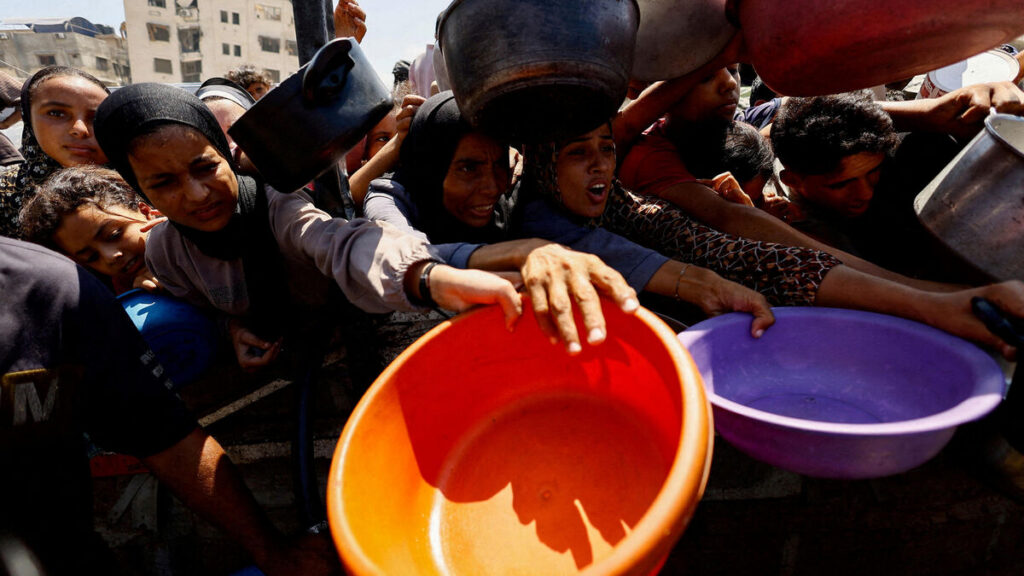
FILE PHOTO: Palestinians wait to receive food from a charity kitchen after the global hunger monitor, Integrated Food Security Phase Classification (IPC), said that Gaza City and surrounding areas are officially suffering from famine that will likely spread, in Gaza City, August 28, 2025. REUTERS/Mahmoud Issa/File Photo
The United Nations has raised an urgent alarm about the escalating food insecurity gripping 16 critical regions worldwide. This dire situation threatens to push millions more people into famine or the brink of starvation, according to a joint report from the Food and Agriculture Organization (FAO) and the World Food Programme (WFP).
Countries facing imminent famine risks
The report highlights severe food crises in several nations, where populations are teetering on the edge of catastrophic hunger. Among the hardest-hit countries are:
- Afghanistan, Palestine, and Haiti – where famine conditions are either already declared or imminent;
- Mali, Sudan, South Sudan, and Yemen – where conflict and economic collapse have devastated food systems;
- Somalia, the Democratic Republic of the Congo, Myanmar, and Syria – facing extreme food insecurity due to prolonged instability;
- Burkina Faso, Chad, Kenya, and Bangladesh (hosting Rohingya refugees) – where climate shocks and displacement exacerbate hunger.
Root causes and compounding factors
The UN agencies emphasize that multiple crises are converging to worsen food insecurity:
- Armed conflicts disrupting agriculture and supply chains;
- Economic shocks driving up food prices beyond reach;
- Extreme weather events – such as droughts and floods – destroying crops and livestock;
- Chronic underfunding of humanitarian aid, leaving critical programs under-resourced.
Humanitarian aid at a breaking point
Financial shortfalls have crippled life-saving operations. Of the $29 billion needed to support vulnerable populations, only $10.5 billion has been secured. This funding gap has forced the WFP to slash food rations for refugees and suspend school feeding programs in several countries. Meanwhile, the FAO warns that agricultural support—such as seed distribution and veterinary services—is critically underfunded, threatening long-term recovery.
“We are on the brink of a preventable food catastrophe that could plunge entire nations into widespread famine,” warned Cindy McCain, WFP Executive Director. “Failure to act now will only deepen instability and suffering.”
Urgent calls for action
The FAO’s Director-General, Qu Dongyu, stressed that addressing hunger is not just a moral obligation but a strategic investment in global peace and stability. He urged immediate financial commitments to:
- Expand emergency food assistance;
- Reinforce agricultural resilience;
- Protect livelihoods in conflict zones;
- Address the root causes of food insecurity.
Without swift intervention, the UN warns that the humanitarian crisis will spiral further, with irreversible consequences for millions of families already struggling to survive.