As Gabon strives to establish a modern Fifth Republic, its media industry is currently enduring one of the most severe crises in its history. With the decline of print journalism, the fragility of digital platforms, a shrinking advertising market, and the increasing difficulty of accessing public information, the situation is dire. Beyond the financial survival of these companies, the very integrity of our democracy is now at stake.
There are certain silences that should cause more alarm than any public controversy. The current quiet surrounding the financial collapse of the Gabonese media is one of them. While national attention is fixed on major infrastructure projects and political milestones, a sector vital to democratic life is deteriorating in an atmosphere of general indifference.
A democracy without a viable media landscape is a democracy that eventually talks only to itself. When a government reaches a point where it only hears its own echoes, the danger of becoming completely disconnected from reality is immense.
The decline of print as a mirror of national health
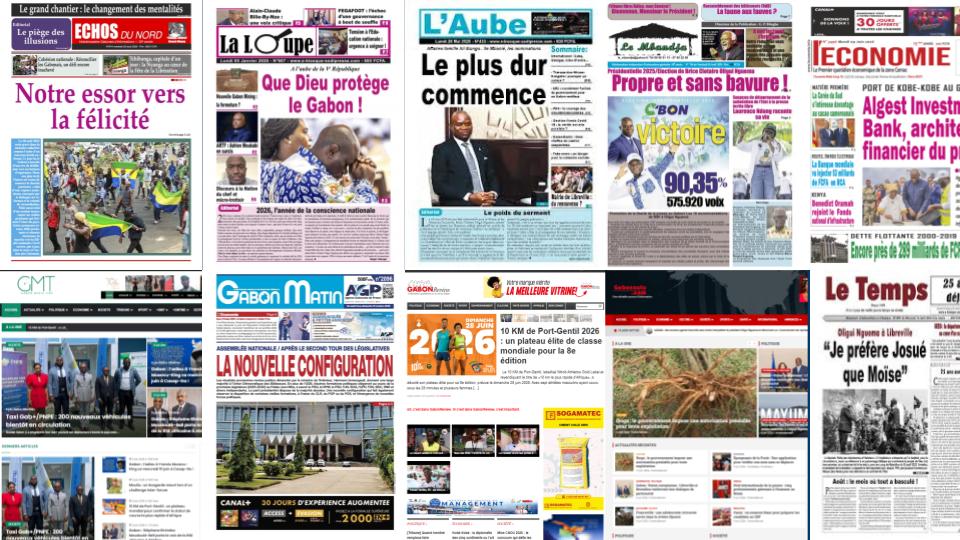
The state of the print press perfectly captures this steady decay. There was a time when newsstands were the heart of public debate. Newspapers were read, debated, and eagerly anticipated. Titles such as La Loupe, L’Aube, and Échos du Nord survived through much more difficult periods. In those days, their critical reporting often led officials to label them as hostile or systematically oppositional. Nevertheless, they continued to publish, people continued to buy them, and they continued to fuel the national conversation.
Today, in a striking paradox, these same issues have become rare items, sought after by nostalgic readers who remember when the written press held a real place in the public square. This shift is not merely economic; it is deeply political. When a newspaper disappears, it is not just a business closing its doors—it is a voice being silenced forever.
A symbol of the industry’s retreat
The trajectory of Gabon Matin deserves its own national reflection. For decades, the government daily was a pillar of the media landscape. After years as a daily, it shifted to a biweekly format before attempting a weekly version during the transition. Today, the paper is no longer available at newsstands, having moved to a strictly digital distribution.
While official narratives suggest this is an adaptation to new technology, it is hard to believe this was a purely editorial choice. The reality is far simpler: the economic crisis hitting the sector spares no one, not even the media outlets historically backed by the State.
The mystery of sector restructuring
A critical question remains unanswered. For several years, there has been talk of support mechanisms intended to help restructure the industry. Large sums were mentioned, announcements were made, and expectations were raised. However, on the ground, publishers are still fighting a daily battle for survival.
Many are now questioning the actual results of these initiatives. The true measure of any public policy is found in its impact, not in speeches. Currently, the observed effects are nothing short of worrying.
Digital media on life support
The situation for online media is equally precarious. While Gabon has seen a proliferation of websites and platforms, how many actually have a structured newsroom? How many have a physical office or transparently list their publication directors and journalists? Very few.
In this climate, a handful of outlets try to maintain high professional standards despite limited resources. Yet, even they face an impossible economic equation. Private advertising is vanishing, digital revenue remains negligible, and operating costs are rising. Furthermore, access to major institutional advertising campaigns is often restricted to a very small circle of players.
Democracy cannot thrive with a weakened press
This issue has moved beyond economics; it is now a matter of democratic functionality. How can we speak of pluralism when media outlets are struggling to stay afloat? How can we ensure a diversity of opinions when news organizations are vanishing one by one? It is impossible to demand high-quality journalism when newsrooms are living in permanent precarity.
An economically fragile press naturally becomes more susceptible to outside influences, pressures, and compromises. A healthy democracy needs the exact opposite: independent, robust, and credible media that can operate without fearing for their survival every month.
A collective failure in the making
The paradox is harsh. The body responsible for regulating the media may soon find itself overseeing a landscape that has been emptied of its substance. What is the point of regulation when the actors have disappeared? What use is a legal framework when the companies meant to follow it can no longer afford to exist? Pluralism on paper means nothing if independent voices are being extinguished. This is about Gabon’s ability to maintain a vibrant, diverse, and democratic public space.
Protecting the media to save public debate
It is time to face the facts. The media crisis is not just a problem for journalists or publishers; it is a problem for society as a whole. A country that allows its media to die eventually impoverishes its own public discourse, which in turn weakens the foundation of democracy.
Gabon now faces a choice: continue to watch the slow decline of the sector, or finally launch a deep reform of the media economy based on transparency, equity, and viability. Ultimately, a democracy does not only die when newspapers are forcibly closed; it begins to wither when they are simply left to perish.