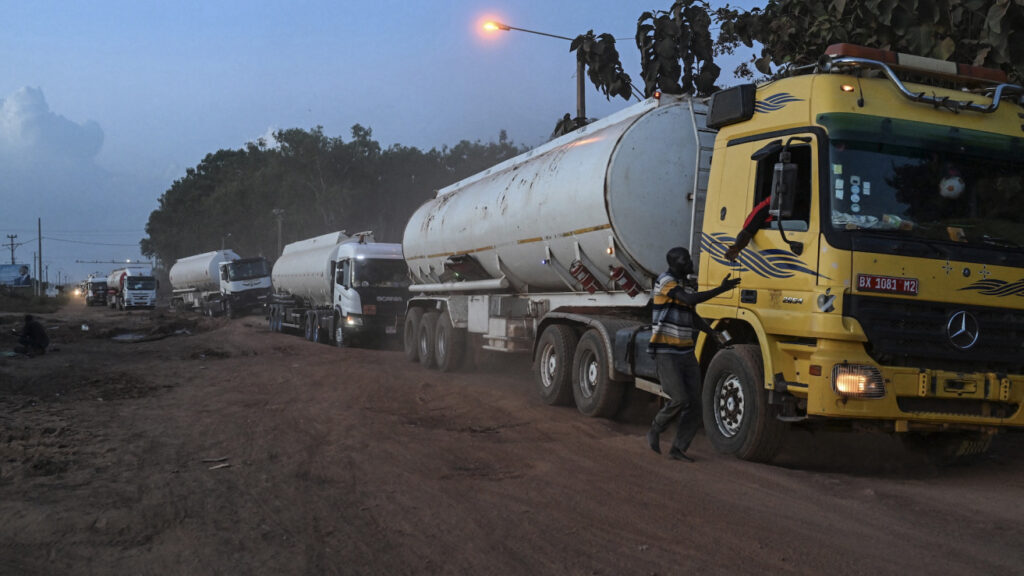
Malian tankers trucks drives at the entrance of Boundiali, northern Ivory Coast, on October 30, 2025 on the way to Yamoussoukro and Abidjan to load oil. In northern Ivory Coast, truck drivers prepare to head back to neighbouring Mali, aboard their tanker trucks loaded with fuel and anxiety. One acronym strikes fear into the hearts of all the truck drivers: JNIM, the name of the jihadist group affiliated with Al-Qaeda that decreed two months ago that no more tanker trucks would be allowed to enter Mali from a neighboring country. Since then, hundreds of trucks have been set ablaze, selling fuel from Abidjan or Dakar, and are part of JNIM’s economic jihad strategy, which aims, among other things, to strangle Bamako and the ruling military junta. In 2023, more than half of the petroleum products exported by Côte d’Ivoire were destined for Mali. Malian trucks load up in Yamoussoukro or Abidjan before crossing one of two corridors into the country: the Tengréla corridor or the Pogo corridor, where military escorts take over on the Malian side, all the way to Bamako. An escort can consist of several hundred tankers. But even under escort, convoys are frequently targeted. The most dangerous areas in southern Mali are the Kadiana-Kolondiéba and Loulouni-Sikasso axes. (Photo by Issouf SANOGO / AFP)
JNIM’s blockade paralyzes Mali’s commercial lifelines
On April 25, Mali faced a coordinated wave of assaults orchestrated by the Jama’at Nusrat al-Islam wal Muslimin (JNIM) and the Front de Libération de l’Azawad (FLA). The coordinated strikes targeted strategic hubs including Kati, Mopti, Sévaré, Gao, and the capital Bamako, leaving a trail of destruction and claiming the life of Defense Minister Sadio Camara.
In response, Malian authorities launched a sweeping counteroffensive against militant positions. Military prosecutors in Bamako subsequently announced the detention of multiple suspects spanning civilians, active-duty soldiers, and former military personnel.
Within five days of the initial attacks, JNIM imposed a comprehensive blockade on Bamako, particularly targeting western transit corridors. The complete closure of the Kita-Bamako route trapped hundreds of civilians and severed critical supply lines for food and water.
The siege has sent shockwaves through regional commerce. The Kayes-Bamako corridor, once a vital trade artery, now lies inoperative. Compounding the crisis, militants have expanded their attacks to the Conakry-Bamako route, previously considered relatively secure.
Regional economic fallout intensifies
Since September 2025, JNIM has systematically targeted fuel convoys across western and southern Mali. These deliberate strikes are eroding commercial stability and threaten to destabilize the broader West African economic framework.
West African nations share deeply interconnected trade networks. Coastal ports serve as lifelines for landlocked Sahelian states, with road corridors acting as umbilical links between these regions. Most of these routes pass through areas under JNIM’s operational influence.
The Dakar-Bamako corridor, a linchpin for both nations, has borne the brunt of the insecurity gripping western Mali. In 2024, Mali accounted for 26.5% of Senegal’s total exports—equivalent to 802.8 billion FCFA (1.42 billion USD). By the first nine months of 2025, export figures to Mali had reached 662 billion FCFA (1.17 billion USD).
However, JNIM’s recent campaign has dramatically altered this trade dynamic. Between September and November 2025, Dakar’s port recorded daily blockages of approximately 120 containers destined for Mali, resulting in monthly losses of 15 billion FCFA (26.54 million USD) for Senegal. By late November 2025, over 2,000 containers remained stranded in Dakar. By February 2026, 4,000 empty containers were immobilized in Bamako as drivers refused to risk the return journey along the perilous Dakar route.
This paralysis is severely disrupting Mali’s access to petroleum products, refined goods, hydraulic cement, and essential food supplies. Thousands of drivers, traders, and logistics operators face mounting economic hardship. Other critical corridors—linking ports in Côte d’Ivoire, Ghana, Togo, and Bénin to the Sahel—now face similar vulnerability.
In 2025, Mali retained its position as Côte d’Ivoire’s top customer within the West African Economic and Monetary Union (UEMOA). The Abidjan-Bamako route plays a pivotal role in supplying Mali with petroleum and food products. By late 2025, approximately 1.47 million tons of goods had traversed this corridor, now increasingly targeted by JNIM in the Sikasso region.
Côte d’Ivoire also serves as Burkina Faso’s leading African supplier, particularly for petroleum, electricity, and fertilizers. Burkina Faso’s imports either originate in or transit through Côte d’Ivoire, Ghana, and Senegal. The February 14 attack that killed seven Ghanaian tomato traders in Titao, northern Burkina Faso, underscores the expanding security threats along this vital route.
Government responds with targeted measures
Facing these challenges, Malian authorities have implemented several countermeasures. Since November 2025, military escorts have been assigned to fuel convoys, enabling the weekly entry of 200 to 300 tanker trucks—down from nearly 1,200 before the attacks began. A customs facilitation agreement with local petroleum groups aims to streamline trade procedures, while fuel rationing has been introduced to curb black-market activity.
Efforts are also underway to alleviate pressure on Dakar and Abidjan ports by diverting some commercial flows to alternative infrastructures.
Collaboration imperative to safeguard regional stability
The April 25 assaults expose the limitations of Mali’s military-centric counterterrorism approach. Despite deep-seated divisions, JNIM and the FLA demonstrated unprecedented operational coordination during these attacks, highlighting the urgent need for regional unity among Sahelian and coastal states.
The expanding blockade underscores a critical reality: without joint protection of transborder commercial corridors, the economic stability of West Africa remains severely compromised. Regional bodies including the Economic Community of West African States (ECOWAS), the Alliance of Sahel States (AES), the Entente Council, the Mano River Union, and UEMOA must act decisively to prevent this crisis from spreading to other vital routes.
While the road ahead remains challenging, combating terrorism could serve as a catalyst for revitalizing essential regional cooperation between West Africa’s Sahelian and coastal nations.