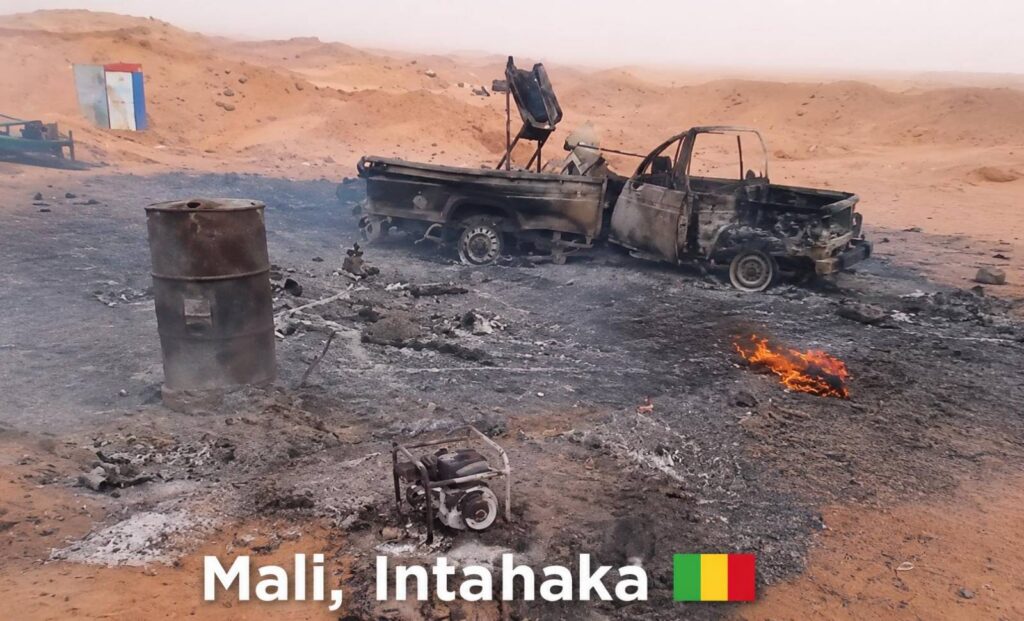
The early hours of Monday revealed a tragic miscalculation in Mali’s conflict-ridden north. A Malian armed forces drone, deployed under Bamako’s all-drone strategy, struck a vehicle belonging to the Imghad Tuareg Self-Defense Group and Allies (GATIA), a militia long aligned with the government. The attack in Intahaka, a gold-rich zone near Gao, left several dead and wounded—ironically, among forces that have fought alongside the Malian army against insurgents and terrorists.
Intahaka: a lethal failure of coordination
The strike was initially hailed as a successful counterterrorism operation, but the reality quickly unraveled. Local witnesses and military sources confirmed the grim error: a drone strike on a GATIA vehicle, blurring the lines between ally and adversary in a war where targets are increasingly indistinguishable. This incident underscores not just a technical failure but a systemic breakdown in command and control, leaving troops and allied militias exposed to both enemy fire and friendly fire.
Defense analysts point to a dangerous disconnect between Bamako’s reliance on unmanned aerial systems and the chaotic, fluid nature of the battlefield. Despite the junta’s claims of technological superiority, drones have repeatedly struck civilians and friendly forces, including in the recent San incident. Meanwhile, Russian-backed Africa Corps advisers watch on, their presence doing little to curb the escalating chaos.
The limits of drone warfare in Mali’s asymmetric conflict
Since seizing power, the military leadership under Colonel Assimi Goïta has promoted drones as the cornerstone of a security solution to reclaim lost territory. Yet the Intahaka strike shows how this approach has backfired. Instead of restoring stability, the drones have become instruments of instability—misidentifying targets and deepening mistrust among communities already trapped between warring factions.
The situation has worsened as the Permanent Strategic Framework has rebranded itself into the Azawad Liberation Front (FLA), joining forces with the Group for the Support of Islam and Muslims (JNIM). Together, these groups have launched coordinated offensives that have overwhelmed government forces in key towns. Their use of drone jamming and even kamikaze drones has neutralized the junta’s technological advantage, exposing the hollowness of Bamako’s military strategy.
Gold, guns and grief: the human cost of Intahaka
Intahaka is no ordinary village—it sits atop the largest artisanal gold mine in the Gao region. For years, this site has fueled both local livelihoods and illicit networks, attracting fighters from all sides. The latest drone strike has not only killed civilians and allies but has also crippled the economy of northern Mali. Gold panning, a lifeline for thousands of families, has ground to a halt under constant bombardment and road blockades by armed groups.
« *We don’t know where to go anymore. The roads are blocked by terrorists, food prices have tripled in Gao, and now even the sky—the sky controlled by Bamako—is raining death on us,* » said a resident of Gao, speaking on condition of anonymity. To local communities, the presence of the Malian army and its drones has become a source of terror, not protection.
From strategic blunder to national crisis
The Intahaka tragedy is more than an operational failure—it is a symptom of a deeper political and military impasse. By abandoning peace accords and embracing a purely military response, Bamako has alienated even its former allies, including GATIA. As the north and central regions slip further from state control, the junta’s slogan of national sovereignty restoration rings hollow.
If the military leadership continues to confuse war propaganda with strategic effectiveness, it won’t just misfire at its allies—it will erase the future of an entire nation. The people of Mali, caught between drones, terrorists and collapsing economies, are paying the price of a leadership that has lost its way.