In the Democratic Republic of Congo, President Félix Tshisekedi has returned the controversial referendum law to Parliament for a second review. This decision comes just hours before the expiration of an ultimatum issued by the C64 opposition coalition. Despite this move, the political standoff between the presidency and the opposition continues unabated.
The C64, a coalition of opposition groups and over sixty civil society organizations, had demanded that President Tshisekedi abandon his constitutional reform project and, consequently, reject the referendum law by August 15th. They also called for the initiation of an inclusive national dialogue. However, with the deadline fast approaching, no dates for such a dialogue have been announced.
Tshisekedi’s tactical withdrawal under pressure
Many observers initially believed that the law governing the organization of a referendum was already in effect, given the constitutional provision (Article 140) for promulgation within fifteen days. Yet, President Félix Tshisekedi opted to send the text back to Parliament.
The stated aim is a fresh deliberation, incorporating the observations and reservations previously made by the Constitutional Court.
Professor Bob Kabamba, an academic at the University of Liège in Belgium, interprets this presidential action as a tactical retreat. He suggests that while it may be a step back, it does not signify President Tshisekedi’s abandonment of efforts to secure his position beyond 2028, the scheduled end of his second term.
“We must not forget the significant pressure from the opposition, as well as from regional countries,” Professor Kabamba elaborated. “These pressures, combined with consultations that have taken place, have compelled Tshisekedi to backtrack, specifically by requesting a second reading of this contentious law. It’s a retreat, but one that won’t deter Tshisekedi from exploring other avenues to navigate past the 2028 deadline.”
C64 pledges new actions post-august 15
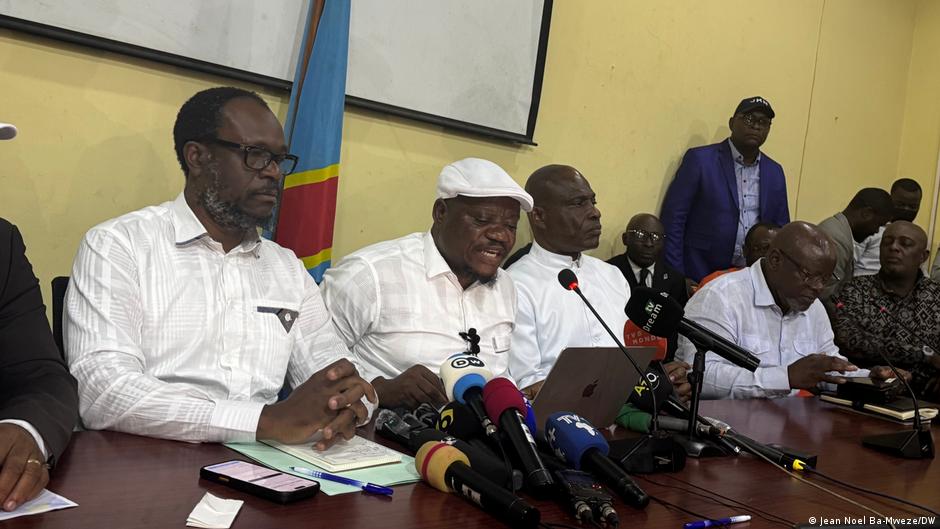
Meanwhile, the Article 64 coalition has acknowledged the return of the referendum law to Parliament. However, it remains resolute in its stance, maintaining pressure on the Congolese president. With the August 15th ultimatum nearing its end, the C64 is contemplating various operations, though their specific nature remains undisclosed.
“At midnight on August 15th, we will simply observe that nothing has been done,” declared Franklin Tshiamala, Secretary General of the Leadership for Governance and Development (LGD), a party led by former Prime Minister Augustin Matata Ponyo. “We will then announce significant ‘surgical operations’ to be deployed by our C64 laboratory, aiming to bring this regime to reason – a regime that has confiscated our freedom and is on the verge of confiscating our national sovereignty.”
The power struggle intensifies
Conversely, the ruling power continues to defend the referendum process as a legitimate political and institutional undertaking. The C64’s ultimatum is dismissed outright as an improper injunction that cannot dictate the Head of State’s agenda.
“Regarding the C64’s ultimatum, you must understand that it is their ultimatum. It was perhaps to please their benefactors. But the Republic continues to function normally,” asserted Adolphe Amisi Makutano, a senior figure within the Union for Democracy and Social Progress (UDPS), President Félix Tshisekedi’s party.
The power struggle thus remains unresolved. This Saturday, August 15th, could indeed mark the commencement of a significant new political chapter in the Democratic Republic of Congo.