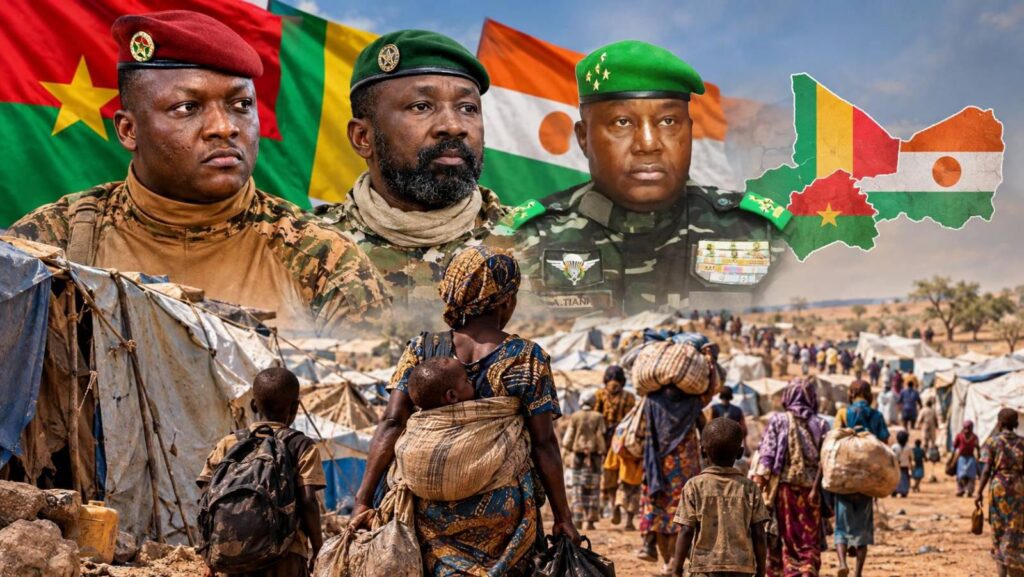
The humanitarian crisis in the Sahel region has reached alarming new heights, with nearly four million people forcibly displaced in Burkina Faso, Mali, and Niger. This staggering figure, representing a near doubling since 2020, exposes a critical failure in addressing the region’s security and governance challenges.
The Sahel Alliance States (AES) have operated under military leadership since 2020, following the first coup in Mali. While these regimes have prioritized territorial control and security rhetoric, the escalating displacement crisis raises a fundamental question: how can governance claim legitimacy when millions remain uprooted despite military rule?
From promises to reality: the widening gap in public safety
The surge in displaced populations now totaling nearly four million contrasts sharply with the stated objectives of AES governments. Military authorities have framed their interventions as essential for restoring order, yet the human toll continues to mount. For families fleeing violence, the absence of security is measured not in political statements but in lost livelihoods, shattered communities, and the erosion of basic human dignity.
Displacement is not merely a statistic; it represents a humanitarian emergency. Children are deprived of education, farmers abandon fertile lands, and entire villages face abandonment. The consequences extend beyond immediate suffering, destabilizing regional economies and straining already fragile social structures.
Accountability in governance: where security policies fall short
The AES governments have consistently emphasized sovereignty and military operations as solutions to the crisis. However, the persistence of mass displacement suggests a disconnect between policy declarations and ground-level outcomes. When security is framed as the primary justification for military rule, its failure to protect civilians demands scrutiny.
Governments must be held accountable not only for their stated goals but for tangible improvements in living conditions. The proliferation of displacement camps, strained resources, and the inability to restore stability undermine claims of progress. As long as civilians remain trapped in cycles of displacement, the legitimacy of military governance remains in question.
Rebuilding beyond rhetoric
To address this crisis, AES governments must move beyond symbolic gestures and focus on actionable solutions. Prioritizing the safe return of displaced populations whether through demining initiatives, economic recovery programs, or community-based security is essential. The international community, too, bears responsibility in supporting these efforts, ensuring that humanitarian aid reaches those most in need.
Ultimately, the Sahel’s future hinges on whether military rule can translate its security promises into tangible improvements for its people. Without this transformation, the humanitarian crisis will continue to deepen, and the credibility of AES governments will remain under siege.
By Georges Essomba — Journaliste / Rédacteur