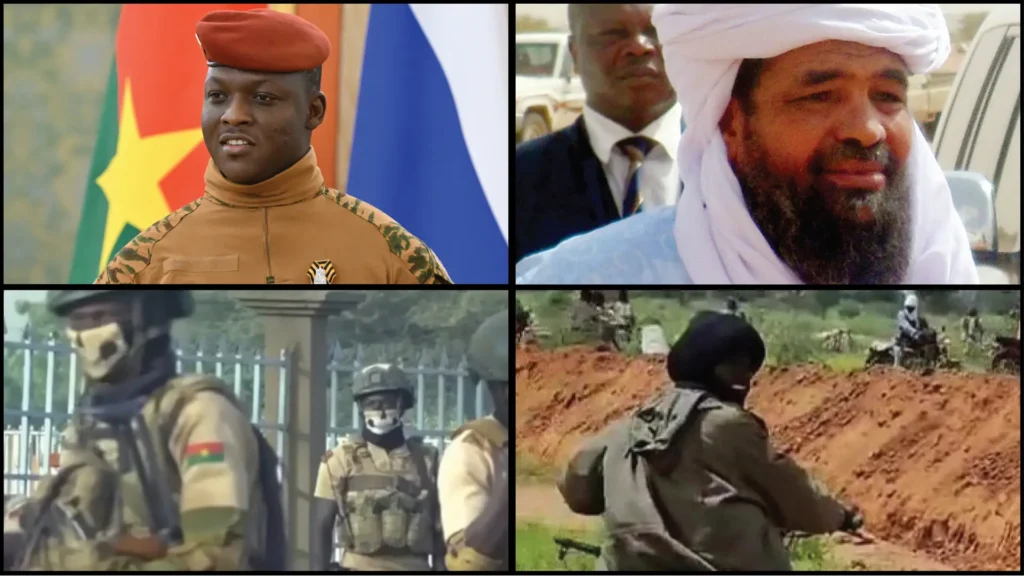
From the Koulouba palace, Captain Ibrahim Traoré, who seized power and dissolved democratic processes, recently addressed a select group of journalists. For two hours, the military leader painted a picture of progress in Burkina Faso: the national army reclaiming control over vast territories, a burgeoning industrial sector, increasing gold reserves, expanding infrastructure, and an unprecedented era of freedom for its citizens. This optimistic portrayal served as his self-assessment of the nation’s trajectory under his command.
A grim counter-narrative emerges
Yet, this polished image of a thriving Burkina Faso was starkly contradicted by a comprehensive 351-page report simultaneously released by Human Rights Watch (HRW). Titled "No One Will Escape," the document meticulously details the deaths of 1,837 civilians over a mere two-and-a-half-year period. The HRW investigation implicates various actors, including the Burkinabè army, the Volunteers for the Defense of the Homeland (VDP) militias, and JNIM jihadist groups. Crucially, the report highlights a disturbing pattern: state-affiliated forces are depicted as systematically executing civilians, often with aerial surveillance and clear directives. The findings point to potential war crimes and crimes against humanity, including the deliberate ethnic targeting of the Fulani community. Documented atrocities include the summary executions of 223 civilians, among them 56 children, in Nondin in February 2024, hundreds killed in Baraboulé in December 2023, and the massacre of 130 Fulani individuals near Solenzo in March 2025. This evidence is bolstered by survivor testimonies, satellite imagery, and the discovery of mass graves, painting a chilling picture that stands in stark opposition to the official narrative.
The unsettling truth behind ‘recaptured’ territories
Ironically, Captain Traoré’s list of ‘recaptured’ towns, such as Baraboulé and Pétégoli, directly overlaps with locations where HRW documented severe atrocities. The report specifically details ‘Operation Tchéfari 2’ – ‘The Warriors’ Honey’ in Fulfulde – an operation where the national army allegedly killed hundreds of civilians across 16 villages. While state media lauded these actions as a triumph, survivors recount them as brutal massacres. Traoré’s explanation attributes these killings to terrorists disguised in military uniforms, orchestrating complex operations with drones and multiple battalions before disappearing. This narrative suggests an extraordinary level of strategic capability for groups he otherwise dismisses as unsophisticated.
The unspoken crisis: targeting the Fulani community
A glaring omission from Captain Traoré’s two-hour address was any mention of the Fulani community. This silence is particularly disturbing given HRW’s extensive documentation of systematic targeting against this ethnic group, which constitutes 8% of Burkina Faso’s population. The Fulani are collectively accused of terrorism, leading to widespread massacres in villages and the displacement of hundreds of thousands. The HRW report even cites Traoré’s own words from February 2023, warning Fulani leaders of severe consequences for their community, a sentiment reportedly echoed more explicitly by his presidential guard chief. Despite overwhelming evidence, the official stance denies any specific ethnic issue, framing it instead as a general ‘problem of Fulani’ within the nation.
Suppression of dissent and engineered narratives
Contrary to Traoré’s assertions of greater freedom in Burkina Faso compared to Europe, the reality for critical voices is stark. Journalists face abduction and forced conscription into militias, independent media outlets are silenced, and human rights websites are blocked. The abolition of the electoral commission and the reinstatement of the death penalty further underscore a tightening grip on civil liberties. Simultaneously, sophisticated pro-junta troll networks, known as the ‘BIR-C’ (Rapid Communication Intervention Battalions), propagate state-sponsored narratives and deepfakes across social media, cultivating an image of the captain that rivals the most authoritarian regimes.
Selective justice and accountability
The HRW report urges an investigation into Captain Traoré for command responsibility, naming six generals in connection with the documented abuses. Yet, none have faced trial. The junta’s decision to withdraw from the International Criminal Court (ICC) raises significant concerns about accountability. This move, often seen as an attempt to evade international scrutiny, contrasts sharply with the domestic focus on minor corruption cases, such as publicizing the humiliation of a traffic officer for a small bribe. While such incidents are framed as national scandals, the massacre of hundreds of civilians by the army is conveniently dismissed as ‘terrorist perfidy,’ revealing a troubling disparity in the application of justice.
Deflecting criticism: the postcolonial shield
Any external critique, from a European Parliament resolution to the statements of a French army chief, is swiftly labeled as interference. Non-governmental organizations, independent media, and even the internet are dismissed as purveyors of manipulation and falsehoods. The comprehensive 351-page HRW report, built on 450 interviews, is similarly denounced as fabricated. While acknowledging the legitimate historical grievances of postcolonial exploitation, particularly by France, the article argues that this historical context is being weaponized to deflect accountability for grave domestic human rights abuses. Anti-imperialist rhetoric, it emphasizes, does not grant impunity for violence against one’s own populace. In a final, stark contrast, Traoré’s recent encouragement for Burkinabè citizens to ‘have children’ due to the ‘richness of the land’ takes on a grim irony, given the documented evidence of mass burials within that very soil.