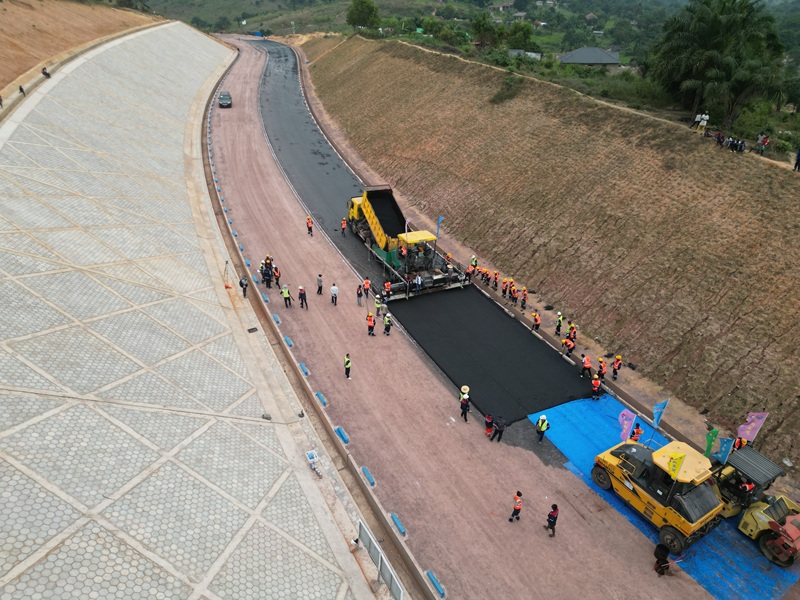
Despite concerted efforts from technical, financial, and institutional stakeholders, critical delays in customs clearance are stalling progress on infrastructure projects under the Sino-Congolese Program in the Democratic Republic of Congo (DRC).
Critical materials stuck at Matadi customs
Nico Nzau Nzau, Director-General of the Congolese Agency for Major Works (ACGT), recently briefed Infrastructure Minister John Banza on the severe impact of these delays during an infrastructure caravan inspection. Without the stranded bitumen shipment—held at Matadi customs for over six months despite tax exemptions—the paving of several major road projects would already be underway.
The blockade is more than a logistical setback; it risks halting operations entirely if key players, including the Agency for Project Coordination and Monitoring (APCSC), fail to intervene. Months of unaddressed requests for tax relief and customs facilitation—despite legal provisions under Law No. 14/005 (February 11, 2014) and the 2024 Collaboration Agreement Addendum No. 5—exacerbate the crisis.
Infrastructure progress at risk
While some projects show promise—such as the Kikwit General Referral Hospital, where construction of 17 new buildings and modernization of 11 others will expand capacity from 150 to 650 beds—the dry season’s window for accelerated work is closing fast. Persistent delays threaten to derail multiple high-priority initiatives, including:
- The South-East and South-West Rocades of Kinshasa
- The Manterne–Tshela–Singini road
- The Kananga–Kalamba Mbuji route
- The RN1 segment between Mbujimayi and Nguba
- The Idiofa Stadium
Over 1,477 tons of bitumen destined for Kinshasa’s Rocades, the Matadi–Tshela–Singini project, and the Kananga–Kalamba Mbuji road remain stranded at Matadi Port since January 2026. An additional 1,650 tons of bitumen for the RN1 rehabilitation and heavy machinery—including concrete plant components for the Idiofa Stadium—are similarly immobilized at customs checkpoints.
Government responds with inspections
In response, Minister Banza and his delegation launched an inspection caravan across Grand Bandundu and other provinces to assess progress. While projects funded by SICOMINES are progressing well—such as the Kikwit hospital—the cumulative delays pose a national challenge, delaying the delivery of modern infrastructure critical to economic growth.
The APCSC, tasked with streamlining customs for these projects, holds central responsibility to resolve the impasse. Without urgent action, the country risks losing both time and tangible development, leaving citizens without access to modern facilities and improved connectivity.