The Central African Republic has once again been thrust into a nightmare of its own making, as fresh evidence of unspeakable brutality emerges from the depths of the country’s interior. Disturbing footage, circulated widely across social platforms, lays bare a scene of calculated carnage orchestrated by Wagner Group mercenaries. In an act of calculated savagery, defenseless men were systematically executed before their severed heads were arranged in a grotesque display on the ground, echoing the macabre theatrics of extremist factions long feared across the region.
The orchestrators of this horror did not shy away from documenting their crimes, their gloating voices captured on video as they carried out their grim work. Among the chilling audio snippets is a command from the Wagner militia leader, his voice dripping with menace: “You refuse peace? Then this is your fate. Slaughter every last one of them!” Such unfiltered displays of violence harken back to the darkest eras of jihadist propaganda, where fear was weaponized through the public exhibition of cruelty.

The normalization of extreme violence
The victims of this atrocity were not hardened combatants but individuals who had gathered under the false promise of a disarmament initiative—a government-backed program hijacked by Wagner operatives. Among the casualties were civilians, including a village elder, lured into what they believed would be a peaceful process. The sheer frequency of such incidents has desensitized the population, turning the once-unimaginable into an everyday reality. The Central African Republic, long described as a “non-state” or “a country that does not exist”, has become a lawless terrain where survival hinges on navigating a labyrinth of armed groups and foreign mercenaries.
Decades of political instability, failed coups, and mutinies have left the nation fractured, its government reduced to a fragile enclave in Bangui while armed factions carve out fiefdoms across the countryside. International missions, such as the UN’s MINUSCA, have struggled to curb the tide of violence, their efforts often overshadowed by the unchecked brutality of outsiders like Wagner. The arrival of these Russian mercenaries, operating under the guise of bilateral cooperation, has only exacerbated the crisis, embedding a culture of impunity where atrocities are met with indifference.
A shadow government of terror
Wagner’s presence in the Central African Republic is no fleeting deployment—it is an entrenched occupation. These mercenaries, retaining their original branding in homage to their late founder, Evgueni Prigojine, have woven themselves into the fabric of the nation’s power structures. They exert control over the military, police, judiciary, intelligence services, and even airport operations in Bangui. Their influence extends to the exploitation of mineral resources, further entrenching their stranglehold on the country’s fragile economy.
Their crimes are legion: forced disappearances, systematic torture, harassment campaigns, and extrajudicial killings—all conducted with impunity. Reports of their dominance over local authorities are rife, with many suggesting that Wagner’s writ runs deeper than that of the official government. The Central African Republic has become a laboratory for a new form of colonial order, one where foreign mercenaries dictate the terms of survival.
The macabre celebration of Prigojine’s legacy—marked by annual commemorations attended by both Wagner operatives and Central African soldiers—serves as a stark reminder of how deeply these mercenaries have embedded themselves into the nation’s psyche. The silence from authorities in response to the latest atrocities only underscores the complicity of those in power, who prioritize clinging to authority over the safety of their people.
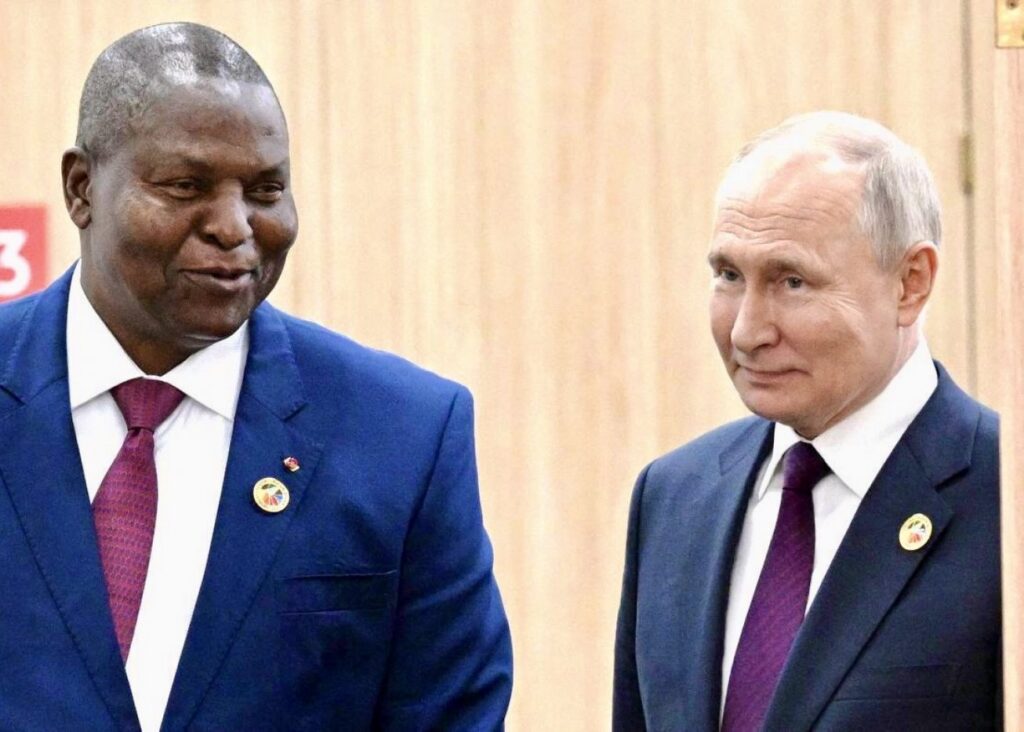
Four years ago, during a closed-door meeting with his cabinet, President Faustin-Archange Touadéra was warned of the potential fallout from Wagner’s actions. His response was chilling: “We need the Russians. They are the reason we still hold onto power.” The message was clear: power, regardless of the cost, is the only currency that matters. The result? A nation teetering on the brink, where terror is not an exception but the norm, and where the world looks away in weary resignation.