- Bénin
- Politics
Bénin: how a spiritual transition showcases presidential unity
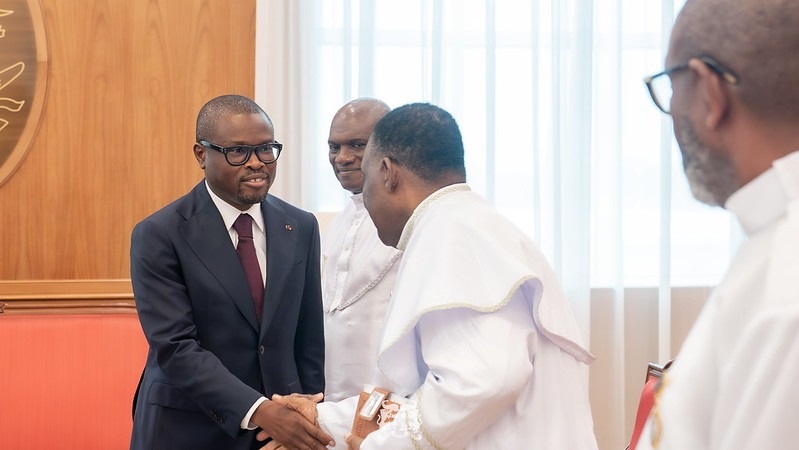
On June 4, 2026, President Romuald Wadagni welcomed a delegation from the Celestial Church of Christ, an encounter that revealed an unexpected dimension of Benin’s political transition. The meeting underscored how two leaders are orchestrating a seamless handover, turning a religious dossier into a symbol of state continuity.
When governance meets faith: a dossier that tests national cohesion
Certain government files carry more weight than others. The reunification process of the Celestial Church of Christ falls into this category. Though the process unfolds behind closed doors—through theological consultations and internal deliberations—its success hinges entirely on political stability. Any interruption in state commitment could signal to the Church’s factions that the process is vulnerable to electoral shifts. This risk has evidently been carefully managed.
A choreographed transition: two presidents, one mission
The story begins with the handover of the Higher Council of Labor’s recommendations, a key moment where Patrice Talon and Romuald Wadagni stood side by side. Talon was still the sitting president; Wadagni, the president-elect yet to be sworn in. Their presence together was not ceremonial—it was deliberate. It signaled an explicit transfer of responsibility, an unspoken agreement between the two leaders on the importance of sustaining the process.
The events of June 4 further illustrated this well-orchestrated transition. In the morning, Talon officially installed the council tasked with implementing the Higher Council of Labor’s recommendations. By evening, Wadagni received the same council’s delegation. The sequence was almost theatrical in its precision: one leader installs, the other welcomes; one legitimizes the framework, the other breathes life into it.
Defined roles for a unified vision
This sequence reveals a deliberate governance structure. Patrice Talon assumed the role of facilitator—a mediator who creates dialogue conditions without imposing authority. His historical legitimacy on this file stems from launching the process under his administration, structuring it, and ensuring the Higher Council of Labor delivered its conclusions. To the Church’s stakeholders, he embodies the process’s credibility.
Romuald Wadagni, meanwhile, represents active republican continuity. By reaffirming his support for the delegation, he made clear that the state is not merely passing the baton—it is embracing the dossier. This nuance matters. A simple handover would have sufficed to ensure continuity. Wadagni went further: he engaged personally, asked incisive questions, and demonstrated a deep understanding of the file. This was no courtesy call.
A litmus test for leadership cohesion
Beyond the Church itself, this dossier serves as a litmus test for the relationship between the two presidents. In many African transitions, files left unfinished by outgoing leaders often languish in institutional limbo—neither abandoned nor fully adopted. The temptation to start afresh is strong.
Here, the opposite is true. By engaging actively in the first weeks of his term on a dossier initiated by his predecessor, Wadagni sends a powerful message: state continuity trumps agenda disruption. If this principle holds across other sectors, it could define a hallmark of his early presidency.
A global stage for local leadership
Reducing this dossier to its national scope would be shortsighted. The Celestial Church of Christ is a global entity with followers on every continent. A successful reunification would be an international milestone—and Benin, as its founding nation, would stand at its center.
The engagement of both Beninese leaders transcends Cotonou’s borders. It positions Benin as a hub for resolving a global religious divide, with its presidents as responsible actors in a peace process affecting millions. In this context, diplomacy takes a softer form—not through coercion, but through mediation and influence.
The June 4 audience was more than a religious event. It was a foreign policy act, a national cohesion statement, and tangible proof that the transition between Patrice Talon and Romuald Wadagni was executed not just formally, but substantively.