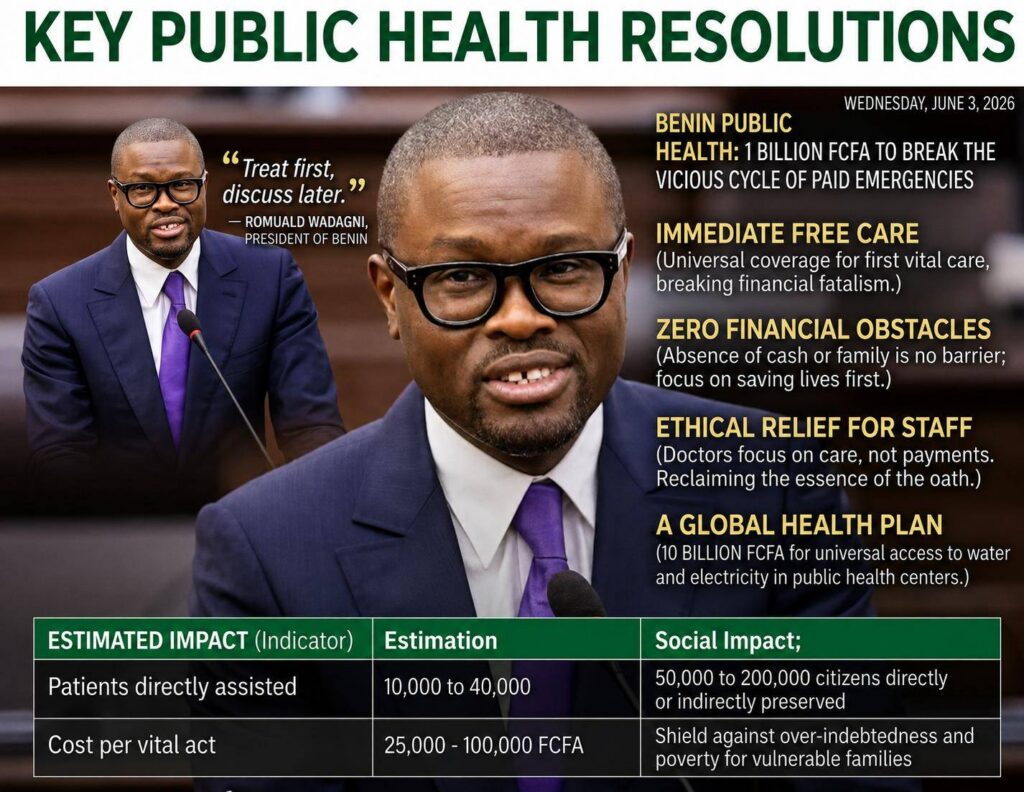
In a decisive move to transform public healthcare accessibility, President Romuald Wadagni announced the release of a one-billion-franc CFA allocation on June 3, 2026. The funds are earmarked for public health facilities to ensure immediate, cost-free treatment for life-threatening emergencies.
Breaking the cycle of emergency care barriers
The initiative targets urgent medical cases such as severe road accidents, obstetric complications, respiratory distress, and cardiac arrests. Under the new policy, financial constraints will no longer delay critical interventions, eliminating the tragic reality of preventable deaths due to unpaid emergency services.
« Treat first, discuss later », declared President Wadagni, emphasizing the humanitarian shift in healthcare policy. This unprecedented financial commitment guarantees that hospitals can administer essential care without prior payment, prioritizing lives over bureaucratic hurdles.
Measuring the impact on vulnerable families
While the exact number of beneficiaries remains fluid—given the unpredictable nature of emergencies—financial estimates provide insight into the program’s potential reach. Typical emergency care costs in public hospitals range from 25,000 FCFA for moderate cases to 100,000 FCFA for severe trauma or surgical stabilization. With the billion-franc fund, an estimated 10,000 to 40,000 patients could receive life-saving treatment.
The ripple effects extend beyond individual patients. In Benin, a single hospitalization can destabilize an entire household’s finances. By shielding families from crippling debt, asset liquidation, or sudden loss, this initiative protects the economic stability of approximately 50,000 to 200,000 citizens—an indirect lifeline for communities grappling with poverty.
Empowering healthcare workers to focus on saving lives
For medical professionals, the policy lifts an ethical burden that has long hindered their work. Doctors and nurses in public hospitals often face agonizing choices between providing care and enforcing payment demands. The new framework allows them to uphold the Hippocratic Oath without compromising on humanity or urgency.
« No life should be lost because financial constraints prevent immediate action. Human life demands absolute priority, » affirmed President Wadagni, reinforcing the government’s commitment to a more compassionate and equitable healthcare system.
A broader vision for health infrastructure
This billion-franc injection is part of a larger health and infrastructure strategy spearheaded by President Wadagni. To ensure hospitals operate efficiently, an additional 10 billion FCFA has been secured for universal access to clean water and electricity in underserved public health centers.
Together, these measures mark a pivotal step toward achieving universal healthcare coverage by 2030. The initiative underscores a fundamental truth: medical efficacy must align with social justice to create a sustainable health ecosystem. The focus now shifts to the Ministry of Health, tasked with meticulous implementation to ensure every franc translates into preserved lives across Benin.