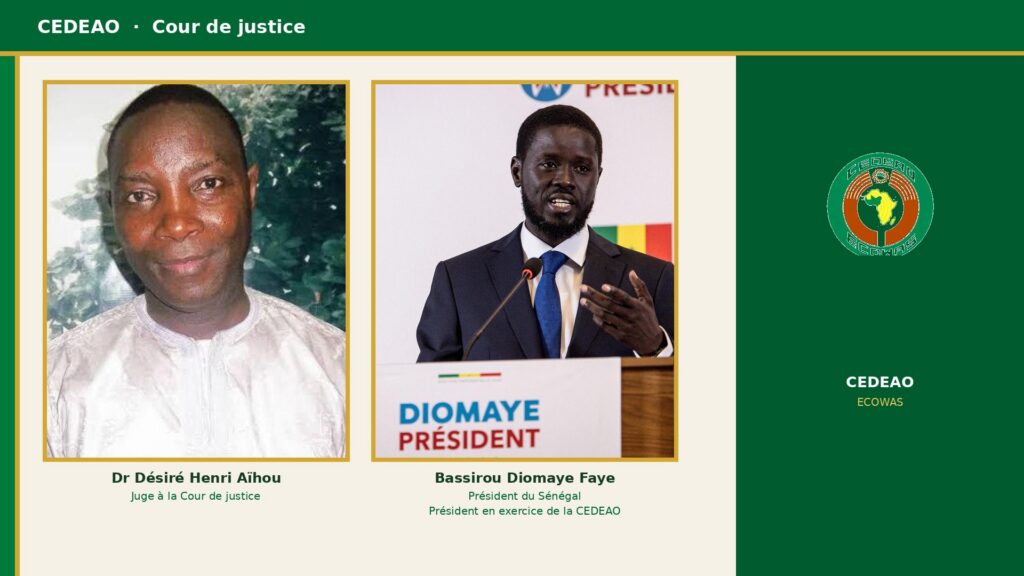
On October 6, 2026, in Abuja, the Republic of Benin marked a pivotal moment in its regional judicial engagement. Doctor Désiré Henri Aihou took his oath as a judge of the ECOWAS Court of Justice, assuming a four-year, non-renewable mandate. While his appointment represents the elevation of a Beninese jurist, it arrives at a critical juncture when West African justice is being called upon to deepen the rule of law, uphold fundamental rights, and restore public trust in regional institutions. This moment is deeply connected to Benin’s legacy as a democratic pioneer in West Africa, a legacy forged in the crucible of the 1990 National Conference of Living Forces.
Can a single judge transform regional justice?
The swearing-in ceremony took place at the ECOWAS Commission headquarters in Abuja. It was presided over by President Bassirou Diomaye Faye of Senegal, who currently chairs the Authority of Heads of State and Government. Five judges were sworn in that day: Désiré Henri Aihou (Benin), Awa Bah (Gambia), Charlyne M. Brumskine (Liberia), Henrietta Uzoamaka Didigu (Nigeria), and Yaouza Ouro-Sama (Togo). Their appointments were confirmed during the 69th Ordinary Session of the Authority, held on July 19, 2026, in Lungi, Sierra Leone.
Their four-year, non-renewable mandate reflects a deliberate effort to ensure judicial independence and reduce political influence. With these five jurists now in place, the Court operates with a renewed credibility, tasked with interpreting and enforcing the ECOWAS Revised Treaty and protecting the rights of citizens across 15 member states.
From constitutional legacy to regional responsibility
Désiré Henri Aihou’s presence on the bench is not merely symbolic. It reflects a direct line from Benin’s historic commitment to constitutional governance. In February 1990, the National Conference of Living Forces convened in Cotonou. Representing diverse social, political, and professional sectors, delegates declared their resolve to establish democracy, respect human rights, and build transparent institutions. The resulting Constitution of December 11, 1990, enshrined the separation of powers—executive, legislative, and judicial—as a bedrock principle. The creation of the Constitutional Court in 1993 further cemented this vision, embedding the rule of law at the heart of national governance.
Now, three decades later, that same principle is being extended to the regional level. The ECOWAS Court of Justice, as the judicial arm of the Community, was designed to ensure that states do not treat their treaty obligations as empty promises. It has the authority to rule on disputes between member states, interpret community law, and, increasingly, adjudicate cases involving individuals whose rights have been violated by state action. This is a significant expansion of its original mandate.
A judge’s role in a system under scrutiny
Unlike diplomatic appointments, Désiré Henri Aihou’s role is purely judicial. He is not representing Benin’s political interests; he is exercising independent adjudication within a supranational court. His appointment underscores the ECOWAS’s commitment to a justice system insulated from political interference—an ambition long championed by Benin’s own democratic evolution.
Yet, the effectiveness of this system hinges on more than judicial appointments. It depends on whether decisions handed down by the Court are respected and implemented. In 2024, ECOWAS’s Judicial Council acknowledged that enforcement remains a persistent challenge. States occasionally resist or delay compliance, raising concerns about the Court’s real authority. Désiré Henri Aihou’s mandate begins against this backdrop—a moment when the Court’s credibility is under the microscope.
Why enforcement is the real test of regional justice
The ECOWAS Court of Justice is not just a symbolic institution. It is designed to be a last line of defense for citizens whose rights are violated by their governments. In a region marked by political instability, constitutional crises, and debates over the future of regional integration, a strong, independent judiciary can serve as an anchor of stability and legal clarity.
For Benin, a country whose political identity was forged in the struggle for democratic renewal, this responsibility carries deep significance. The 1990 National Conference did not just end a dictatorship; it redefined governance around transparency, accountability, and constitutional limits. That ethos is now being projected onto a broader stage.
But will the Court’s rulings translate into real change? The next four years will test whether West African justice can move from paper to practice. The stakes are high: without genuine enforcement, even the most eloquent legal principles risk becoming hollow declarations.
What Benin’s judicial envoy brings to the bench
Désiré Henri Aihou brings more than legal expertise to the Court. He carries with him the institutional memory of a nation that chose law over arbitrary rule. Benin’s experience—where power is checked by courts, where elections are monitored by independent bodies, and where constitutional crises are resolved through dialogue—offers a model that resonates across the region.
The question now is whether this model can be scaled up. Can ECOWAS justice become a shield for citizens, a corrective for weak governance, and a unifying force in a diverse and often divided region? The answer may lie in the hands of the judges now sworn in—and in the willingness of member states to abide by the rulings they issue.
The oath taken in Abuja was not just a formality. It was a declaration: that even in a region where power often trumps principle, the law must have the final say. Désiré Henri Aihou’s journey from Cotonou to Abuja symbolizes a broader hope—that democracy, once national, can become regional.
Beyond the ceremony: the long road ahead
The arrival of new judges at the ECOWAS Court of Justice marks a promising chapter, but the most critical test is still to come. The Court must prove it can deliver timely, respected, and transformative justice. Citizens across West Africa are watching whether regional institutions can protect their rights when national systems fail.
For Benin, this is not just a diplomatic victory. It is a continuation of a 36-year commitment to constitutional governance. As Désiré Henri Aihou takes his seat, the message is clear: the fight for justice does not end at the border. It begins there.