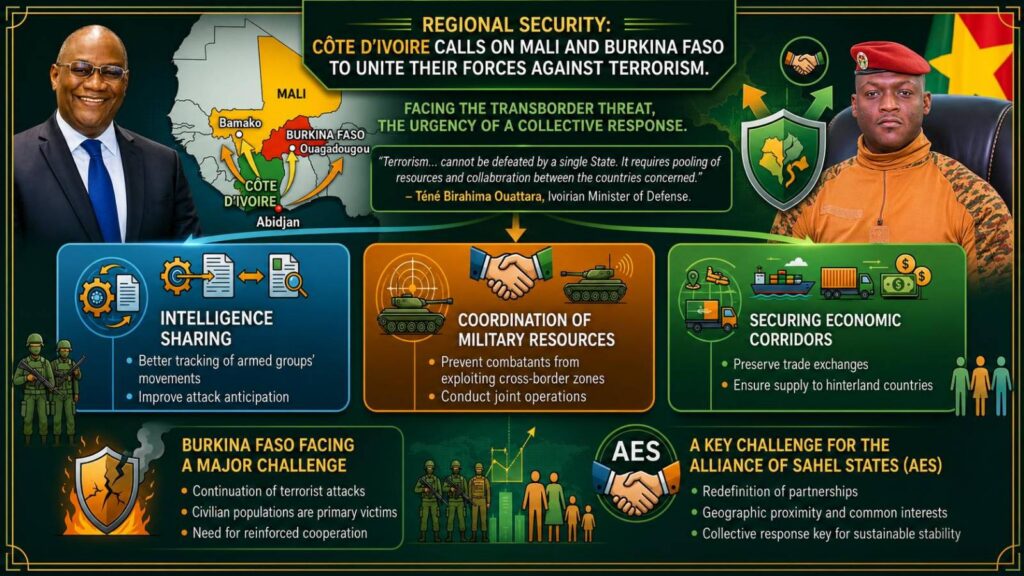
In response to the escalating terrorist insurgency gripping the Sahel, Côte d’Ivoire has issued a decisive call for regional solidarity. The intensifying cross-border attacks, which have exacted a devastating toll on Mali and Burkina Faso, now threaten to destabilize West Africa’s coastal states. This precarious security landscape demands a unified response, transcending historical grievances and diplomatic posturing.
Abidjan’s strategic overture to Bamako and Ouagadougou
The Ivorian government, under President Alassane Ouattara, has extended a formal invitation to its Sahelian counterparts, emphasizing the urgent need for collective action. Defense Minister Téné Birahima Ouattara underscored the gravity of the situation, stating that no single nation can confront this threat in isolation.
« Terrorism in its current form cannot be defeated through unilateral efforts. It requires pooled resources, shared intelligence, and coordinated military operations across national boundaries. »
This diplomatic initiative serves as a stark reminder to Burkina Faso, where the security apparatus remains strained despite concerted national mobilization efforts. The persistent attacks, territorial losses, and civilian casualties have placed President Ibrahim Traoré’s administration at a critical juncture. Analysts within the region suggest that the president must prioritize pragmatic cooperation over political isolation to safeguard Burkinabè lives and sovereignty.
Côte d’Ivoire’s three-pillar security framework
Abidjan has outlined a comprehensive collaboration strategy, structured around three core pillars designed to strengthen regional resilience:
- Intelligence sharing: Establish a joint monitoring system to track the movements of jihadist factions along vulnerable border zones.
- Military coordination: Synchronize cross-border operations to eliminate safe havens for insurgents, ensuring terrorists cannot exploit porous frontiers.
- Economic corridor protection: Secure vital trade routes to sustain the flow of goods essential to landlocked nations’ economies.
The proposed framework reflects Côte d’Ivoire’s strategic stability and logistical advantages, positioning it as a natural partner in this endeavor.
A test of political resolve for the AES
The Alliance of Sahel States (AES)—comprising Mali, Burkina Faso, and Niger—faces a defining moment. While these nations have redefined their international alliances, geographical realities remain immutable. Côte d’Ivoire’s geographic proximity and economic influence make it an indispensable ally in the fight against terrorism.
For President Ibrahim Traoré, embracing this collaboration would not signify capitulation but rather a demonstration of political maturity and a commitment to protecting Burkinabè citizens. In confronting an elusive and adaptive adversary, fragmentation guarantees failure; only a unified strategy offers a pathway to restoring stability in the region.