Ankara’s arms shipment to Niamey: a deal wrapped in debt
During an official visit to Ankara, General Abdourahamane Tchiani stunned observers by disclosing that President Recep Tayyip Erdogan had authorized the delivery of military hardware to Niger without prior financial compensation. While Niamey’s leadership portrays this as an act of solidarity, the gesture—deviating from standard international arms trade practices—exposes the contours of a partnership that encroaches on Niger’s sovereign prerogatives.
Violating the unspoken rules of defense procurement
The notion of a “total credit” arrangement in military acquisitions is fundamentally flawed. Defense manufacturers universally require substantial upfront payments before finalizing deliveries. The announcement made by Niger’s transitional leader on June 4, 2026, therefore conceals a far more intricate economic and geopolitical arrangement where no concession is made without reciprocity.
The undisclosed financial framework: deferred payments and strategic exchanges
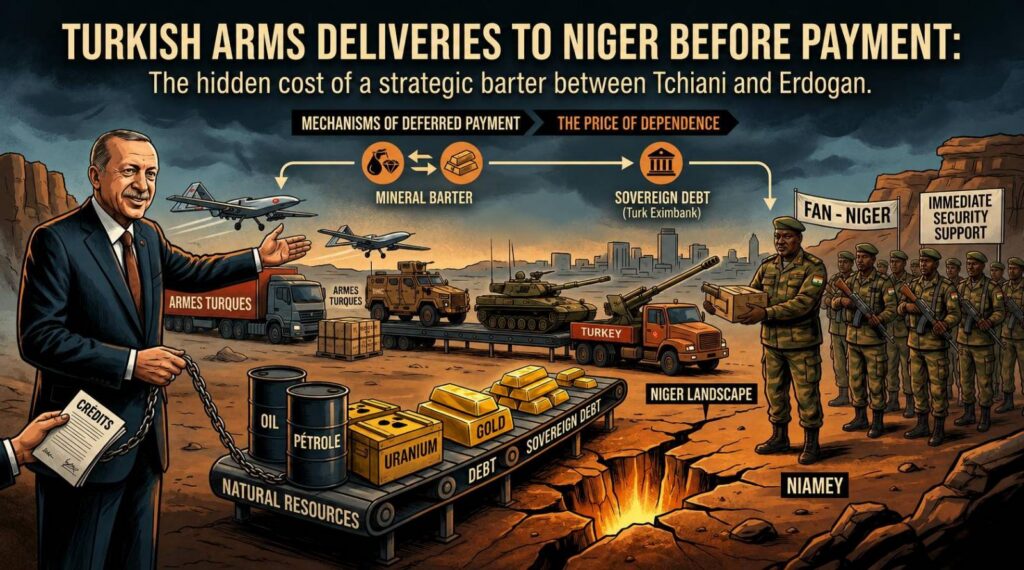
International trade operates on a principle as old as commerce itself: every shipment, sooner or later, must be settled. To reconcile Niamey’s immediate budgetary constraints with Ankara’s willingness to supply arms, a series of compensatory mechanisms have been activated behind closed doors:
- Resource-for-arms barter: Niger’s mineral wealth—uranium, oil, and gold—serves as collateral. In exchange for the early delivery of military equipment, Turkish state-backed firms secure exclusive rights to explore and exploit key mining concessions across the country.
- Sovereign credit lines: The transactions are not charitable donations. Payment schedules are tied to loans extended by Turkish financial institutions such as Turk Eximbank. What appears as immediate military relief for Niamey translates into a long-term financial obligation to Ankara.
The long shadow of sovereign dependence
For General Tchiani, the alignment with Turkey represents a pragmatic solution to replenish the Nigerien Armed Forces (FAN) following the withdrawal of Western partners. Yet this tactical maneuver comes at a steep cost: the gradual erosion of national autonomy in economic and resource governance.
The burden of debt-driven defense
By accepting deliveries of Bayraktar TB2 drones, armored vehicles, and communications systems on credit, Niger is not merely deferring payment—it is relinquishing future leverage over its own strategic sectors. Turkish involvement is expected to extend beyond logistics, potentially granting Ankara direct influence over Niger’s mining policies and economic decision-making.
What Turkey gains from Niamey’s bargain
President Erdogan’s approach to arms diplomacy in the Sahel is a calculated geopolitical investment aimed at three primary objectives:
- Consolidating regional influence by displacing Western powers from the Sahel’s security landscape.
- Countering Russian strategic presence, particularly the Africa Corps, through the supply of advanced defense technologies.
- Securing markets for Turkey’s burgeoning defense industry, positioning it as the region’s preferred technological partner.
A fleeting political victory with lingering uncertainties
General Tchiani’s announcement delivers a domestic political boost by securing arms without an immediate fiscal impact. Yet beneath the surface of this tactical success lies a sobering reality: Niger has not escaped the cycle of external influence. It has merely exchanged one creditor for another—from Western donors to Turkish lenders and Moscow’s security patrons—while the ultimate price for the Nigerien people remains undefined.