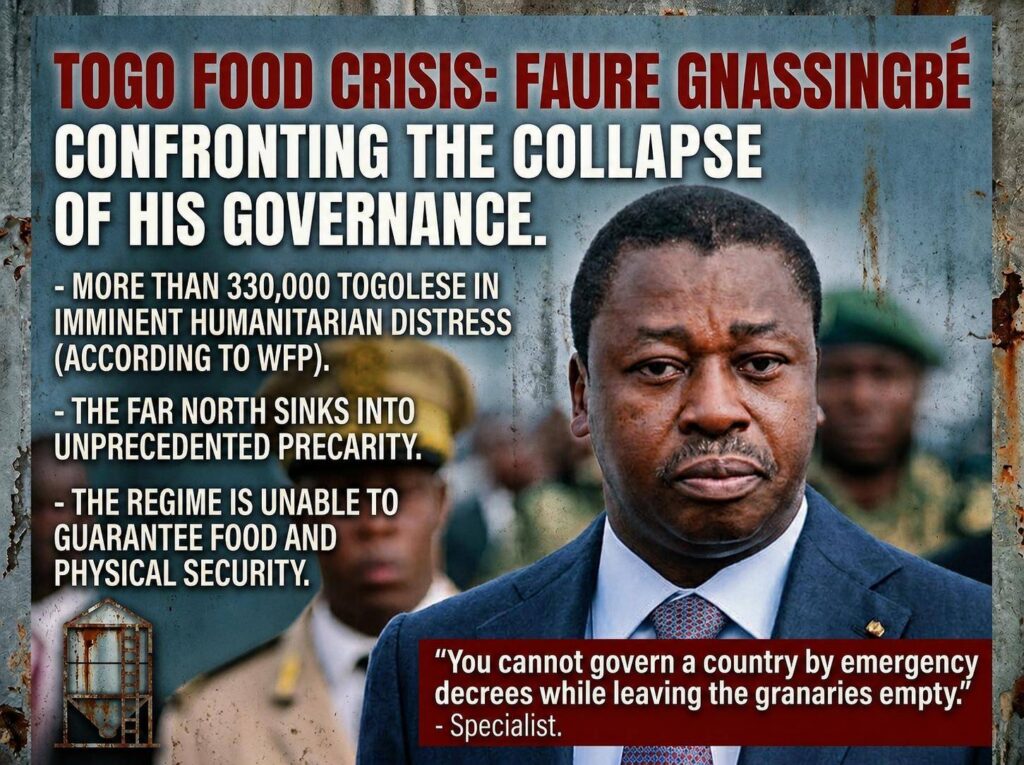
The humanitarian crisis unfolding in northern Togo has laid bare the shortcomings of President Faure Gnassingbé’s administration, with experts warning of an impending catastrophe. As international aid agencies escalate their warnings, the extreme northern regions of the country face an unprecedented level of food insecurity that threatens to engulf over 330,000 individuals within the next three months.
The northern savannas: a region abandoned to its fate
The Savanes region, Togo’s northernmost territory, has become the epicenter of this unfolding disaster. Bordering Burkina Faso, this area has long grappled with chronic poverty and environmental vulnerabilities. Now, it bears the brunt of a dual crisis: a deepening security vacuum and the collapse of local economic structures.
The proliferation of armed groups and the prolonged enforcement of emergency measures have not only failed to restore stability but have exacerbated the plight of local communities. Cross-border trade disruptions and the displacement of thousands of civilians—compounded by an influx of refugees from neighboring Burkina Faso—have crippled the region’s fragile economy. As harvests dwindle and food stocks deplete, the pressure on already scarce resources has reached a breaking point.
A government paralyzed by inaction
Analysts attribute the severity of the crisis not to unforeseen circumstances but to systemic governance failures. Despite repeated pledges to bolster agricultural resilience and food security, the reality in the Savanes region is stark: nearly half of households cannot afford a basic, nutritious diet.
Rather than addressing the root causes of the crisis, the government has increasingly relied on international aid organizations to manage the fallout. This abdication of core responsibilities—protecting and providing for its citizens—has eroded public trust in the administration. Inadequate food storage infrastructure, volatile staple food prices, and a militarized, ineffective approach to crisis management have left the northern population to fend for itself.
“A nation cannot be governed solely through emergency decrees while leaving its granaries empty. What we are witnessing in northern Togo is the direct consequence of economic neglect and unresolved security failures.” — A political analyst specializing in West African governance.
The imperative for decisive action
The coming weeks are critical in averting a full-blown humanitarian emergency. While international calls for urgent funding highlight the gravity of the situation, they also underscore a troubling question: how long can Togo continue to rely on external aid to compensate for the failures of its own policies?
For the 330,000 Togolese on the brink of starvation, the era of empty promises is over. Survival itself now hinges on immediate, tangible action from the highest levels of government—a region that has paid the heaviest price for the state’s inertia and strategic missteps.