From president to unelected strongman
Recent arrests of two French nationals in northern Togo have exposed the depths of institutional decay in the West African nation. The detainees, held incommunicado for days before being formally charged, appear to have been targeted on orders from President Faure Gnassingbé himself. His reported instruction to the Justice Minister—“do not yield to any pressure”—underscores a disturbing truth: the country’s legal system now operates as an extension of presidential will.
The constitutional sleight of hand
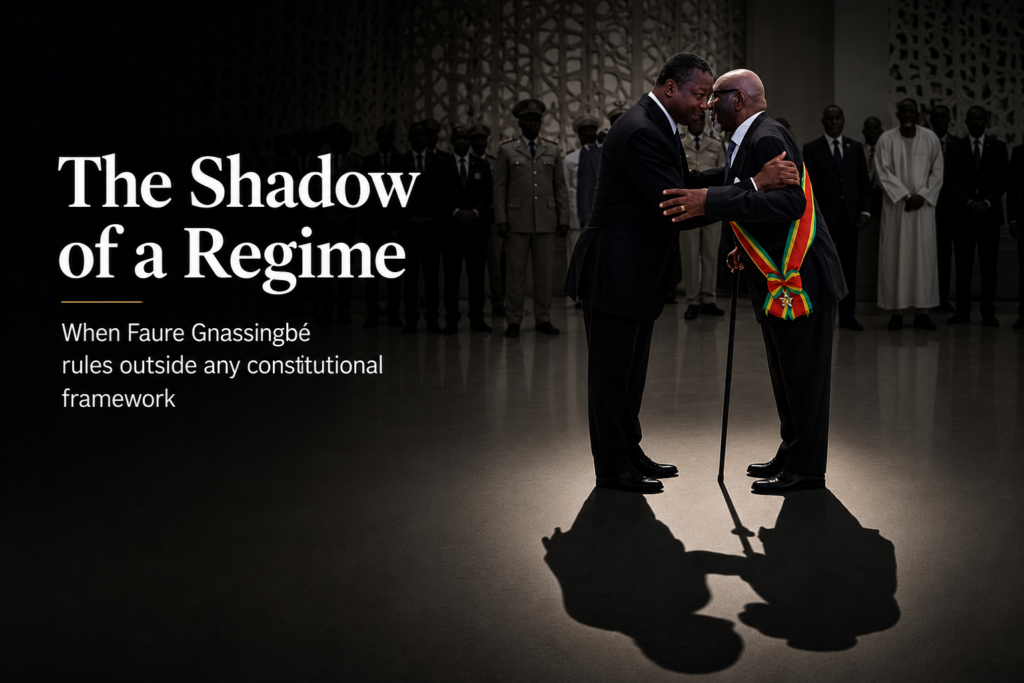
The 2024 constitutional overhaul, railroaded through a rubber-stamp parliament dominated by the ruling UNIR party, dismantled the republic’s framework entirely. Under the new system, the ceremonial president (Jean-Lucien Savi de Tové) holds no executive authority, while the newly created position of president of the Council—occupied by Gnassingbé since May 3, 2025—wields absolute power. This role faces no term limits, effectively removing any constitutional barriers to perpetual rule.
The 2024 legislative elections, boycotted by opposition forces, ensured UNIR’s supermajority (108 of 113 seats). The result was predetermined: a democratic veneer over a dynastic power structure. What was once a contested transition has become a permanent fixture of governance.
Justice as a political weapon
The case of the French journalists (Sébastien Perez Pezzani and Gaël Mocaër), detained while filming for a documentary, is not an anomaly. It reflects a pattern where intelligence services and the judiciary act on direct orders from the executive. The alleged command to “yield to no pressure” reveals a chain of command that obliterates judicial independence. When the head of state dictates legal outcomes, the separation of powers becomes a relic of the past.
This pattern extends beyond isolated cases. June 2025 protests were met with arbitrary detentions, critical voices face systematic prosecution, and sensitive cases are adjudicated based on political expediency. The law, once a pillar of governance, now serves as a tool for power retention.
A legitimacy built on sand
The fundamental question—who truly governs Togo?—has a clear answer: one man. Faure Gnassingbé, who inherited power in 2005, has spent two decades consolidating authority before engineering a constitutional coup to retain it indefinitely. Crucially, the overhaul was never put to a public referendum. The opposition’s boycott of the 2024 elections left the process devoid of democratic legitimacy, while the president-appointed Senate further entrenches his control.
This is no transition. It is the institutionalization of personal rule. Titles shift, procedures multiply, but the decision-making center remains unchanged: Faure Gnassingbé, now president of the Council, commander of the armed forces, and unchallenged final arbiter of state affairs.
The powder keg of arbitrary rule
When institutions lose their purpose, when justice bows to political dictates, and when power is exercised without constraint, the social contract frays. Togo is no longer grappling with a constitutional dispute—it is confronting a regime that governs outside any stable or predictable republican framework.
The question is no longer “who rules?” but rather: how long can a system built on arbitrariness and repression endure before internal fractures or popular upheaval force a reckoning?