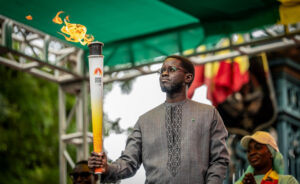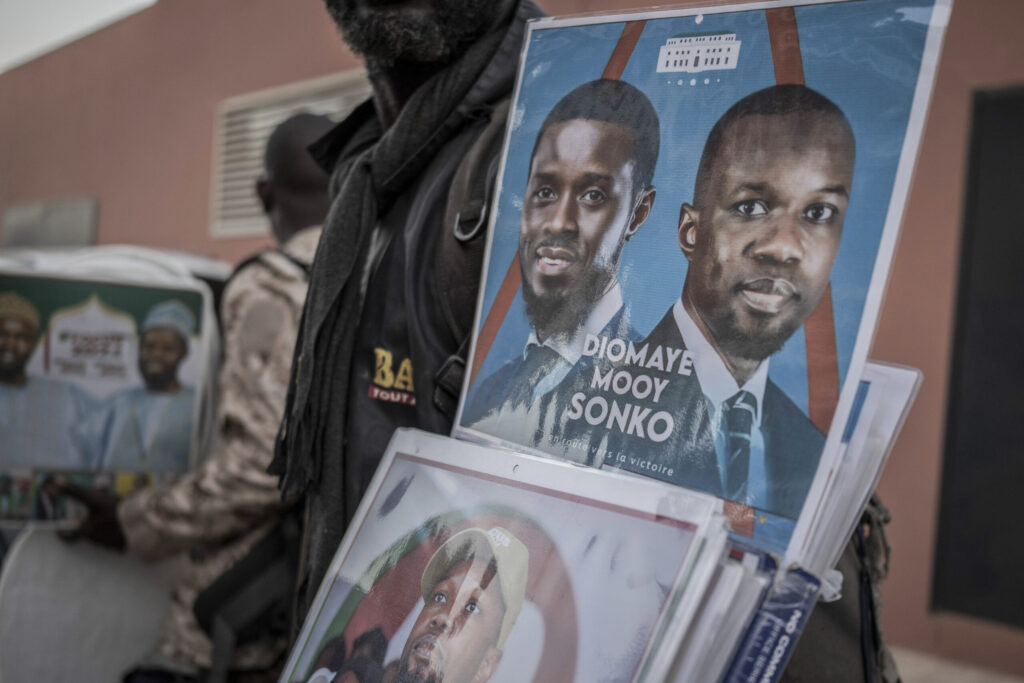
A vendor sells merchandise in support of Ousmane Sonko, Senegal's opposition leader, and Bassirou Diomaye Faye, presidential candidate, outside the venue of a news conference in Dakar, Senegal, on Friday, March 15, 2024. Ousmane Sonko and Bassirou Diomaye Faye were released after lawmakers approved amnesty for crimes linked to political protests between 2021 and 2024. Photographer: Annika Hammerschlag/Bloomberg via Getty Images
Political analysis / West Africa
Senegal’s political split: Bassirou Faye and Ousmane Sonko’s alliance crumbles

Caroline Roussy
Research Director at IRIS, Head of the Sub-Saharan Africa Program
On May 22, Ousmane Sonko was dismissed as Prime Minister, sparking fears of a political crisis. For months, he described their relationship as a ‘soft cohabitation’—a term that rings hollow given the inherent contradictions of such an arrangement, particularly since both men emerged from the same political circle and shared deep camaraderie as recently as 2024.
An apparently unbreakable friendship
Their bond, forged in student days and cemented at the National School of Administration (ENA), seemed destined to endure. Both pursued careers as tax inspectors before co-founding the PASTEF party in 2014, a platform rooted in work, ethics, and fraternity. By 2022, Bassirou Diomaye Faye had risen to become the party’s secretary-general, while Sonko set his sights on the presidency.
Their victory on March 24, 2024, was nothing short of triumphant—a sweet revenge against the obstacles placed in their path by Macky Sall’s prolonged grip on power. Both had faced imprisonment at Cap Manuel, yet within days, the tide turned. Public outrage swelled, international media descended on Dakar, and Sall was forced to yield to mounting pressure.
Emerging from prison, they launched a lightning-fast campaign under the slogan ‘Diomaye mooy Sonko, Sonko mooy Diomaye’ [Diomaye is Sonko, Sonko is Diomaye]. With Sonko’s candidacy barred, Faye was elected president, with Sonko’s unwavering support.
Their bond appeared unassailable—until cracks began to show. Many argue that Sonko, not Faye, was the true architect of their electoral success, as Faye was largely unknown to the public before 2024.
Sonko had already made his mark in 2019, defying expectations to become a presidential contender. Despite legal challenges and controversies, his popularity among Senegal’s youth remained undiminished. He had cultivated a unique political and emotional connection with a significant portion of the population, built on a narrative of resistance and change.
Faye, in contrast, seemed destined for obscurity without Sonko’s populist backing. Yet he assumed the presidency, setting the stage for an inevitable clash.
Political duos in Senegal: a recurring pattern?
History suggests that Senegalese political tandems, no matter how tight-knit they may appear, rarely survive the test of power.
Consider the partnership between Léopold Sédar Senghor and Mamadou Dia. Once inseparable allies in the struggle for independence, their differences over governance and economic policy culminated in Dia’s arrest in 1962, accused of plotting a coup and imprisoned for over a decade.
The alliance between Abdou Diouf and Moustapha Niasse dissolved almost as quickly as it formed.
Under Abdoulaye Wade, conflicts of loyalty escalated dramatically. Once seen as Wade’s heir apparent, Idrissa Seck’s political downfall culminated in his imprisonment in 2005 over the Thiès construction affair. Though later acquitted, the streets of Dakar erupted in protests, with crowds chanting ‘Idi,’ as if betrayed by a father figure.
Faye and Sonko’s split, while mirroring past patterns, is distinct in one critical way: the one who wielded electoral legitimacy was not necessarily the one who held political capital.
What drove them apart?
Much of the friction between them remains opaque, but one thing is clear: their entourages played a pivotal role. Faye and Sonko, despite media narratives emphasizing their friendship, grew increasingly hostile toward one another.
Over the past two years, grievances accumulated. Methodological disagreements over the pace of reforms, the treatment of former regime figures, and judicial overhauls frustrated Sonko, who publicly expressed impatience with the slow pace of change.
Economic strategy became another battleground. Sonko advocated distancing Senegal from the IMF, while Faye favored a more pragmatic approach. Questions surrounding debt, political funding, and international constraints highlighted a deeper divide: should governance prioritize immediate rupture or incremental adaptation?
The first major flashpoint occurred on November 8, 2025, during Sonko’s ‘Tera Meeting’ at Dakar’s Léopold Sédar Senghor Stadium. Designed to mobilize supporters nationwide, the event drew buses from across Senegal and drew intense media attention. The sheer scale of the gathering underscored Sonko’s enduring political capital.
Officially a celebration of 18 months in power, the rally was widely interpreted as a power play—a demonstration of force that left no doubt about who commanded the movement’s loyalty.
Faye responded by elevating Aminata (Mimi) Touré within the ‘Diomaye President’ coalition, a move widely seen as an assertion of presidential autonomy. Touré, a former Prime Minister under Macky Sall and a controversial figure within PASTEF, embodied Faye’s determination to break free from Sonko’s shadow.
For months, Faye had struggled to assert his authority, trapped in a cohabitation where Sonko—his former ally and now rival—acted as if he, not Faye, held the mandate. Sonko’s supporters repeatedly reminded the public of his pivotal role in their ascent, citing his selection in Pascal Boniface’s Masters of the World as proof of his outsized influence.
What lies ahead?
Sonko’s dismissal as Prime Minister on May 22 was met with a sense of relief on his part, as he posted on social media that he was finally ‘sleeping at home in Keur Gorgui.’ Yet this respite proved fleeting.
On May 26, El Malick Ndiaye resigned as President of the National Assembly, and Sonko—leader of the majority party with 130 of 165 seats—assumed the role. Once again, he finds himself in opposition, a position that once defined his political identity and fueled his popularity.
This unprecedented scenario—a president stripped of his primary political ally while facing a legislature controlled by his former partner—risks plunging Senegal into uncharted political turbulence. Can Faye govern effectively without Sonko? Will Sonko seek to undermine his presidency? The answers remain uncertain.
Yet beyond the personal feud lies a far greater concern: Senegal’s pressing challenges. Two years after the historic alternance, many promised reforms remain stalled, exacerbating unemployment, economic hardship, and crumbling public services. The political infighting risks distracting from the needs of a population desperate for change.
Was this turmoil inevitable? The question lingers.