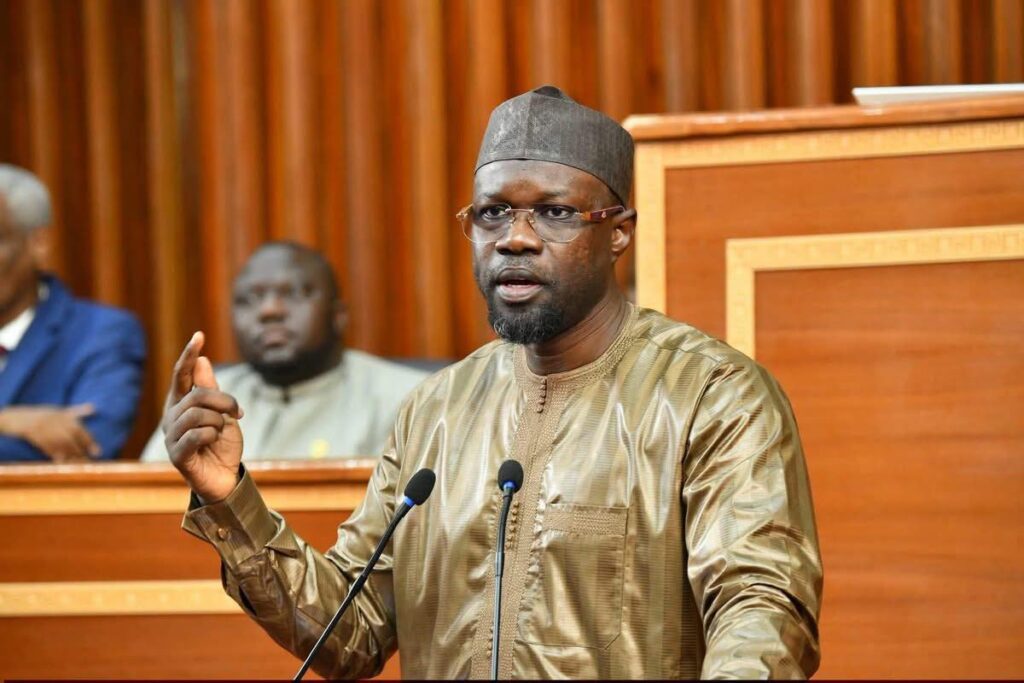
Ousmane Sonko’s ascent to power reshapes Senegal’s political power dynamics
The unexpected elevation of Ousmane Sonko to the presidency of Senegal’s National Assembly has sent shockwaves through the political establishment. Following a series of institutional maneuvers that defy conventional political timelines, the former opposition leader has swiftly transitioned from political exile to a position of legislative authority, raising critical questions about the future of governance in the country.
An institutional chessboard in motion
The rapid succession of events appears meticulously coordinated, leaving little room for coincidence. Sonko’s dismissal from prior government roles was followed by an abrupt resignation from the sitting Assembly president, paving the way for his seamless installation as the new head of the legislative body. This strategic repositioning has placed him at the heart of the nation’s political machinery, granting him unprecedented influence over legislative processes.
A calculated move toward institutional dominance
By assuming the presidency of the National Assembly, Sonko has positioned himself as a formidable counterbalance to the executive branch. His control over legislative agendas, budgetary allocations, and lawmaking procedures provides him with formidable tools to challenge or obstruct government initiatives. Observers warn that this concentration of power within a single political figure could precipitate a period of institutional friction, potentially stalling national policy implementation.
« This is no longer standard political maneuvering; it is a deliberate strategy to exert maximum institutional pressure. » The declaration, attributed to a political analyst familiar with the unfolding dynamics, underscores the gravity of the situation.
From opposition figure to institutional powerhouse
Critics argue that Sonko’s rise reflects a shift from his earlier persona as a reformist outsider to a pragmatic operator willing to exploit political crises to consolidate his influence. Once a vocal critic of the establishment, he now occupies a pivotal role within it, leading many to question the authenticity of his stated objectives and the sincerity of his political convictions.
For his supporters, however, this transition represents a long-overdue correction to Senegal’s political landscape, where power must be balanced to ensure democratic accountability. Yet, the consolidation of legislative authority in the hands of a single figure has sparked debates about the potential risks of unchecked political ambition.
The path ahead: cooperation or confrontation?
The implications of Sonko’s ascendancy extend far beyond partisan politics. At its core, the question revolves around whether this development will foster constructive governance or serve as the opening salvo in a broader struggle for institutional dominance. As political alliances realign and power blocs recalibrate, the nation stands at a crossroads where the stability of its democratic institutions hangs in the balance.
One thing remains clear: Senegal’s political future will be shaped not only by the policies enacted but by the delicate balance of power between its legislative and executive branches. The coming months will reveal whether this shift serves the broader public interest or becomes a catalyst for deeper institutional conflict.