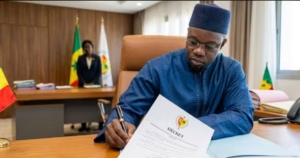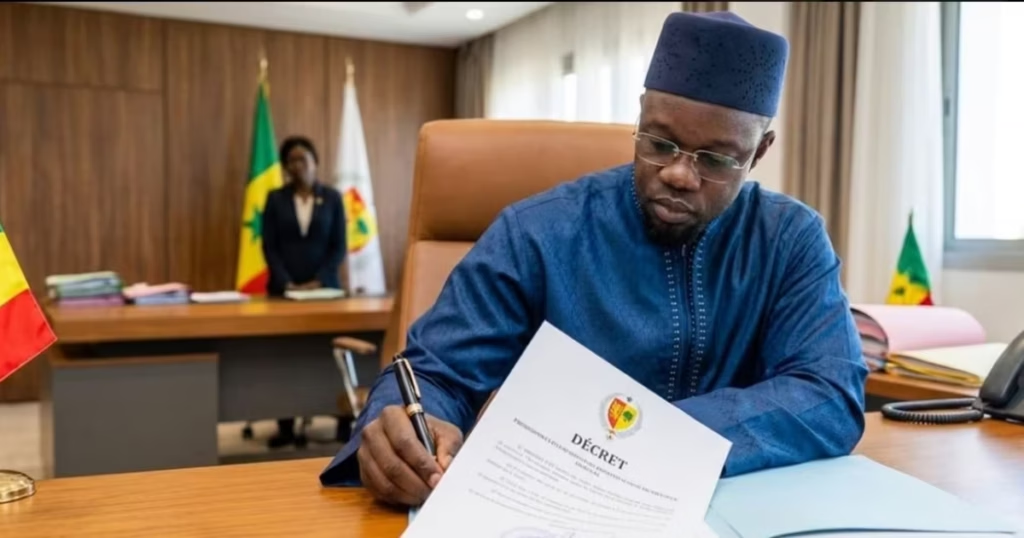
On December 2, 2026, Senegal will reach a critical political inflection point. That date marks the first day the president can legally dissolve the National Assembly, following a constitutional provision that grants this power after two years of a legislature’s term. With the Assembly currently dominated by opposition leader Ousmane Sonko’s Pastef party, President Bassirou Diomaye Faye faces a stark choice—dissolve parliament to regain control or navigate a tense cohabitation.
The constitutional trigger: what December 2 means for Senegal
The dissolution threshold is not arbitrary. Under Senegal’s Constitution, Article 87 allows the president to dissolve the National Assembly after two years of its five-year mandate. The current legislature, elected in November 2024 and seated on December 2, 2024, now meets this condition. December 2, 2026, is thus the earliest possible date for dissolution—turning it into a decisive moment for the nation’s political direction.
The context has shifted dramatically since the legislature’s installation. After breaking ties with Pastef on May 22, 2026, President Faye lost his parliamentary majority. The Assembly is now led by an opposition speaker, while Faye has formed a new government and launched his own party, Kiiraay. This unprecedented cohabitation pits two factions of the same movement against each other, creating uncharted political terrain.
Signals from the presidency: caution meets strategy
Officially, the president has left all options open. Speaking in New York, Faye noted that the date has not yet arrived and no dissolution decision has been made. Yet his inner circle is less restrained. In mid-August, Commerce Minister Serigne Guèye Diop openly accused Pastef lawmakers of sabotaging the presidency by rejecting key initiatives. The veiled threat of dissolution now looms large over parliamentary debates, serving as a pressure tactic before any formal decree is signed.
If dissolution occurs in early December, Senegal would face a compressed electoral timeline. The Constitution requires legislative elections within 60 to 90 days, placing the vote between late January and early March 2027. The last legislative elections in 2024 were held just two months after dissolution—from September 12 to November 17—highlighting the rapid pace this process demands.
But timing is complicated by another electoral hurdle. Prime Minister Ahmadou Al Aminou Lo has announced municipal elections for January 17, 2027. Holding two national votes within weeks risks logistical chaos and political fatigue. Some officials have floated the idea of merging ballots, but legal deadlines may prevent it. A dissolution could thus force a reshuffle of the municipal calendar, a scenario civil society groups are already scrutinizing.
Stalemate or dissolution: the cost of inaction
The alternative—maintaining the status quo—carries its own risks. Governing without a reliable majority would turn every major bill into a battleground. The 2027 budget cycle, already underway, could become a flashpoint. Pastef’s leader has publicly demanded transparency on the IMF agreement and debt restructuring, signaling that legislative gridlock is likely if no resolution is found.
Financial stakes are high. In 2024, organizing early legislative elections cost approximately 20 billion FCFA, including over 11 billion for electoral materials alone. With 41 competing lists, printing ballots and campaign documents consumed a significant share of the budget. Comparatively, the presidential election earlier that year cost around 14 billion FCFA. A new dissolution would add at least another 20 billion, on top of municipal election costs. Already, some Kiiraay officials in Kaolack are questioning the prudence of holding immediate local elections, citing fiscal responsibility concerns amid pressing social needs.
The stakes for Faye and Kiiraay: risk versus reward
For President Faye, dissolving parliament offers a path to reclaim a working majority and govern unimpeded until the end of his term. It’s central to Kiiraay’s mission, launched in July to consolidate his political base ahead of future elections, including the 2027 local polls. Yet the gamble is enormous. Kiiraay, barely two months old, has never contested an election. A defeat would leave the president facing a reinvigorated opposition and a more hostile legislature for the remainder of his mandate.
Pastef, holding 130 of 165 seats, has little to gain in terms of seat numbers by going to the polls early. But the party’s leadership sees symbolic value in victory. A strong showing would validate claims that Faye betrayed the original project, positioning Sonko as the true political center of gravity in Senegal. The party is not idle. While Faye launched Kiiraay, Sonko’s team launched a nationwide membership drive, signaling preparations for an electoral showdown regardless of the date.
For smaller parties crushed in 2024, early elections present an opportunity. The split in the former majority opens space for new alliances and realignment. Opposition groups must now choose whether to align with Faye or Sonko—or forge an independent path. Tactical alliances with either bloc could determine the next parliament’s composition.
As December 2 approaches, Senegal stands at a crossroads. The president may dissolve parliament immediately, wait for the January municipal vote to gauge public sentiment, or keep the threat alive as leverage. The passage of the rectified finance law and the 2027 budget will reveal the true temperature between the two former allies. One thing is clear: 2027 will begin with an electoral reckoning—and it may be the moment when the balance of power between Faye and Sonko is truly decided.