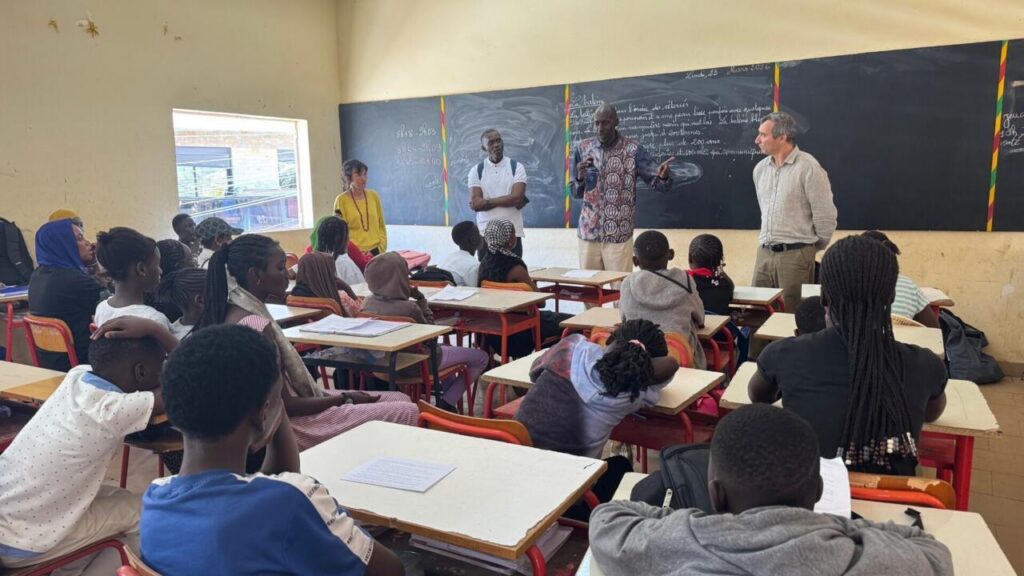
In Senegal, whale recordings are being used to raise awareness among children about environmental protection. This initiative is led by the association Germes d’Écocitoyens through its Gestu program, which blends science and tradition in learning environments. A few weeks ago, the organization arranged three sessions in Dakar primary schools with Olivier Adam, a professor and cetacean expert. One of these introductions to whale language took place at Alieu Samb Primary School in the Ngor district of Dakar.

With mouths wide open, seated at their desks, about thirty CM2 students listen intently to a recording of a humpback whale made off the coast of Ouakam in Dakar (recorded in 2018 and 2022).
“These songs you just heard are from humpback whales,” explains Olivier Adam, a professor at Sorbonne University. “Humpback whales come to Dakar to give birth. Their calves are true Dakar natives.”
For this cetacean sound specialist, it is crucial to popularize the idea that whales possess language. “I myself was surprised when I first recorded whales and realized they produce sounds that are intentional and structured like a language,” shares the professor, who traveled from Paris specifically to speak with children. “Whenever I meet students, I think they absolutely must know this. We need to understand the oceans, and we will only understand them by knowing the living species within.”
The curious children do not hesitate to ask questions: “How many stomachs does a whale have? How many kinds of whales are there? How does a whale give birth? What does it eat?”
“Their song and the way they talk” impressed Fanta, age 12, the most.
For Thierry, the teacher of this CM2 class at Alieu Samb School in Ngor, this lesson about the living world is vital. He shares his realization: “Without this knowledge, you wouldn’t know that a whale can only have one calf per birth. That means it’s a species that could disappear if we don’t protect it.”
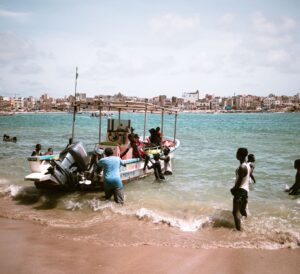
Babacar Sy, a spearfisherman for over 30 years who originally recorded these whales in Dakar and came to lead the workshop, confirms the urgency of combating ignorance. He catches fewer fish each day. “I was lucky to see nature as it was and then watch it change drastically. Last year, I caught only five thiofs the entire year. If we continue like this, one day we’ll talk about thiof to our children and they’ll ask what it is, because it no longer exists,” worries the fisherman. “We are heading to the bottom of the pit. It’s time for people to wake up!”
Two other schools in Dakar hosted Olivier Adam and his whale recordings. Along with awareness days on waste collection, the Gestu association aims to help change mindsets.