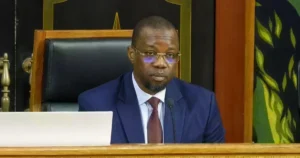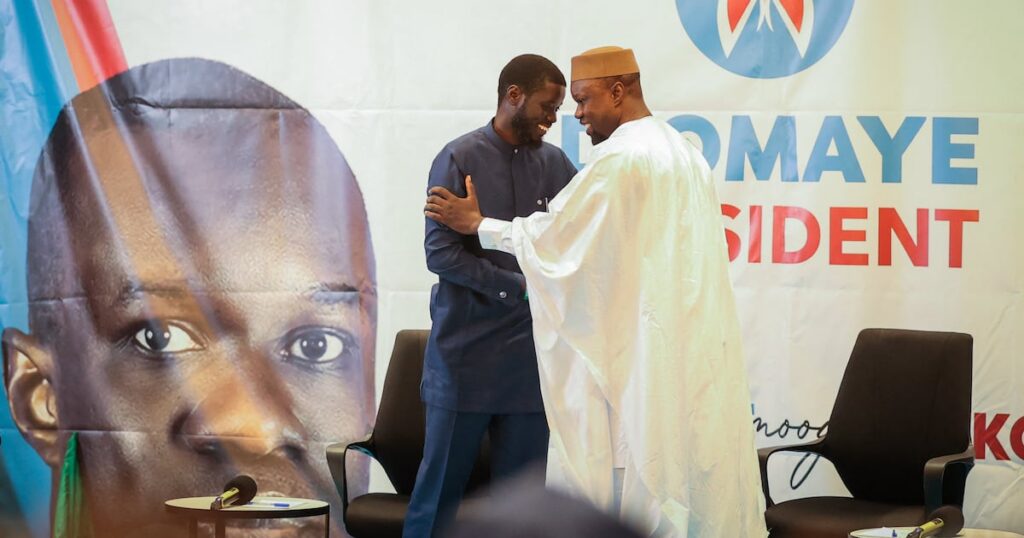
In Dakar’s political circles—from bustling ministry corridors to neighborhood discussions—the once-unshakable alliance between President Bassirou Diomaye Faye and his Prime Minister Ousmane Sonko has visibly frayed. The campaign slogan that once united them, « Diomaye mooy Sonko, Sonko mooy Diomaye » (Diomaye is Sonko, Sonko is Diomaye in Wolof), no longer resonates as it once did. Today, it’s more common to hear variations of « Diomaye n’est plus Sonko », signaling a growing distance between the two leaders.
Over time, their differences—ranging from governance methods to power struggles—have intensified, making their cohabitation at the helm of the state increasingly unsustainable. Methodological clashes, competing influence networks, and a rivalry for true leadership have left little room for compromise. For one of them, the choice was inevitable: step aside or force a confrontation.
Why Ousmane Sonko pushed the limits
Long before his dismissal, Ousmane Sonko systematically tested the boundaries of his relationship with Bassirou Diomaye Faye. As the historical leader of the Pastef movement, he knew that prolonged coexistence with a president eager to assert full authority was unsustainable. Yet, he also understood that an open clash would likely favor him in the eyes of the party’s base, given his deep emotional and militant connections.
The trap lay in forcing Diomaye Faye into an impossible dilemma: uphold institutional authority or preserve the political unity of Pastef. By remaining in government while simultaneously asserting his autonomy—through ambiguous statements, public disagreements, and subtle reminders of his founding role—Sonko steadily increased the pressure on the president. Each move was a calculated step toward a breaking point.
Diomaye Faye’s risky decision
When Bassirou Diomaye Faye chose to dismiss his Prime Minister, he sent a clear message about presidential authority. But he may have also fallen into a strategic miscalculation. Removing Sonko might have been the outcome Sonko himself anticipated. For the opposition leader, a forced departure could transform him into a martyr—a narrative that resonates powerfully with a base that has long seen him as the movement’s undisputed figurehead.
An involuntary exit allows Sonko to reclaim his identity as the movement’s historic leader, untarnished by the compromises of governance. To many militants, he remains the symbol of the break with the old system, while Diomaye Faye, despite his institutional legitimacy, risks being perceived as the one who disrupted the movement’s original spirit.
The danger of new allies
Since taking office, Bassirou Diomaye Faye has been surrounded by a new circle of advisors: former supporters of former President Macky Sall, political operators, and opportunistic notables. Their unified message to the president is simple: « You are the president—assert your authority. »
While this rhetoric flatters the ego of any head of state, it warrants scrutiny. Where were these individuals during the Pastef’s years of struggle—when Sonko and Faye faced judicial persecution, violent crackdowns on protests, and smear campaigns? Many enjoyed the privileges of the system they now denounce with revolutionary fervor. These political chameleons thrive on division, amplifying rivalries and nurturing competing egos. Their loyalty is conditional, their allegiance fragile.
For Diomaye Faye, the risk is clear: believing that those who encouraged him to distance himself from Sonko are genuinely invested in strengthening his presidency. In reality, many may be more interested in weakening the Pastef to dismantle the political project it embodies.
A fractured movement?
The current power struggle is far from over—and Ousmane Sonko may hold the upper hand. The Pastef’s dominance in Senegal’s political landscape remains unmatched, fueled by a highly mobilized, youthful base and a compelling narrative forged during years of opposition. Central to this narrative is Sonko himself, whose leadership became a rallying point even when he was barred from running in the presidential election.
While Diomaye Faye holds institutional legitimacy, Sonko commands unparalleled popular and militant support. If the Pastef fractures—with some factions aligning with the president and others with Sonko—the outcome is uncertain. Many cadres, elected officials, and activists may gravitate toward the figure they still view as the movement’s cornerstone. Without a fully developed political apparatus of his own, Diomaye Faye’s position remains precarious.
The curse of political heirs
History shows that political heirs often struggle to carve out their own identity. No leader can indefinitely accept a secondary role. Yet, beyond personalities, the real casualty of this crisis may be the Pastef’s founding vision—a promise of ethical governance, sovereignty, and social justice. Ego-driven conflicts have a way of derailing movements from their original mission, leaving their legacy in question.
The irony? The opponents of the Pastef might ultimately benefit from a crisis they didn’t create—a fracture that could weaken the movement without their intervention.