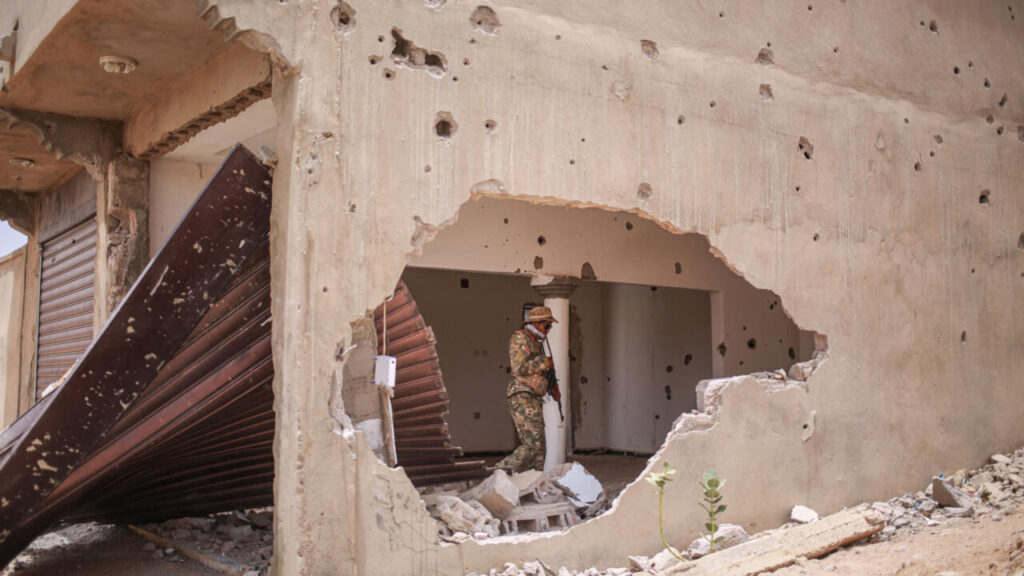
In a recent analysis titled “Mali: anatomy of a security earthquake”, the Timbuktu Institute, an African research center for peace based in Dakar, shed light on the dramatic security shifts gripping Mali. The report, released on May 13, examines the coordinated attacks of April 25, which left Defense Minister General Sadio Camara dead and saw jihadist groups seize control of Kidal in the North. These events raise critical questions about the effectiveness of Mali’s security strategy, particularly its reliance on external partners such as Russia and the Alliance of Sahel States (AES).
the collapse of outsourced security in Mali
According to Bakary Sambe, Director of the Timbuktu Institute in Dakar, the attacks of April 25 exposed the failure of Mali’s security outsourcing strategy, especially its partnership with Moscow. The death of General Sadio Camara and the chaotic withdrawal of Russian forces from Kidal symbolize what Sambe describes as a “myth shattered”. After the withdrawal of French forces from Operation Barkhane, which included civil-military and development aspects, the regime of interim leader Assimi Goïta turned to Moscow for security support. However, this strategy has not delivered the promised results.
Sambe argues that the reliance on Russian private military contractors, such as the Africa Corps, has proven ineffective against locally rooted insurgencies. While the Africa Corps remains active alongside the Malian army, the withdrawal from strategic locations like Tessalit underscores the limitations of this approach. The failures in Kidal and Tessalit highlight that outsourcing security has not worked in Mali.
limits of the alliance of Sahel states
The April 25 attacks also revealed the structural weaknesses of the Alliance of Sahel States (AES), initially designed as a mutual defense pact. Despite the charter’s Article 5, which mandates solidarity among member states (Burkina Faso, Mali, and Niger) in the event of an attack, no military support was provided by the alliance’s partners. While leaders like Burkina Faso’s interim president Ibrahim Traoré condemned the attacks as a “monstrous conspiracy”, their responses remained largely rhetorical.
Sambe explains that the AES countries are primarily focused on their own domestic security challenges. Burkina Faso, for instance, has faced multiple attacks in recent weeks. The lack of concrete military support from the AES demonstrates that the alliance’s capacity to respond to regional threats remains untested.
public opinion and the paradox of national unity
While the security failures may appear to weaken the interim government, Bakary Sambe highlights a paradoxical shift in public opinion. Despite unmet promises of security, the attacks have fostered a temporary sense of national unity. The regime’s legitimacy is now almost entirely tied to its security promises, and the April 25 attacks have drawn parallels with the 2012 crisis, when armed groups rapidly seized control of northern Mali.
Sambe notes that the Malian public’s reaction is difficult for foreign analysts to grasp: “There is a paradox where attacks paradoxically strengthen the regime of General Assimi Goïta, rallying the population around the flag.” This phenomenon reflects a deep-rooted sense of national resilience, even in the face of persistent insecurity.
the fragile alliance between jihadists and separatists
The report also examines the tactical alliance between the Group for the Support of Islam and Muslims (JNIM), linked to al-Qaeda, and the Azawad Liberation Front (FLA), a separatist movement. These groups launched coordinated attacks on April 25, marking an unprecedented level of coordination and signaling a potential shift in Mali’s conflict dynamics.
Sambe describes this alliance as a “marriage of convenience” rather than a long-term political project. While the groups share a common enemy—the Malian transitional government—their objectives remain fundamentally divergent. The JNIM seeks to impose Sharia law, while the FLA advocates for Azawad’s autonomy. Additionally, the dominance of the Katiba Macina faction within JNIM raises questions about the group’s willingness to fully commit to the FLA’s separatist agenda.
Sambe suggests that this alliance could serve as a catalyst for the JNIM to reposition itself as a national political actor. By collaborating with figures like Bina Diarra, the group is attempting to shed its image as an external threat and present itself as a legitimate political force capable of negotiating a future role in Mali.
the necessity of dialogue
Amidst the ongoing violence, the question of dialogue with armed groups has resurfaced as a potential solution. While the transitional government maintains a military approach, opposition figures like the Coalition of Forces for the Republic (CFR) and religious leaders such as Imam Dicko advocate for inclusive national dialogue.
Sambe argues that dialogue has become inevitable. The jihadist threat is no longer perceived as an external invasion but as a deeply rooted internal phenomenon. “Mali must talk to all its children, even those considered lost,” he asserts. The endogenization of jihadism means that military solutions alone are insufficient. A political process that addresses the grievances of marginalized communities is essential to breaking the cycle of violence.